€250m development plan proposed for Dún Laoghaire Harbour
Dún Laoghaire Harbour Company is preparing a masterplan to address a changing emphasis from a commercial to a recreational harbour and to ensure its medium to long-term sustainability. The harbour is widely recognised as one of the finest man-made harbours in the world.
Subject to approval and planning permission being granted, an estimated 2,800 full-time jobs will be created during the ten-year roll-out phase (1,400 on site, 600 via suppliers and 800 in the wider economy in retail/services). When fully operational, businesses have the potential to employ 1,400 full-time persons, according to DKM Economic Consultants who are part of the Project Team.
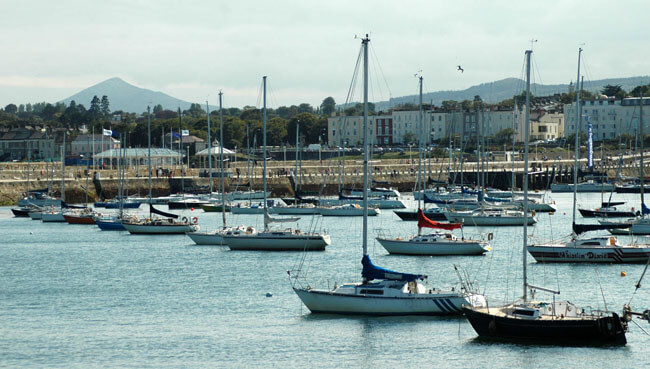
Public opinion favours full integration of the harbour with the town. Photo Gillian Mills/Inshore Ireland
Public input
An initial survey of pier users and an on-line questionnaire attracted over 500 responses which answered questions on themes including tourism, marine leisure, heritage conservation and the environment. Main concerns centred on: improved toilet facilities; better tourist-friendly approach; introduction of bicycle lanes; refurbishment or removal of the baths; live music events; improved public access to sailing activities; cheaper car parking and clean-up of pet fouling.
The Project Team, comprising environmental consultants, planners, architects and designers, will take into consideration the retention of the physical harbour (including the many protected structures); protection and enhancement of the natural features; appropriate development (e.g. cruise ships, tourism initiatives etc); relationship between the harbour and Dun Laoghaire town centre; meeting the objectives of the Dún Laogahaire/Rathdown Development Plan (2010-2016) and the potential for renewable energy and other green initiatives.
Cultural/heritage importance
Separately, a heritage management plan for the harbour has been commissioned. While it is a ‘stand alone’ plan, its principle purpose is to guide management on the significant cultural heritage in the context of current and future challenges and changes.
It comprises three elements:
- description of the historic and current character to provide an understanding of the nature and origins of the cultural heritage
- existing and likely/potential future challenges that threaten the cultural heritage significance of the harbour
- a series of heritage management policies to enhance and protect the cultural heritage while acknowledging that DLH is a living, dynamic place that has been and will continue to change over time.
Proposed redevelopment plan to include:
|
| ‘Save our Seafront’ submission In a statement, the SOS action group contends that Dun Laoghaire Harbour is ‘at a crossroads’ whereby commercial usage, which it says funds 70% of the harbour’s income, ‘may not be available to the same extent in the future’. In adds that ongoing maintenance of the infrastructure has created financial problems for the harbour company and that the harbour ‘cannot survive as a commercial entity unless changes are made.’ |
Response
While the SOS welcomes many aspect of the plan, such as the Diaspora Museum; leisure and cultural activities; marine services; sporting events and potential job creation, it ‘seriously questions’ and in some cases ‘out rightly opposes’ a number of elements:
‘The plan needs to be placed in the context of the McCarthy report, the EU/IMF deal and the government’s plan to review all 10 state owned harbours’, in particular the ‘absolutely unacceptable’ recommendation in the McCarthy report that “privatisation of some or all of the ports should be considered”.
The SOS questions whether to develop the harbour ‘to serve the needs of the people of both the country and of Dun Laoghaire and maintain it as a fully public entity, or allow inappropriate commercial development that will change the nature of the harbour forever.’
‘This is a major development that will affect the future of the harbour for the next hundred years. The proposal for a developer-led plan repeats all the mistakes of the Celtic Tiger era. The proposal to finance the redevelopment through a PPP deal is not the way forward,’ the group contends.
It adds that the 300 private apartments proposed to pay for the public element of the plan ‘are not only unrealistic in the current economic climate but are also totally inappropriate to the redevelopment of the harbour as a public amenity. The inclusion of any private developments will change forever the nature of the harbour’
The Group believes that any plan ‘must be integrated with proposals for the more general redevelopment and revitalisation of Dun Laoghaire town as a whole, to allow for a more efficient development that meets the needs of the town as well as the harbour users.’
While it welcomes inclusion of some waterside outlets it is concerned that any retail or shopping component ‘might take business from the town centre adding to the difficulties that traders already endure’.
SOS contends that a proposal to provide berthing for very large cruise liners to attract 100,000 visitors per annum to be a ‘highly ambitious target’, citing that in 2010 the total number of cruise liners visiting Ireland was 202, carrying 204,000 passengers.
It adds that no overall costs to dredge the harbour or create berthing facilities have been provided, ‘neither do we know the impact of such a large-scale development on the ecology of the harbour’.
Proposals
Acknowledging that an integrated plan for the harbour and town is needed, the group suggests that it must be preceded by ‘robust environmental impact assessments that take into account rising sea levels and impact on marine ecology and biodiversity. The Harbour Company should also seek to designate Dun Laoghaire Harbour as a National Monument and seek national funding to maintain and develop it.’
Other proposals include:
- finding a replacement ferry operator that will utilise the existing facilities to provide a revenue stream for ongoing harbour maintenance
- development of the Carlisle Pier for publicly run cultural and tourism projects, including the Diaspora Museum and genealogy centre
- providing facilities for existing rowing clubs and small boat users
- utilisation of an existing building to create a ‘marine cluster’ for engine repair, sail making, small boat repair, riggers and marine engineering workshops
- development of a boatyard with landing and berthing facilities
- promotional event (e.g. boat shows / maritime festival etc) to attract business to the harbour
- commercial and sporting fishing sector should be included in the development.
- creation of a waterfront forum involving yacht clubs, commercial users, leisure and sporting clubs, local residents and public interest groups. (A submission by the combined Dun Laoghaire sailing clubs has outlined the benefits of such events and the sport of sailing to the local community.)
SOS contends that any plan to shape the harbour for the 21st century must protect and retain the ‘fundamental and unique character and heritage of Dun Laoghaire Harbour as a public amenity and working harbour for all harbour users’.
| Timetable:
18/7: Closing date for receipt of comments on the consultation masterplan 3/8: Publication of draft masterplan, draft heritage management plan and the SEA (on display at DLHC for 4 weeks) 31/8: Closing date for receipt of comments on draft masterplan, draft heritage management plan and the SEA 12/9: Publication of masterplan, heritage plan and SEA |
| CHUG submission Among other submissions is one from the Coal Harbour Users Group (CHUG) – a body composed of concerned local individuals representing many maritime interests who have been campaigning many years now for a set of guarantees by the Dún Laoghaire Harbour Company covering public access to and use of these facilities. CHUG argues it its submission that the Coal Harbour area is now and for some years has been the only remaining section of Dublin Bay with efficient launching facilities available to the public for entrance to the Bay waters. The rest has been ‘privatised’ in earlier ‘land grabbing exercises’. CHUG’s main point is that the retention and continued maintenance of the Coal Harbour boatyard and its surrounding waters ‘for public use’ should be a specific and clearly stated point of principle in the proposed Development Plan. Otherwise, CHUG is fearful that existing undertakings and agreements in this regard might easily be swallowed up in the major developments involving future decisions. |