ACRUNET 6th Partner Meeting in Lisbon
Norah Parke
A very successful two-day meeting of the ACRUNET (Atlantic Crab Resource Users Network) was held at the end of June in Lisbon, Portugal. The meeting was hosted by the Portuguese ACRUNET partner ― the Institute for the Sea and Atmosphere, (IPMA), at one of its local facilities.
On the morning of Day 1, intensive focus group meetings gave delegates an opportunity catch up on their individual area of interest before proceeding to more integrated business for the next day and a half. ACRUNET is now entering its final year and it was evident from the tone and content of the presentations and discussions that many of the activities are now reaching completion.
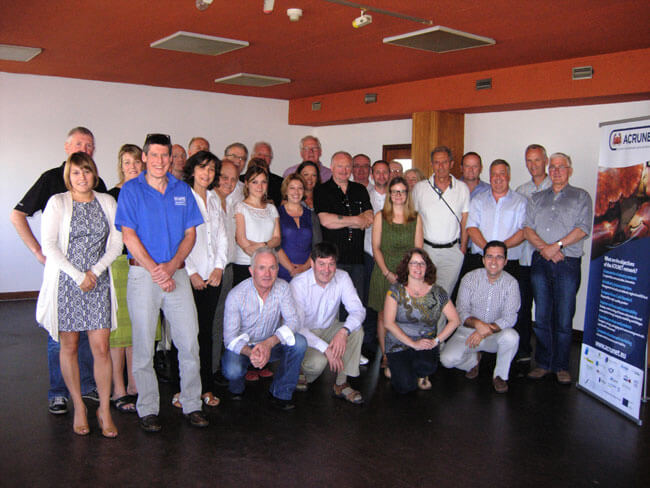
ACRUNET partners at the 6th meeting, in Lisbon, June 2014
It was interesting to note that in many cases the tasks undertakenby ACRUNET had themselves opened up new areas for investigation, such as further refinements on live brown crab transport systems and ways to quantify brown crab quality. Managing brown crab fisheries is still high on the ACRUNET agenda.
Comité National des Pêches (CNPMEM) gave the industry-focused group a detailed report on the management system employed in France. This approach is based on local committees, supported by fishermen, which are empowered to make regulations reflecting local conditions, resulting in a more predictable and stable system.
CNPMEM appreciates that national legislation may prevent this approach in other partner countries but feels ACRUNET must explore other management options to reach the objective of controlling fishing effort. In the meantime, the ACRUNET fisheries management activity remains focused on assessing the extent and impact of latent effort.
Irish and UK fishermen feel any improvements in other areas of the industry could be undermined by the easy access of an unknown number of additional vessels to the sector and, at the very least, industry should be able to quantify this threat.
Delegates were delighted to hear the European Brown Crab Standard continues to make progress; on this occasion they were able to vote on the format of a guide on quality and handling, being produced in all four Atlantic Area languages, specifically tailored for fishermen and brown crab handlers.
The process of auditing the selected vessels has also been agreed and should be completed by autumn 2014. The activities concerned with industry analysis, consumer education and marketing, while distinct in their approach, are closely linked in the output of results.
Innovative marketing materials specifically designed to appeal to a younger consumer, are now available in the project languages and can be used in local and national advertising and marketing campaigns. ACRUNET aims to produce a communications strategy that will provide strategic recommendations for communications in partner countries and formulate appropriate consumer messages.
Trials on live brown crab transport options continue under the guidance of the University of Hull, and considerable interest was expressed by industry partners on how soon and at what cost they would be able to implement the outcomes. ACRUNET has also facilitated some advances on better utilisation of crab waste and partners are hopeful that this area will continue to develop.
ACRUNET partners were pleased to see the wide selection of shellfish available in local Lisbon outlets. Brown crab was particularly evident, and it was reassuring to see that even in today’s less affluent environment, this species is still popular and is presented in a variety of formats.
The next partner meeting of ACRUNET takes place in Bristol on 7/8 October 2014.