
Landing Obligation kicks in on January 1, 2015
From January 1, 2015, fishermen in certain parts of the EU targeting pelagic and industrial species, and salmon and cod fisheries in the Baltic, must land the fish they catch. But all catches of undersized fish, over quota or in excess of catch composition rules, must continue to be returned to the sea, the EU Commission has declared.
Pelagic fisheries in international waters are also subject to the Landing Obligation with the exception of fisheries in non-EU waters where there is a legal obligation to discard in an international agreement (e.g. ICCAT rules relating to Bluefin tuna) and fisheries in the waters of third-countries where the law of the third-country applies.
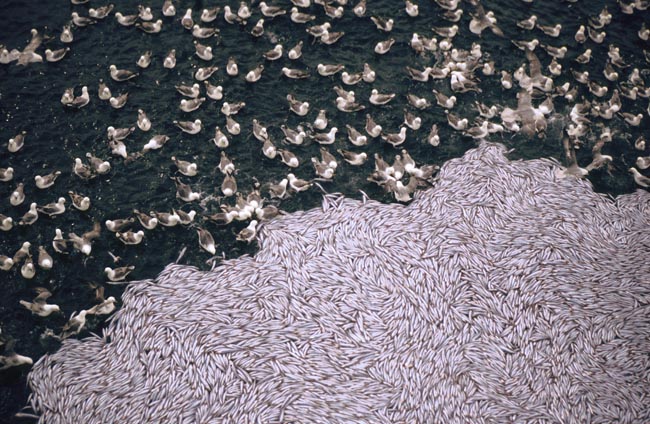
The practice of ‘slipping’ at sea. The net is never taken from the water – it is simply opened to release the fish, the majority of which are already dead. These fish are not accounted for and the extent of the damage is not known
Sean O’Donoghue, CEO of the Killybegs Fishermen’s Organisation which represents the majority of Ireland’s pelagic fleet, believes the Landing Obligation creates an “immediate anomaly as it runs in direct contravention of existing regulations – in particular Council Regulation (EC) No 850/98, or the Technical Conversation Measures regulation.”
An ‘Omnibus Regulation’ proposed to bring the conflicting regulations into line by the Council and the European Parliament before the January 1 deadline failed to reach agreement.
FULL STORY Inshore Ireland, publishing January 31
Council meeting
A meeting of the AGRIFISH Council today (26.01) discussed the Baltic Sea multiannual plan and the Omibus Regulation. A proposal was also tabled on the protection of sea bass, effective until the end of April.
In a statement following the meeting, Karmenu Vella, Commissioner for Environment, Maritime Affairs and Fisheries, noted that the Baltic Sea multiannual plan was the ‘first of its kind’ since reform of the Common Fisheries Policy.
‘An obligation to land all catches of cod, herring, sprat and plaice…in the Baltic Sea entered into force this year. The measures foreseen in the current discard plan have been transposed in our proposal.’
Once the plan is adopted, the technical measures, provisions for the landing obligation and specific conservation measures for the by-catches in the fisheries for the stocks concerned, will be specified by Baltic Member States and adopted by the Commission as a delegated act.
‘We expect updated science from ICES in March and we will make this available to the co-legislators so that this dimension can be adjusted then.’
Omnibus adoption
Securing the adoption of the Omnibus proposal on landing obligation was a priority for the Commission, remarked Commissioner Vella.
‘We have been working very closely with both institutions to facilitate an agreement, politically and technically. The landing obligation is now in place, for the pelagic industry and in the Baltic – and this is leading to queries regarding the rules that apply.
‘Our biggest priority is to provide legal and practical clarity for the fishermen affected.’
Dialogue between the Presidency and rapporteur in the European Parliament is underway. ‘The suggestions now under discussion could – and in my view should – lead to a speedy agreement,’ he noted.
Sea Bass
The Commission proposed measures to avert the collapse of the declining sea bass stock.
‘Immediate effective emergency measures will place a ban on targeting the fish stock by trawling while it is reproducing, during the spawning season, which runs until the end of April.’
Pelagic trawling has a major impact on the spawning stock as it makes up 25% of the impact on the stock.
‘This will be complemented by further measures in the coming days and weeks which should ensure that all those who fish sea bass make a balanced and fair contribution to saving the stock.’
For recreational fishing, which accounts for 25% of sea bass catches, the Commission will propose a limit of three fish per day per angler.
‘We expect Member States to set a minimum size of 42cm so that fish are not caught before they have had a chance to reproduce. We will also be launching a process to limit catches of sea bass for other commercial fisheries.
‘This is about saving sea bass stock and saving jobs in the commercial and recreational fishing sector. I am proud of the quick reaction to what is an immediate danger to the stock. Emergency measures, if adopted, would therefore come into force immediately and last until 30 April 2015. It will apply to the Channel, Celtic Sea, Irish Sea and southern North Sea,’ he advised.

