
Another ‘Lisbon 1755 tsumani’ could see two metre waves hitting Irish coastline
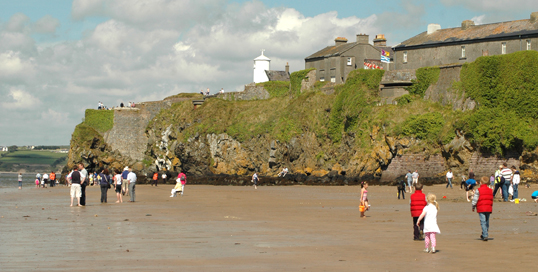
While the last major tsunami to hit the Irish coastline was the Lisbon 1755 event, generated by a ~8.5mW earthquake roughly 100km off the Portuguese city, tsunamis pose a ‘significant hazard’ to the south east and west coasts of Ireland, according to wave experts at UCD and Geological Survey Ireland.
The earthquake and subsequent tsumani resulted in a very high death toll and severe damage along the coasts of Portugal, Spain and Morocco; the effect was felt across the Atlantic basin with reports of tsumani waves arriving in the Caribbean, UK and Ireland.
It is regarded as having caused the partial destruction of Galway’s Spanish Arch and for making an island out of Auginish in north Clare.
Researchers led by Prof Frédéric Dias (UCD School of Mathematics and Statistics) have found that tsumani amplification occurs in the region, with underwater features contributing to this amplification.
Computer modelling
A pilot study of a new ‘faster-than-real-time’ Volna-OP2 simulation code could greatly reduce the impact that tsunamis might have on Irish and global coastlines, the authors contend.
The team used the Lisbon 1755 event as ‘a worst-case scenario’ in their models being the last major tsumani to affect the Irish coastline,
Quickly and accurately assessing tsumani waves before they arrive on land ‘is critical to allowing sufficient response time to reduce their impact on people, property and infrastructure.
‘This is why the tsumani community relies on computer models to help minimize the threat posed. A tsumani’s high speed in deep water can create severe time constraints for those tasked with assessing its threat level and deciding on which areas are at most risk,’ the report states.
“Tsunami warning centres traditionally rely on massive pre-computed databases of potential tsunami sources. Being able to produce faster than real-time simulations ‘on the fly’ would greatly augment these traditional approaches and provide more accurate warnings,” explained PhD student, Daniel Giles.
Low lying vulnerability
The new study confirms an earlier study from the French Tsunami warning centre (CENALT) which found Galway Bay was particularly vulnerable to a Lisbon-type event, along with low lying areas in Dunmore East and Waterford.
The flooding that could be brought ashore in these areas ‘could reach upwards of 2 metres in parts, posing a significant hazard to those living near the shoreline and various infrastructures such as the Great Island Power Station in Wexford.’
The coastal flooding component of the study includes bathymetry and topography data from GSI and the Office of Public Works.
