Can Ireland overcome challenges and become a global seafood supplier?
Ireland’s seafood sector has the potential to increase sales to €1 billion and deliver 1,200 additional jobs by 2017, delegates heard at a recent industry conference organised by BIM.
But the sector faces similar issues to the 1980s Irish dairy industry of quota restriction, a fragmented processing infrastructure, a limited international footprint and zero presence on the stockmarket, warned Joe Gill, director of Goodbody Ireland. He added that the dairy sector evolved by consolidating through investment.
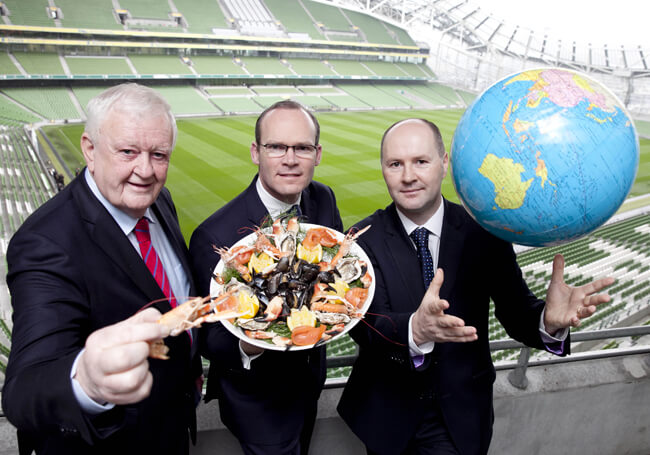
Kieran Calnan, BIM chairman with Minister Simon Coveney and Jason Whooley, BIM chief exectuve
“The seafood sector should have the ambition to follow that route,” he told participants attending Capturing Ireland’s Share of the Global Seafood Opportunity.
“Taking a 10-year view, it is not unreasonable to target three stockmarket listed seafood companies based in Ireland but operating globally. To achieve this, the sector must have leadership, vision and capital.”
Far East markets
Worth €810m in 2013, the seafood sector is now looking east to new markets in Asia where demand for quality produce is showing major growth. Irish shellfish in particular is highly sought after in China and Hong Kong where exports have increased by 34%.
A major challenge however facing Ireland’s seafood sector is building scale. Of the 180 registered seafood companies with processing facilities, many are small, often family-run with turnover of less than €10 million.
While family-run businesses will remain an essential component of the Irish seafood landscape, it is in stark contrast to a typical European competitor with an average turnover in excess of €50m.
“Ireland is being presented with opportunities for unprecedented sectoral growth, largely dependent on our ability to produce and supply fish and related products to an increasing world population,” remarked Jason Whooley, BIM chief executive.
“Demand for seafood will see the global requirement for fish grow by an additional 42 million tonnes per annum by 2030.”
He added that the opportunities being presented can only be fully utilised if Ireland increases sustainability, competitiveness, grows industry scale and expands the raw material base. In terms of scale, the agency’s CEO outlined the inward investment opportunities for the sector:
“Irish seafood is considered a premium protein commodity on our key markets. International companies are viewing Ireland as a realistic investment proposition, and BIM will continue to facilitate strategic partnerships to enable this investment to take place,’ he said.
Food security challenges
Opening the event, Simon Coveney, Minister for Agriculture, Food and the Marine focused on opportunities for Irish produced seafood on the global market on the back of food security challenges from climate change, market volatility, competition for land use and water scarcity.
While the EU seafood market is valued at over €600bn; member states produce less than 40% of their own needs and are reliant on imports. Between now and 2050, the world’s population is set to rise by one third to over 9 billion people.
“One of the greatest challenges facing mankind will be ensuring an adequate sustainable protein supply. The UNDP predicts that Africa’s population alone is expected to double from just over 1 billion in 2010 to over billion by 2050,” Minister Coveney said.
With food production levels set to increase by up to 70% over the next forty years, “the seafood industry must play its part in meeting this demand in a sustainable manner.”
And he sees the opportunities for both aquaculture and sea fisheries to bridge the gap between current output and future needs as being “vast” and providing economic growth and jobs. “But these opportunities can only be fulfilled if keys issues of scale, supply and sustainability are addressed,” he added.
Quality, not quantity
With commercial fisheries governed by quota, emphasis today is on quality assurance, not quantity. And the spotlight is evermore turning to aquaculture production to meet global seafood demand however this sector faces many challenges.
“A better framework for sustainably developing aquaculture was agreed in the reformed Common Fisheries Policy to reduce the dependence of imported fish and to boost economic growth in coastal and rural areas,” Minister Coveney noted.
“When regulated and managed correctly, fish farming provides valuable employment, investment and revenue. Irish organic farmed salmon is a key target growth area but aquaculture is not limited to one species, we can also expand oyster and mussel production around the coast,” he said.
Minister Coveney acknowledged BIM leadership in this drive and for organising the conference which he said was designed to dovetail with the targets and objectives set out in the Food Harvest 2020 national food production plan with Harnessing Our Ocean Wealth 2020.
“These strategies set out ambitious targets for growth in output, job creation and increased exports from the seafood sector. I am very optimistic about the potential that exists for Ireland to significantly expand and develop a large sustainable seafood sector.”
A plenary session heard presentations by national and international speakers in seafood, agri-food and investment sectors was followed by panel sessions that discussed economies of scale, raw material supply and sustainability. The conference attracted more than 200 delegates from industry, investment and banking communities this first national industry-wide event organised by BIM under its strategy 2013-2017.