Canadian Ambassador visits RV Celtic Explorer at Galway docks ahead of transatlantic survey
Cushla DromgoolRegan, Marine Institute
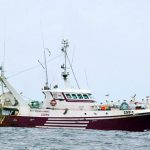
Irish and Canadian scientists have joined forces on a transatlantic survey on-board the Irish National Research Vessel, RV Celtic Explorer to carry out fisheries research in the Newfoundland and Labrador Seas.
Dr Peter Heffernan, MI; Dr George Rose, Memorial University of Newfoundland and Canadian Ambassador to Ireland, his Excellency Loyola Hearn on board RV Celtic Explorer
The aim of this research is to locate ‘hot spots’ of smaller mid-water fish, such as lanternfish (Myctophidae) and begin to understand their distribution. Canadian Ambassador to Ireland, his Excellency, Loyola Hearn, visited the vessel at Galway Docks on April 15 to meet the Irish and Canadian collaborators in this transatlantic expedition.
The survey led by Dr George Rose, Director of the Centre for Fisheries Ecosystems Research at the Fisheries and Marine Institute of Memorial University of Newfoundland (MUN), is multidisciplinary and will gather oceanographic data as well as acoustic recordings across the entire North Atlantic, building on work done on the two previous transatlantic surveys in 2011 and 2012.
Multi-disciplinary team
Canadian scientists will be joined by Irish researchers from National University of Ireland, Galway (NUIG) and Mayo Institute of Technology (GMIT). Sheena Fennell, NUI Galway will carry out oceanographic monitoring throughout the journey to St. John’s and will collaborate with Dr Rose on acoustic data also collected.
The vessel will research the cod stocks on the Flemish Cap en route to Newfoundland and Labrador before completing a large-scale survey for cod and capelin in Newfoundland and Labrador waters. As a former Minister of Fisheries and Oceans, Loyola Hearn was particularly interested to board the RV Celtic Explorer:
“We are now seeing growth in the fish stocks off Newfoundland and Labrador, and surveys like this provide essential information on their sustainability. The potential for increased involvement both in ocean research and the fishing industry between Ireland and Canada is now being realised. RV Celtic Explorer is an ideal ship to carry out this research which will be of such great benefit to both countries.”
Forging links
Dr Peter Heffernan, Chief Executive, Marine Institute said the collaboration was “hugely important for Ireland” and builds on the strong relationship between Ireland, Newfoundland and Labrador established since the first Newfoundland survey on the RV Celtic Explorer in 2011.
“It will allow Irish researchers to forge strong links with their Canadian counterparts as part of a wider international ocean observatory initiative. This is particularly relevant in the context of the European Union’s Atlantic Strategy and the emerging Action Plan, which is on course to be completed during the Irish Presidency of the EU.
He added that this type of multidisciplinary research and international cooperation was “essential to achieving healthy marine ecosystems” – outlined as a key goal of government’s Integrated Marine Plan for Ireland – Harnessing Our Ocean Wealth, published in 2012.
“We’re delighted with this collaboration with our Canadian partners,” he said. Dr George Rose reiterated these sentiments, saying that the voyage continues to have tremendous value to both Irish and Canadian researchers. “It contributes significantly to the knowledge-base and prosperity of the Newfoundland and Labrador fisheries.I look forward to the continuance of this collaboration.”
Observational platform
During the passage, an observational platform called a benthic lander system which sits on the seabed will be deployed at a depth of 800-900 m in a canyon on the continental shelf off the Irish Coast to monitor turbidity, flouresence, temperature, salinity, water column and near seabed currents. The lander will remain in the canyon until June when it will be recovered during an NUIG-led biodiscovery survey on-board Celtic Explorer.
The data collected will be used to support a PhD on Nephloid layers being carried out by Annette Wilson in NUIG. These are layers of material that have been studied in open continental shelves, marginal seas and submarine canyons and have the potential to deliver ‘fresh’ organic material to abyssal depths, support deep-sea ecosystems and hold important implications for deep-sea carbon storage.
GMIT researcher, Johannes Bulfin will monitor cetacean activity during the passage across the Atlantic to Newfoundland and Labrador. University College Cork graduate, Rachel Morgan will join the survey through the Training Through Research Surveys Scheme, run by the Strategic Marine Alliance for Research and Training (SMART).
This programme gives young Irish researchers an opportunity to gain invaluable experience on multidisciplinary surveys. The survey is primarily funded through charter of the national research vessel by the Fisheries and Marine Institute of Memorial University.
It builds on a strong collaborative relationship between the Irish Marine Institute and the Marine Institute of MUN and facilitates a transatlantic multidisciplinary survey which brings together experienced Irish and Canadian oceanographers, marine biologists, benthic ecologists, as well as young researchers who will gain invaluable experience onboard this survey. Participation of third level students is funded though the Strategic Marine Alliance for Research and Training (SMART) programme.