

Seaweed biomass cultivation likely to replace finite fossil fuels
Stefan Kraan, Ocean Harvest Technology
Total worldwide energy consumption today is roughly 480 exajoules with almost 90% derived from the combustion of fossil fuels. Fossil fuels such as coal, oil and natural gas are limited in supply and will one day be depleted. As a result, the quest for renewable energies – being energies generated from sustainable natural resources such as sunlight, wind, tides, etc and from industrial or urban waste and biomass – began decades ago.
In 2007, the 27 member states of the EU decided that 20% of its energy should come from renewable sources by 2020 (Lisbon Treaty).
The table above shows global energy consumption and its estimated increase by 2050, and the worldwide potential of biomass for energy production based on recent studies. This clearly indicates the need for aquatic biomass to fulfil our energy consumption in a renewable and sustainable way
At sea biomass production
Since the available area for cultivation at sea is so much greater than on land (70% of the earth’s surface is ocean) and with macroalgae growth rates being much higher than of conventional land crops, the potential for biomass production at sea is enormous.

Aquaculture to play a major part in providing seafood security under the next fisheries policy
Dr Peter Heffernan, MI; Commissioner Maria Damanaki; Minister Simon Coveney; Commissioner Maire Geoghegan-Quinn and Jim Fennell, MI.
Outlining Common Fisheries Policy reform proposals to Irish stakeholders in Dublin recently, EU Maritime Commissioner Maria Damanaki said the new policy must preserve stocks in a responsible, science-based way.
She spoke bluntly about the status of fish stocks throughout European waters: “If nothing changes, only eight out of 136 stocks will be at sustainable levels by 2022.”
Not only would small-scale fisheries be affected but jobs would be lost across processing, transport, port infrastructure, packaging and retail.
She noted however the crucial role that aquaculture could play in reducing the amount of seafood imported into Europe:
“Ireland’s fish-farming industry, worth €100m, deserves proper funding to help produce the excellent salmon, trout and shellfish that it farms and consumers expect,” she said.
“I will be establishing an “open method” to allow national authorities to exchange best practices “to ensure business security.”

Offshore finfish farms – a game breaking opportunity?
Donal Maguire
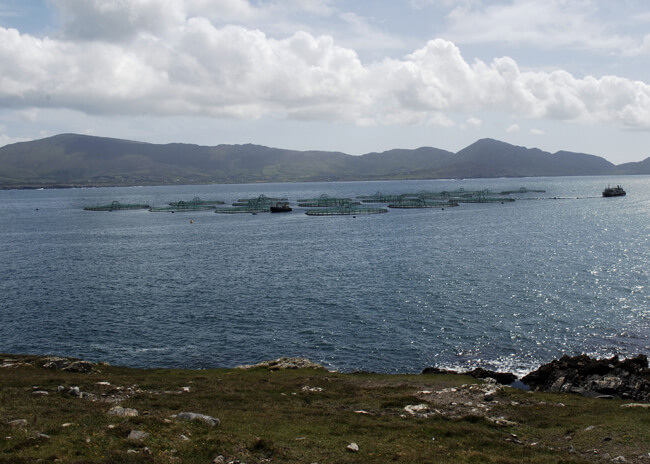
With the backing of the Minister for Agriculture, Food and the Marine, Simon Coveney, and in line with the actions set out under the department’s visionary ‘FOOD HARVEST 2020’ strategy, BIM and the Marine Institute are embarking on an ambitious project to fast-track development of one or more, large-scale offshore marine finfish production units off the west coast of Ireland.
Highly automated offshore production nodes with fish cages and service platforms for personnel to transform Irish aquaculture. Artist's impression, BIM
It is envisaged that these production units, which will each eventually generate in excess of 15,000 tonnes annually, will be located outside of any Natura 2000 designations, in areas with very high water exchange, remote from any possible negative interactions with migratory fish and be virtually invisible from the land. In the Minister’s words, the intention is to make a “game changing breakthrough in the development of Irish aquaculture”.
Positioning on global markets and jobs potential hang in the balance
Marine Harvest Southwest, the Castletownbere-based subsidiary of Marine Harvest Ireland – the country’s largest salmon farmers and processors of organic and premium eco-label salmon – is on track to achieving its 2011 production target but could double sales of organic farmed salmon in line with demand abroad if aquaculture licensing * was resolved.
Speaking to Inshore Ireland, operations manager John Power says the industry is looking to Minister Coveney to “get to grips” with the issue that has dogged aquaculture for the past decade.
“Like everyone involved in the aquaculture industry, I’m hopeful that the new marine minister will have enough clout at the cabinet table and will act quickly to sort out this ten year log-jam.
"With his background knowledge of Ireland’s marine sector, Minister Coveney is well aware there are real jobs in aquaculture, with real people and real expertise. And there’s no doubt given a fair chance, we can produce the goods and create employment where it really counts – in the remoter parts of the country,” Power declares.
https://oceanfocus.ie/wp-content/uploads/2020/05/Ocean_Focus_marine_Publication.png
0
0
Guest Writer
https://oceanfocus.ie/wp-content/uploads/2020/05/Ocean_Focus_marine_Publication.png
Guest Writer2011-05-10 12:26:102019-02-13 17:44:18Is climate change already impacting aquaculture?
https://oceanfocus.ie/wp-content/uploads/2020/05/Ocean_Focus_marine_Publication.png
0
0
Guest Writer
https://oceanfocus.ie/wp-content/uploads/2020/05/Ocean_Focus_marine_Publication.png
Guest Writer2011-05-09 12:28:432019-02-13 17:38:37Breakthrough in shrimp farmingSea urchins: the Asian delicacy

Sea urchins seem certain to appear soon on the growing list of animal and plant species being farmed commercially by the Irish aquaculture industry, after they performed well in a new type of land-based rearing system designed by the Aquaculture and Fisheries Development Unit at University College Cork
This will be welcome news for Ireland’s tiny seaweed industry, which can expect to see the knock-on benefits from supplying the sea urchins with their preferred diet of high-quality native seaweeds.
Dr Gerry Mouzakitis, a former manager of the AFDU, told Inshore Ireland that the UP System “had proven beyond doubt” that Paracentrotus lividus, a native sea urchin once plentiful in Irish coastal waters but now rare because of over-fishing “has enormous farming potential.”
He declined however to reveal any details of the UP System before it is protected by a world-wide patent due to be issued later this month.
Mouzakitis is confident however that within a decade, the new system will have revolutionised the farming of Paracentrotus lividus in Ireland and probably worldwide.
https://oceanfocus.ie/wp-content/uploads/2020/05/Ocean_Focus_marine_Publication.png
0
0
Guest Writer
https://oceanfocus.ie/wp-content/uploads/2020/05/Ocean_Focus_marine_Publication.png
Guest Writer2008-02-19 12:41:052019-02-13 17:05:50Farming the deep blue
https://oceanfocus.ie/wp-content/uploads/2020/05/Ocean_Focus_marine_Publication.png
0
0
Guest Writer
https://oceanfocus.ie/wp-content/uploads/2020/05/Ocean_Focus_marine_Publication.png
Guest Writer2008-02-19 12:38:362019-02-13 17:05:35Sentinels of the sea