Coastal communities to be ‘empowered’ by new structural aid programme
A “new departure” for structural aid specifically aimed at fisheries areas was unveiled to stakeholders in marine, maritime and fisheries industries at a launch in Dublin earlier this month.
Axis 4 – Sustainable Development of Fishery Dependent Areas Programme – is an ‘area-based approach’ introduced by the European Fisheries Fund (EEF) which reflects the complex and rapidly changing forces affecting fisheries areas and communities. 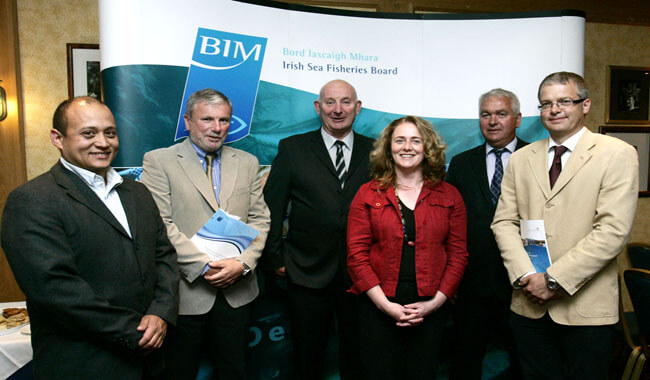
Central to the ‘area-based approach’ is the argument that the EU must be able to provide accompanying measures in conjunction with converting areas affected by the restructuring of the fisheries sector.
Axis 4 provides the EEF with such measures while the ‘area-based approach’ means that solutions can be adapted to the different situations and problems that exist in different parts.
The programme will be delivered as part of the National Development Plan and the EEF. Fisheries Local Action Groups or FLAGs will be established in each region to deliver a strategy for their own area on a devolved basis.
Local governance
“In essence, Axis 4 aims to empower local fishing communities to use the valuable resource of fishing and aquaculture to create new and sustainable sources of income,” remarked Michael Keatinge, Fisheries Development Manager of BIM – the Implementing Authority for the EEF in Ireland.
Outlining the programme to stakeholders, Keatinge said that projects must have a clearly identifiable marine connection or provide a specific benefit to a fishing region. In many cases, beneficiaries will be required to be either workers in the fisheries sector or persons with a job linked to the sector.
The €2.5m package to 2015 comprises public and private investment. A concern from the floor said this figure was very small and would not go far amongst the number of projects likely to emerge.
It was explained that under the next EEF post 2015, Axis 4 would continue in another format and that this was just the beginning.
Background
Under Axis 4, the territorial development approach fundamentally changes the way in which local areas, partnerships and strategies are perceived and defined.
“It is no longer enough merely to start from fixed administrative boundaries, to consider the needs or problems in deficit terms or to look for someone (usually an outside agency) to fill the gap by distributing public funds. The cycle has to start with a positive vision and strategy for what the area could become.”
Keatinge added that fishing and aquaculture were the “lifeblood of many coastal communities” and that this programme “will provide the tools and resources for local people – who best understand both the problems and aspirations of their own community – to develop solutions to meet their future needs.”
To allay concerns expressed from the floor, of too many agencies and a lack of joined-up thinking, Keatinge said that the process by its very nature “must be a cross-check amongst agencies and that synergies would emerge beyond traditional ways of operating”.
Whilst acknowledging a similarity with other initiatives such as LEADER, which provides rural communities with a method for involving partners to steer development in their area, the aim of Axis 4 is to enable fisheries communities to create new and sustainable sources of income and to improve their quality of life.
Ending on a strong note Michael Keatinge stressed that design and implementation of Axis 4 would be as “decentralised as possible” and coordinated by a partnership of public, private and community sectors that have come together to form a FLAG.
“Boundaries will be decided by local communities – not bureaucrats in Dublin,” he said.
In Coloured box
Central objectives
- maintaining economic and social prosperity by adding value to fisheries and aquaculture sectors
- retaining and creating employment by supporting diversification, and
- restructuring areas facing socio-economic difficulties as a direct result of changes in the fisheries sector.
In coloured box
FLAG regions:
North-East (Omeath to Lough Shinny)
South-East (Greystones to river at Youghal)
South-West (the river at Youghal to Foynes)
West (Kilimer to Leenane)
North-West (Killary to Easkey)
North (Ballyshannon to Muff).
Each FLAG will comprise a mix of representatives from State organisations, fishing and marine groups.
To qualify for funding, projects must satisfy specific criteria. For example, projects must be based in coastal areas with a population not greater than 15,000 and must be located within 10km of the sea.
Once operational, each FLAG will formulate a local development strategy that identifies suitable projects requiring financial or expert assistance. A call will then issue for projects from individuals and local communities.
Typical projects will be drawn from the following:
- small-scale fisheries and tourism infrastructure
- skills transfer, particularly, training and up skilling of fishermen
- diversification into marine eco tourism
- promoting the consumption of sea food
- adding value to local/artisanal fisheries
To facilitate the process a National Implementation Board has been established whose role is to inform the Implementing Authority (BIM) and to ensure consistent implementation of Axis 4.
The first meeting of FLAGs in the west and southeast are due to be held at the end of June.