Connecting the marine industry with educational institutes
e-learning platform
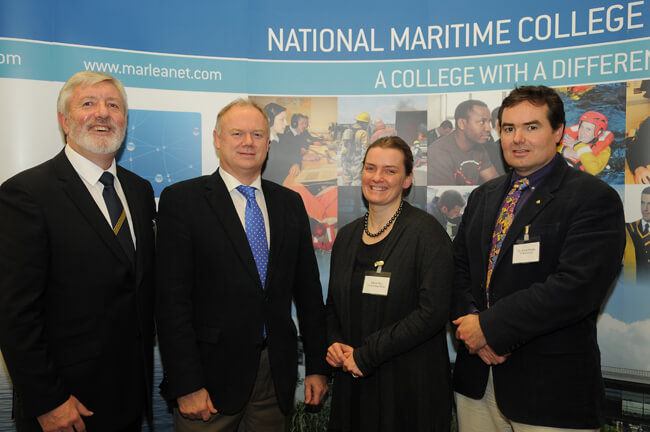
According to Ms Lynch, the MarLeaNet e-learning platform is beginning to play a key role in the education and training of seafarers, and includes inputs from all six of the partner institutes in France, Spain, Portugal and Ireland.
“The e-learning platform itself is being created by the Unversité De Bretagne Occidentale (UBO) in France but we at the Cork Institute of Technology, hence the NMCI, are actually responsible for putting courses on line and having them evaluated by students both with our own education system and in the other maritime centres,” she told Inshore Ireland.
She says the idea behind this initiative is to ensure that there is standardisation and a direct connection between the institutes that are delivering courses in maritime education and vocational educational training across three sectors: fisheries; merchant navy; and naval services.
“For example, if I’m based in Ireland and want to undertake particular training that will further my career and step it up, I should have access to information about those courses which have a shared standard between them,” she explains.
Real-time information
Lynch says that networking between the six centres will continue to be an essential element of the e-learning process and that seafarers will have all the information they require to make up their minds about which courses to take as well as when these will be available.
“We understand that seafarers today have very busy lives and that they may be ashore for only short periods of time. But once they register with the programme they will be able to access courses and information from home or from anywhere in the world,” she declares.
For Captain Michael McCarthy, commercial manager at the Port of Cork who also chaired the NMCI workshop, safety is paramount – especially in a workplace where large vessels operate in a relatively confined space.
He believes that recent high-profile maritime accidents where lives were lost undermine the public’s confidence in marine travel.
“At the Port of Cork, as a commercial company, obviously we are very interested in the wider area of the training of seafarers for vessels entering and departing our port. We have to ensure that the link between our pilots and the professional mariners on board is a seamless one and not broken in any way. Our pilots are highly trained as it is; nevertheless, we send them on the NMCI’s Bridge Resource Management Course,” he says.
“We’re also very interested in the standardisation that MarLeaNet brings to the table. And as a former President of the Irish Institute of Master Mariners which represents sea-going mariners – master mariners in particular – I am always very, very conscious that the standard of the junior officers coming through the various training establishments should not slacken in any way.”
|
MarLeaNet 2010-2013 – the MARitime LEArning NETwork – is an EU-sponsored programme designed to forge co-operation via through a network of maritime training centers in France, Portugal, Spain and Ireland. It is lead by the European Maritime Training Center (CEFCM) in Concarneau, and aims to develop a new and challenging network along the Atlantic area based on cooperation and the transfer of ideas, skills- sharing, dissemination of good practices, experience-sharing in real time and co-production of teaching tools. The 6 partner institutes hope to create the future maritime training: a finally harmonized training taking into account the rapid changes in the maritime world and leading the whole system upwards by exceeding the current international standards. MARLEANET aims at developing training courses to meet the changing maritime activities through the creation of a training network in the fishing, shipping, offshore, sailing industries and in the Navy, by:
|
Essential safety training
And now as the newly-appointed chairman of Cruise Europe which represents ports from Lisbon right up to the north and through the Baltic and Iceland, Captain McCarthy speaks regularly on subject of safety and officer training.
“So, certainly the MarLeaNet Conference was very appropriate at a very appropriate time,” he says.
MarLeaNet also receives strong backing from Gerry Greenway, Maritime Operations Manager with the Revenue Customs Service who believes the training of seafarers is an essential area of interest for all organisations sending personnel and vessels to sea.
He added that STCW 10 sets out the requirements for refresher training for validation of ancillary certificates for seafarers:
“The Marleanet STCW 10 workshop provided an opportunity for interested parties, from a variety of European countries, to discuss and get an insight into how the regulatory bodies in different countries are interpreting and proposing to implement the requirements of STCW 10.”
From the commercial sea-fisheries perspective too, Shane Begley, principal of BIM’s Regional Fisheries Centre in CastletownBere praises MarLeaNet. He argues that “disparate standards” throughout the marine industry are having a real effect by preventing the movement of labour on fishing vessels within the EU. He believes however that the project’s ability to create networking within the fishing industry will be a “win-win situation” for the fishing industry in Northwest Europe especially.
“By networking all the training institutions, MarLeaNet is bound to lead to a standardisation of training in various disciplines like basic sea survival, elementary first-aid and so forth. Other important training that should take place then would be basic stability training. But at least if you have a common standard across Europe it will be easier to effect this type of training,” Begley concludes.