
DNA genetic-tracing surprises surface in the Atlantic

Scientists from the Rockefeller University (New York) investigating shifting Atlantic Ocean migration patterns have bottled the genetic traces of species far north of their normal homes.
By ‘fishing’ for DNA in the water, the researchers found Brazilian cownose rays and Gulf kingfish – never known north of the Gulf of Mexico and Chesapeake Bay respectively – off the New Jersey shore, a 2-hour drive south of New York City.
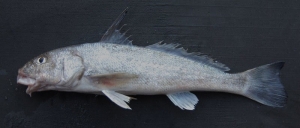
Gulf kingfish: never before recorded north of Chesapeake Bay, VA
Co-author Mark Stoeckle and Director Jesse Ausubel (Director Program for the Human Environment) believe the two-year study ‘demonstrates an accurate, inexpensive way to detect long-predicted marine life range changes’.Bioinformatics expert and co-author Zachary Charlop-Powers who detected bony fish species in consistent seasonal patterns, says just a few species account for the great majority of DNA obtained.
Genetic testing
Published in Frontiers in Marine Science, the study involved drawing seawater twice monthly for two years and testing it for genetic material, (DNA contained in cells sloughed off the slimy, gelatinous outer coating of a fish as it swims, for example), in excretions and tissue fragments shed in combat with a predator or after death or injury.
“DNA degrades and disperses within a few days of an animal’s departure, but lingers in the water despite currents and tides, long enough to detect a species’ passing presence,” explains Dr Stoeckle.
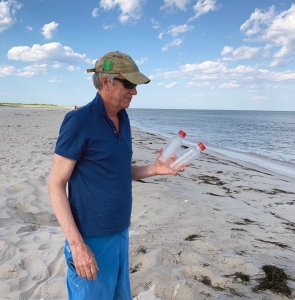
Dr Mark Stoeckle bottles evidence of new marine life migration patterns in the Atlantic
In 2010, a Census of Marine Life programme – the Future of Marine Animal Populations (FMAP) – forecasted changes in diversity of marine species, based on available habitat and anticipated changes in water temperature:
“The Brazilian cownose ray (Gulf kingfish) far north of its known range fits FMAP’s prediction,” believes Jesse Ausubel.
But other examples remain possible,” she adds, “The animal may have simply evaded new Jersey trawl nets for years.”
Monitoring marine mitration
Changes in ocean behaviour due to climate change, chemical pollution, debris, noise and night-time illumination are other factors.
“This study further establishes aquatic environmental DNA (eDNA) as an innovative, inexpensive, low-impact way to monitor marine life migrations, changing ranges, diversity and distribution,” says Jesse Ausubel.
Dr Stoeckle, who has worked with high school and college students, believes the collection process is “simple enough for supervised schoolchildren or citizen scientists” to help monitor the changing ranges of marine life.
After water is drawn it is filtered to concentrate the DNA for extraction. The target segment of the DNA is amplified in a laboratory and the sent for ‘next generation’ sequencing. The results – a record of all the DNA sequences in the sample – is fed into computer software that counts the number of copies of each sequence and searches for matches in an online public reference library.

