Dublin conference attracts international ocean energy experts
The International Conference on Ocean Energy (ICOE) 2012 – the largest of its type in the world which took place over three days in October at Dublin’s Convention Centre, has been hailed a major success by its host, the Sustainable Energy Authority of Ireland (SEAI). 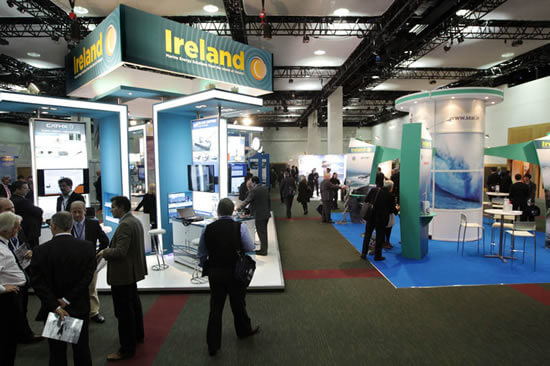
This was the fourth such event of its kind to focus on the global industrial development of renewable marine energy, bringing together almost 1,000 ocean energy experts from 40 countries, and included exhibits from 70 of the leading developers of ocean energy technologies.
Expectations exceeded
“ICOE 2012 exceeded expectations, and we’re delighted with what has been achieved here,” SEAI’s chief executive Dr Brian Motherway told Inshore Ireland.
“We had delegates travelling from as far afield as Australia, Canada, China and New Zealand, and it reflects the true global scale of this burgeoning sector and the potential it holds as so many countries are eager to move to low carbon energy sources and position themselves as the main providers of such a resource.“
Motherway added that all through the three-day event the atmosphere throughout was one of “palpable enthusiasm. There was a real sense that people were keen to learn, share ideas and experiences and ultimately do business.
“And while we are at the start of this exciting journey, significant research and development work has already been undertaken and in some parts of the world, ocean energy devices are operating commercially.”
Potential pole position
He added that Ireland has a real opportunity to be a significant player in this sector, and indeed position itself as a leader on the world stage.
“Ireland has an abundance of ocean energy resources — some might say we have the best ocean resources in the world. Plus we have the skill and expertise to advance this emerging sector. Many Irish companies are already excelling in the global ocean energy market.”
Delegates at ICOE 2012 managed to see first-hand some examples of the Irish companies leading the way in the ocean energy sector. After the formalities finished, a technical tour was arranged to the Open Hydro factory in Greenore and MCT’s SeaGen tidal current turbine in Strangford Lough.
This served as a positive closing to the conference to show delegates practical applications to the many technical, academic and environmental ocean energy topics that had been discussed in the previous days.
“SEAI has produced an Ocean Energy Roadmap which quantifies the potential of the marine renewables sector under different scenarios. This shows that the energy resource off our shores is extremely valuable if properly exploited for electricity generation between now and 2050,” Dr Motherway said.
“We’ve started on this journey, and have already made progress in terms of technology development, test facilities and infrastructure planning. Maximising our ocean energy potential could create thousands of jobs by 2020, offer cleaner energy alternatives and secure Ireland’s energy supply.
“The only caveat is that countries all around the world are equally aware of the economic potential of ocean energy, so we must mobilise all our key players so that Ireland achieves the benefit that is currently open to it.”
Milestone event
Speaking on the final day, Marine Renewables Industry Association (MRIA) chairman Peter Coyle said that the event marked a milestone in the development of ocean energy – wave and tidal. “It reflects in both its scale and the obvious enthusiasm of everyone in attendance, the growing importance of this still emerging field of technology”.
Coyle added that for the Irish ocean energy sector it was a “challenging time” because the technology was still emerging at a time when, even three or four years ago, “pundits in the energy industry expected wave and tidal to be at the experimental, pre commercial stage now”.
When asked why it was taking so long to get energy producing devices to work reliably Coyle replied it was because the marine environment was very tough.
“The forces and natural phenomena playing on a wave device, for example, is stretching man’s ingenuity and knowledge. And tidal – although dealing with a certainty, the timing of tides – also presents huge challenges,” he noted.
Despite this he said it was “important to put matters in perspective” and to realise that Ireland’s wave resource in particular could be the source of many thousands of Mega Watts of energy.
“Estimates undertaken for the Government here are even more positive. Given our huge natural advantage in this area — Siemens estimates that Ireland accounts for one-third of Europe’s total renewable energy resource — we could in time be in a position to become a major energy exporter. Energy could be as important an employer as food is, providing 120,000 jobs,” Coyle said.