
European surveillance service finally gets the green light
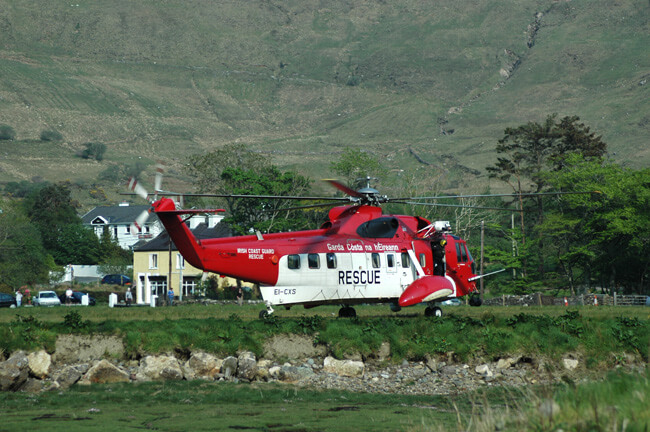
Irish Coast Guard helicopter during a rescue demonstration in Leenane, Co Galway. Photo Gillian Mills/Inshore Ireland
John Cushnahan
When I proposed the establishment of a European Coastguard Service in the European Parliament in June 1993, the response of the European Commission was less than enthusiastic.
In response to my suggestion, the Commission stated: ‘No Member State has ever proposed that a European Coastguard Service be established …….and the European Commission has no intention of changing the existing situation.’
Undeterred by their attitude, I campaigned incessantly for this objective over the next ten years. I raised the issue in relevant parliamentary debates; tabled numerous parliamentary questions on the subject; persuaded fellow MEPs to include my proposal in a variety of European Parliament initiatives dealing with drugs and human trafficking; illegal immigration; marine pollution; fisheries protection; air and maritime safety.
Detailed proposal
My final contribution on the subject as an MEP came, as a member of the European Constitutional Convention, when I submitted a detailed fourteen-page proposal on how I envisaged such a service could operate.
Throughout this period, the closest I came to fulfilling my dream occurred during the Irish Presidency of the European Union, in the latter half of 1996. I persuaded the then Taoiseach, John Bruton, to make it one of the Irish Presidency’s initiatives.
It was then that I realised where the main stumbling block to making progress on this issue actually lay… I discovered this important reality when I was travelling home to Ireland on a flight from Brussels and happened to be sitting beside a senior civil servant from the Department of Justice.
Aware of my campaign on the issue both in Ireland and Brussels, he congratulated me on having it included on the agenda of the Irish Presidency but warned me that it would go no further. I was shocked by his arrogance because he was implicitly making it clear that he would ensure that the proposal would not go any further. I couldn’t believe that a public official would behave in such a manner.
It was, however, a coming of age experience when my political innocence would soon be replaced by a more realistic understanding of political realities. This happened when I discussed the incident with some of my more experienced Irish colleagues.
Final fortress
They educated me about one harsh fact of political life: that the Ministries of Justice (or Ministries of Interior as they were called in some Member States) were the last fortresses of national sovereignty in Member States who would resist European integration and protect their little empires to the bitter end.
Fortunately this situation has now significantly changed, particularly at a time when a new momentum seems to be beginning for the creation of an EU Coastguard.
One of the key elements in the Lisbon Treaty was the recognition that international crime particularly human and drug trafficking; illegal immigration and the massively lucrative trade in cigarette smuggling (in all of which maritime activity plays a key role) could only be effectively dealt with if and when there was greater co-operation between Member States.
Majority voting
The introduction of majority voting into the Justice and Home Affairs field along with other Treaty provisions meant that forever more important decisions in these areas would fall within the democratic supervision of the European Parliament which would take decisions jointly with Member State Governments.
The fortress mentality of Justice/Interior Ministries had now been permanently shattered. Therefore, in my view, now is an opportune time to be bold and imaginative, particularly when the relevant Irish government department that has been charged with taking the first tentative steps on the evolution of a Coastguard is the Department of Transport.
It is headed by an extremely competent, dynamic and courageous Minister in the person of Leo Varadkar. He has given Irish Coast Guard Director Chris Reynolds (Chair of the EU Heads of Coast Guard network) the task of persuading his colleagues that a proposed Europe-wide coastguard secretariat should be based permanently in Ireland.
But why stop there? Why not signal his intent that when Ireland takes over the EU Presidency in 2013, that one of his Department’s objectives will be to seek agreement to establish an EU Coastguard itself and not simply a secretariat?
He could also point out that an ideal place for such a Coastguard would be Co Cork, which is located on some of the most strategic shipping lanes between Europe and other parts of the world including the Americas and Africa (the latter two have been the source of many of the drugs that have flooded the streets of European cities).
Also by mentioning Cork, he would undoubtedly gain a Cabinet ally in the person of Simon Coveney whose responsibilities include marine policy. It would also be essential to have the backing of the Justice Minister if progress is to be made. Protection shortcoming
I believe that he could also elicit a positive response from his counterparts in other EU states. The harsh realities of political life in the EU in the current climate is that the European Union institutions have abysmally failed to protect their citizens from the fall-out arising from the current unending tidal waves of economic woes.
These same institutions might be attracted to an initiative that would be more successful in demonstrating the relevance of the EU to its citizens and their concerns particularly if what is being proposed in the form of a Coastguard will be effective in areas such as:
• combating international trafficking on Europe’s high seas
• providing an effective response to another pollution disaster similar to those which occurred with the break-up of the Prestige in 2002 or the Erika in 199
• protecting our dwindling fish stocks and
• strengthening the safety of our leisure and commercial maritime activities
Such a bold step makes sense. In the current economic climate, pooling resources would also reduce current expenditure requirements in various Member State’s national budgets.
Come on Leo – he who dares, wins!
