
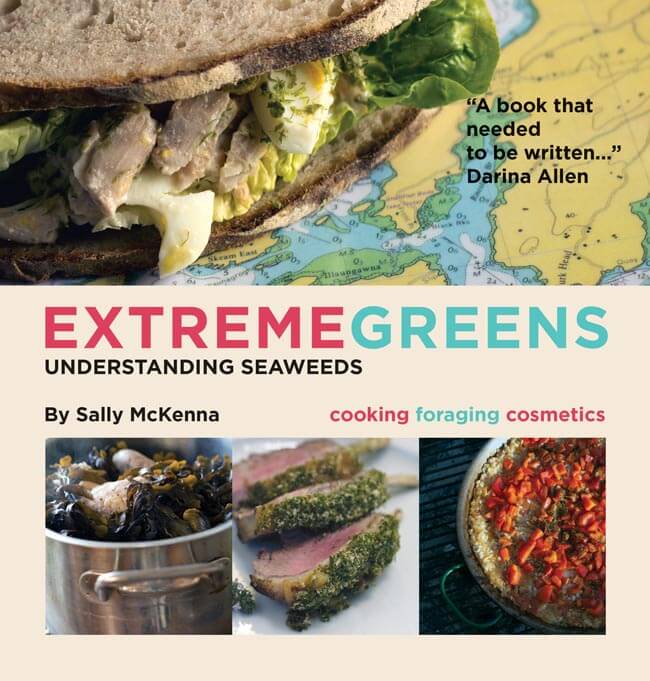
EXTREME GREENS: Understanding Seaweeds
There’s one thing for sure: author Sally McKenna is ‘passionate’ about seaweed. Her love of the seaweed environment began when she first experienced this new world to her at almost eye level from her kayak.
‘My craft took me to secret places, where the water glowed a phthalo green-blue and the rock walls were lined with spicy pepper dulse above the waterline, and purple carrageen below the waterline that sparkled with vivid blue oxygen bubbles. I wanted to know more.’
She tells us that through studying seaweed she has learnt more ‘about the tides, about the universe and about the historical content in which it was eaten. How it was used as a fertiliser, a medicine and a food.
With this knowledge she began to understand that what seaweed could ‘famously do for plants, ie make them grow tall and strong, it could also do for my children. And also for my fifty-year-old self and my husband.’
This colourful and educational study of seaweed, the superfood, emblazoned with more than 80 recipes, describes the history of seaweed in the Irish diet ― back to prehistoric times ― and its use in fifth-century monastic writings.
It is clear, she suggests, that what is known today, scientifically, was learnt by experience by our forebears: that seaweed is a superfood that can regulate metabolism, cleanse the blood and stimulate the immune system.
Extreme Greens is much more than a cookery book. We learn how to recognise and forage for seaweeds; how to make natural beauty products and how to use seaweeds in the vegetable garden.
From more than 500 identified species, Sally McKenna has isolated 15 that are good for eating or for making cosmetics. She explains how to identify and harvest these (loosely divided into three categories: green, red and brown), and a diagram of the splash zone to the sub-tidal shows were each type can be found.
And importantly, she reveals the secret to getting children to eat seaweed; the answer to which she says is simple: ‘Seaweed in a powered form can take on the flavour of anything you put it with, so a tablespoon of dilisk in a casserole, or even a cake, will not be taste-detected by a fussy child.’
Should the reader be left in doubt as to the benefits of seaweed, the author adds a footnote:
‘The Okinawans, who have the oldest demographic in the world, and whose population include the largest proportion of centenarians, eat more kombu seaweed than any other nation. Just saying!’
Published by Estragon Press Ltd, Price €20