
Fisheries Council agrees all-species landing, starting with pelagics in January 2014
An agreement by the Council of Fisheries Ministers to a landing obligation of all fishing vessels for all quota species beginning with pelagic fisheries from January 1, 2014, has been described as a “flawed approach” by the Federation of Irish Fishermen (FIF) as a method to address the complexissue of fish discards.
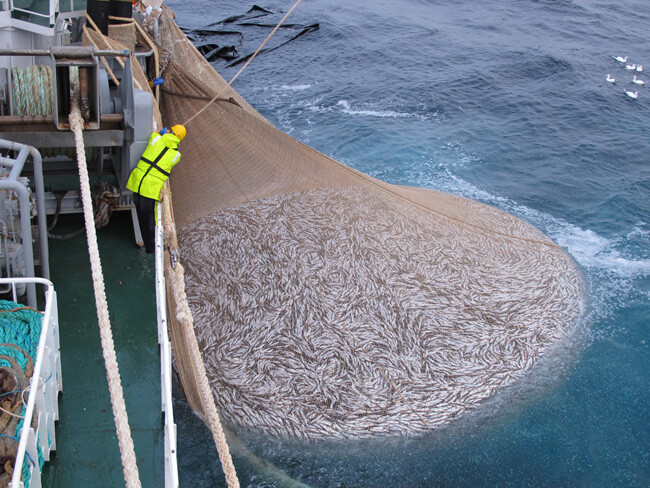
A fine haul of herring alongside mfv Vigilant. The June Council of Fisheries Ministers agreed a landing obligation of all vessels for all quota species, beginning with pelagics in January 2014. Photo John Cunningham
“This approach is impractical and unworkable,” remarked their chief executive who added there was agreement throughout the European-wide fishing industry that discarding needed to be reduced “to the lowest level possible”.
Avoidance approach
Ms O’Sullivan said that the industry had long advocated an approach of avoiding discards “in the first instance” by implementing temporary closures in areas where there are large amounts of juveniles and by gradually implementing increasingly selective technical measures and offering incentives to fishermen to adopt these.
“Instead of adopting this effective and practical approach, the Council has bowed to media pressure to implement an outright ban which is both unworkable and unenforceable.”
The chief executive said fishermen were “more than aware” of the importance of eliminating discards.
“We have developed and implemented a number of measures to reduce discards in both whitefish and pelagic fisheries.”
Practical solutions
While there is general political agreement on the overall objective of gradually eliminating discards, Ireland’s marine minister Simon Coveney said the issue that must be resolved is how to achieve a new policy that involves arrangements that are practical from a fisherman’s perspective.
“In order to find solutions I have tabled a new approach that takes into account the real practical difficulties…of changing practices, economic impacts and other constraints that impact fishermen in mixed fisheries.”
He outlined these to be incentivising changes in fishing behaviour, reducing catches of juvenile fish and allowing fish stocks to grow over a set period.
“I believe this approach stands the best chance of getting ‘buy-in’ from fishermen and in this way effectively delivering more environmentally friendly fishing practices and sustainable fisheries”.
He added that the proposal involves delivering a progressive and phased approach to the obligation to land all catches of quota stocks in a mixed fishery context.
The Fisheries Council also focussed on ironing out outstanding political issues in the Common Fisheries Policy (CFP) reform package with the aim of achieving a General Council Approach in advance of future talks with the European Parliament.
|
O’Neill in fisheries reform talks Attending the Council talks, Northern Ireland’s Fisheries Minister, Michelle O’Neill, particularly noted discussions on Maximum Sustainable Yield (MSY) and the priorities for financial assistance under the future European Marine and Fisheries Fund. “Flexibility in needed in each of these areas, and I am particularly concerned that these objectives must be met by 2015 in a mixed fishery like the Irish Sea.” “She added she was “relieved” the Commission had now recognised it will not be possible to move all stocks to the MSY level at the same pace. “In the Irish Sea we will need to gather more data to better understand the measures required to achieve sustainability for all stocks, and the impacts that these measures may have on our fishing fleet. “I also welcome the proposal from the Danish Presidency to allow more flexibility for Member States to manage their own fish quotas. We operate a well established system, and flexibility is necessary so that existing arrangements can be respected.” Reform of the CFP is expected to be concluded during the Irish Presidency in the first six months of 2013. |