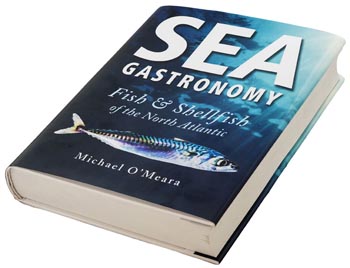
Sea Gastronomy Fish & Shellfish of the North Atlantic
At 440 pages and weighing over 2kgs, this is no ordinary book on seafood but an encyclopaedic culinary study of the variety of fish and shellfish of the North Atlantic.
Narrated over 12 chapters, this beautifully illustrated publication contains over 200 recipes and information on 120 species. Many familiar, and others less so: Poor cod, Three-bearded rockling, Witch, Starry smooth hound and Lumpsucker, for example, are identified and cooked in dry methods (frying, baking, roasting, grilling, barbecuing and deep-frying or wet methods (poaching, pot-roasting, steaming, sous vide and microwaving.)
Galway, and represents over twenty years of research, cooking, diving and photographing the diversity of fish and shellfish.
His passion as a chef is evident on every page, beginning at the age of six at his mother’s side. ‘Using all sorts of offal as well as fresh home-grown vegetables, this was real cooking on a budget of next to nothing,’ he says.
Michael’s father was a lobster and inshore fisherman who worked out of Ballymacaw and Dunmore East. Foraging for cockles, mussels and shellfish in ‘pristine waters’ around Ireland’s coastline, combined with annual camping holidays in France ‘where we explored all regions of the country absorbing by osmosis the culture and fantastic regional dishes and foods’, gave Michael a deep love of food and in particular seafood.
At sixteen he was accepted into the professional chef course in the Galway Regional Technical College, and from there embarked on a quest to cook at the highest level. Time spent at Dromoland Castle gave Michael an understanding of how a French kitchen was run.
But to France he went to ‘learn from the best’, and describes the experience as ‘akin to boot camp, with 18-hour days the norm, but the passion, adrenalin and camaraderie was extraordinary.’
Combining photography with cooking was a natural synergy for Michael as both disciplines are visual arts, he says. Food photography that began as a hobby grew into a secondary career whereby his collection of fish and shellfish images became a fundamental basis for this book.
Describing SEA Gastronomy as a ‘celebration of the culinary potential of our highly valuable marine resources’, Michael however acknowledges that the sea is not an infinite resource, requiring proper fishery regulation and management.
‘For example, if herring are prevented from spawning in an area… the entire food chain is disrupted, because young herring are the primary converter of zooplankton into fish that are in turn consumed by larger fish, and this chain works all the way up to the alpha-predators such as sharks.’
The conservation message is driven home by marine biologist Dr Peter Tyndall who contributes a chapter on sustainability and its importance to maintaining healthy fish stocks.
‘Serious over-exploitation of our fishery resources has undoubtedly been a major problem. But the fishing industry has adapted to the required changes, and is still adapting through reduced effort, full traceability and the employment of selectivity devices.’
New data from the European Commission however ‘proves that these efforts to achieve a sustainable industry are paying off, as eighteen times more commercial species are now fished at safe biological limits than was the case only 12 years ago,’ he writes.
He cautions however that some species have undergone little or no stock assessment ‘so the conscientious consumer finds it difficult to make a decision about their sustainability’.
Product certification such as the ‘Responsibly Sourced Standard’ operated by BIM (the Irish Sea Fisheries Board), and independent bodies such as the Marine Stewardship Council and Friends of the Sea, set standards and work with fishermen and retailers to create awareness for consumers and to educate the next generation.
In the foreword, restaurant critic with The Sunday Times, Ernie Whalley, believes Sea Gastronomy is an important publication:
‘First and foremost, it is a catalogue of the marine life on and around Ireland’s shores. So far as I am aware, no other author has achieved or even attempted this task.’
While acknowledging that fish is perceived as expensive, especially by people who do not have the opportunity to buy directly from a boat or on the pier, ‘Can we expect a commodity for which we send folk out in small boats in all weather to be cheap?, he asks.
Whalley also contends that cooking fish at home is not a challenge, but says many cookery writers ‘to their shame’ largely ignore or gloss over the preparatory skills.
‘Here again, this book, enhanced by high production values, comes up trumps. Not only by equipping the reader with the necessary techniques for cooking fish, written in plain language, but by supplying enticing recipes aplenty, ranging from the easy to the moderately challenging, which keen cooks will appreciate.
‘This book has a mission to demystify, to take the fear of our fish and, better yet, to encourage the appreciation of a wider range of species. After all, tastes do change.’
SEA Gastronomy: Fish & Shellfish of the North Atlantic is published by Artisan House Editions and is available nationwide at Dubray Books; Easons; Waterstones; Hodges Figgis; independent bookshops, ‘Oscars Seafood Bistro’ Galway and at www.artisanhouse.ie
RRP €30
ISBN 978 0 992 6908 4 7