
Good prices predicted for winter sales of bulk oysters from island of Ireland
Fabrice Richez
The 1970s epizootic events almost eradicated the native oysters (Ostrea edulis) in European oyster production regions, and decimated the Portuguese oyster (Ostrea angulata) from the French coast.
The Pacific oyster (Crassostrea gigas), which was introduced to France from Japan and British Columbia to replace the Portuguese oyster, has also been affected by massive mortalities since the 1990s.
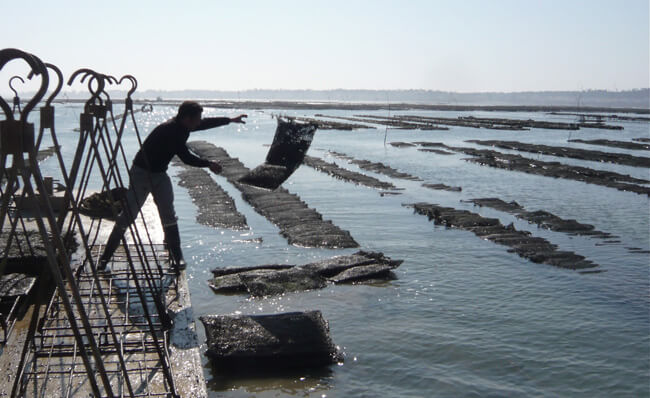
Transfer of half-grown oyster bags at sea in the spring Marennes – Oléron, France. Photo Fabrice Richez
Scientific investigations conclude that mortalities were linked to multifactorial interactions between the oyster, the environment and the presence of pathogens. Moreover, some studies also show a causal link between the presence of pathogens such as the Ostreid herpesvirus-1 (OsHV-1) and oyster mortality.
High mortalities
In France from 2008, the summer mortality situation aggravated when oysters started to die massively and ubiquitously around the French coast. Since then massive mortalities have occurred every year, with mortality rates averaging 80% of the stock.
At the same time, the newly discovered variant (OsHV-1 μVar) became the dominant pathogen and appeared to be more virulent than the main strain, OHV-1.
Severe mortality events in C.gigas were also reported by the main European oyster production countries from summer 2008-2009 and in other part of the world including New Zealand (2010, 2011), Australia (2010), Japan (2010) ).
Favourable conditions
Oyster production regions from Ireland and the UK were less affected by massive mortalities than French ones. It has been suggested that these differences were as a result of colder sea temperatures and lower degree of intensification of oyster farming.
Taking into account large-scale mortalities and economical implications on the oyster industry, the French, British and Irish authorities have engaged with the European Commission, to prevent the spread of the virus to areas where it had not been detected.
Monitoring and research programmes into shellfish diseases have resulted in best aquaculture practices and technologies to reduce these mortalities. Factors that have been identified as has having an impact on higher mortality rates and the spread of the disease include sea temperature (over 16˚C); the degree of intense farming; culture practices; methods of culture; site proximity and hydrodynamics; pollutions; the presence of other pathogens; the genotypic resistance of the oyster and the state of the oyster.
OsHV-1 μVar is an oyster infectious disease harmless to humans; however it had dramatic consequences on the French oyster industry where production collapsed from 128,500 tonnes in 2008 to 80,000 tonnes in 2011.
Optimistic winter sales
For Irish oyster producers it is now a good opportunity to invest in the industry with prices for bulk never seen before. An initial telephone survey on price prediction for bulk oysters seems to indicate a further price increase for the bulk sales of winter 2012. A standard quality diploids oyster should be sold at €3.5 to €3.7/kg and triploids oyster at €4.2/kg. As for the specials, (a superior quality oyster) producers are targeting €5 to €6 /kg.
These predictions will soon be confirmed once the harvest season starts mid October and towards the end-of-year sales. There is also a great a market opportunity for the Island of Ireland to produce disease-free seed at a competitive rate, with no abnormal mortalities in disease free sites. The only commercial hatcheries situated in ‘disease free’ locations in the UK are over capacity and cannot supply oyster farmers located in disease free bays.
It is important for oyster producers to keep in mind that French hatcheries will very likely once again produce select oysters with high survival rates so prices might fall again.
The DARD has allocated some funding to Aquaculture Initiatives to carry out investigations about the massive oyster mortalities, with associated causes, consequences and impacts on the oyster industry in Northern Ireland.
- Review on the oyster mortality situation (Crassostrea gigas) and market opportunities for Ireland will be shortly available for the industy