Impasse on fisheries continues despite advancing precipice
An impasse on fisheries continues to prevail as the EU and UK enter final Brexit talks on September 7 and 28. These are crunch deadline dates to process Treaty ratification if an agreement is to take effect on January 1 next.
The EU will have to travel ‘a very long way from its current position – which is very close to the status quo – if a deal is to be made’, remarked the UK’s National Federation of Fishermen’s Organisation, quoting Prime Minister Johnson and Chief Negotiator David Frost following the latest fisheries talks with the EU.
The Commission is operating under a mandate from the member states that make compromise ‘impossible’, it adds.
‘These two opposing factors make the likelihood of no deal, at present, the most likely outcome.’
NFFO contends that in the event of a no-deal on a fisheries framework agreement, the EU will need to make a judgement call.
Would the ‘self harm’ it would inflict on itself and the UK (by withholding a trade deal), be the right course of action, notwithstanding the rhetoric generated throughout the negotiations, it asks.
If no deal is agreed, the UK will trade with the EU on WTO terms from January 1.
Stand-alone arrangements
In view of these major uncertainties, the UK is preparing for ‘stand-alone’ arrangements in which access for EU fleets to fish in UK waters in 2021 onward would be ‘one element’ within an overall annual agreement.
Other elements include setting TACs ( Total Allowable Catches) and quota shares.
In the event of no agreement being reached during the September negotiations, the UK and EU may set their own autonomous quotas for 2021, the NFFO warns.
‘This is a departure that no sensible party wants.’
Post Brexit
After the transition period ends, the UK’s legal status on fisheries will radically change. The UK will hold the rights and responsibilities of a coastal state as defined in the UN Law of the Sea (UNCLOS).
‘It is imperative that these sovereign rights are not diluted or given away in any agreement with the EU,’ the NFFO argues.
NFFO red-line issues
- quota shares that reflect the resources located in UK waters
- access arrangements to be negotiated as part of annual fisheries negotiations
- regulatory autonomy to allow the UK develop its own distinctive fisheries policy outside the Common Fisheries Policy
- an exclusive 12-mile zone for UK fishers
- friction-less as possible trade deal without compromising UK sovereignty and rights as an independent coastal state
‘These are the criteria against which any deal to emerge from the negotiations will be measured and judged,’ says NFFO.
Brussels position
Speaking at a Dublin event (September 2), the EU’s chief Brexit negotiator, Michel Barnier, said ‘without any doubt” Ireland was the member state most affected by Brexit:
“Since the start of these negotiations, the UK has not shown any willingness to seek compromises on fisheries. No new legal texts have been tabled by UK negotiators. Where the EU has shown openness to possible solutions, the UK has shunned our offers.”
The UK government’s position would “lock out Ireland’s fishermen and women from waters they fished in long before Ireland or the UK joined the European Economic Community in 1973,” he added.
“This is just not acceptable. We fully understand and respect that the UK will become an independent coastal state, outside the CFP. But we will not accept that the work and the livelihoods of these men and women be used as a bargaining chip in these negotiations.”
The chief negotiator added that any solution must ensure a balance:
- between further developing the activities of British fishermen and women
- safeguarding the activities and livelihoods of European fishermen and women
- preserving natural resources
Without a long-term, fair and sustainable solution on fisheries “there will simply be no new economic partnership with the UK”.
The UK has also been “extremely reluctant” to include “any meaningful horizontal dispute settlement mechanisms” in a future agreement. Yet this is the only way to ensure that what we eventually agree on is respected….
“We are simply asking to translate the political engagement taken in the Political Declaration into a legal text. Nothing more. Nothing less,” he added.
Clean break
The UK red-line issues of a clean break from the EU, full sovereignty and freedom to set its own rules and to spend its own money without constraints from Europe, are why it cannot commit to a level playing field or to basic safeguards for a future relationship with Europe.
“And yet the truth is that British negotiations are still seeking continuity in many areas. This is “not a ‘clean break’ at all,” contends Michel Barnier.
“The UK government is still looking to keep the benefits of the EU and of the Single Market, without the obligations.”
Regarding water quality standards of English rivers, lakes and beaches post Brexit, these will be “less rigorous” than under the EU’s Water Framework Directive, and raise “major environmental and health concerns”, Barnier also noted.
As we near the finish line “I still have hope that, despite current tensions – our common history with the UK, shared values and joint commitment towards multilateralism will prevail,”
But he warned, “We will not sacrifice – never sacrifice – the EU’s long-term economic and political interests for the sole benefit of the UK.
“In the past months, the EU has repeatedly shown flexibility and creativity to work with the UK’s red lines: on the role of the European Court of Justice, on preserving the UK’s legislative autonomy and on fisheries.
“It is time for the UK to reciprocate on those issues that are fundamental for the EU.”
NFFO response
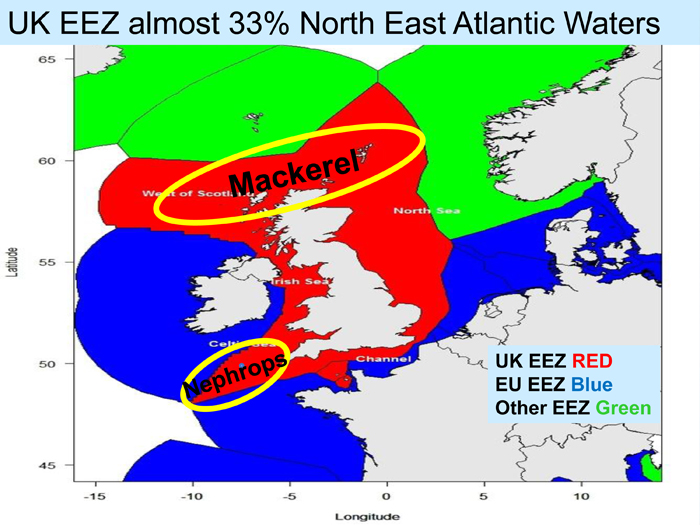
What the National Fisheries Federation Organisation and the UK government is seeking is “nothing extraordinary; it’s the usual relationship that exists between two coastal states which share stock,” CEO Barrie Deas told Ocean Focus.
“Annual fisheries agreements, and quota shares that reflect the resources in each respective EEZ, is the international norm. That is exactly how the EU have shared fisheries with Norway for 40 years.”
Deas added it was the Common Fisheries Policy and the UK’s terms of entry to the EC that distorted these arrangements “to the UK’s serious disadvantage” which they now had an opportunity to redress.
A trade deal is in everyone’s advantage, he believes.
“The EU’s threat to withhold a trade deal would certainly hurt the UK, but it would also hurt a range of member states within the EU27.
Making an “artificial linkage between trade and fisheries as the EU has done is perhaps understandable” in the absence of alternative negotiating leverage on fisheries, he added.
“But there is no sign that I can see that the UK government would sacrifice the fishing industry to get a deal. I don’t think that a repeat of the 1970s is on the cards.”
According to Deas, the EU regularly misrepresents the UK position as an intention to expect all EU vessels from fishing in UK waters.
“In fact, what will change is [that] the EU’s fleet will no longer have ‘automatic’ access to the UK EEZ.
“Access will be available but on negotiated terms as part of an annual fisheries agreement – again, just like EU/Norway currently.”

