
International Guidelines for Small scale fisheries: the long road to recognition
Brian O’Riordan, ICSF
In 1979, anticipating the establishment of 200 mile Exclusive Economic Zones (EEZ), Eduard Souma the then Director General of FAO, speaking at the 13th Session of the FAO’s Committee on Fisheries (COFI), highlighted that: ‘Literally millions of people eke out a living from the sea, risking life and limb in frail craft to reap a meager harvest…The challenge we face is to provide a setting for something better than a new colonialism of the sea.
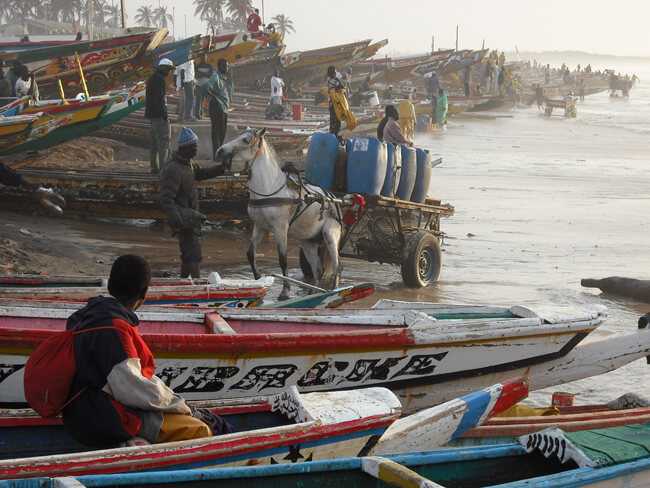
Fishing community of Kayar, Senegal,. Literally millions of people eke out a living from the sea, risking life nad limb in frail craft to reap a meagre harest. Photo ICSF
‘New fisheries can be built as indigenous industries on traditional bases, particularly the small-scale or artisanal fisheries. They can grow without social disruption, without pollution, without most of the painful side effects associated with over-zealous industrial development. The skills are available, the technology is within reach, the opportunity needs only to be grabbed. Let us do so now.’
Nearly 35 years on, the opportunity is still waiting to be grabbed, but seems to be tantalisingly close.
As we know in Europe, the wheels of policy reform and policy change turn slowly. Four years down the road, the third reform of CFP looks like it is nearing completion. But representatives of small-scale fisheries have been knocking on the door of FAO since 1984, demanding such fisheries policy reforms as advocated by the FAO Director General in 1979.
Since 2011, the FAO Fisheries and Aquaculture Department has been leading a process to develop International Guidelines for Securing Sustainable Small-scale Fisheries (IG SSF) – a new international instrument that would combine ‘best practices’ in responsible fisheries with social development. In Rome, from May 20-24, around 200 delegates from over 65 countries met for a ‘technical consultation’ to negotiate the content of these guidelines.
Given the process leading up to this meeting – including five regional conferences organised by FAO in Asia, Africa, Latin America, the Caribbean and Pacific, and discussions in three sessions of COFI – one would have expected that the consultation would quickly reached its conclusion.
At the end of business on 24 May, however, much of the business was left unfinished. After five days of intensive discussions, delegates had completed roughly two-thirds of their job to arrive at a consensus on the content and wording of this new international instrument. This was extremely frustrating for the 35 civil society delegates representing small-scale fisheries from 19 countries across South and North America, Africa, Asia and Europe, who were present as observers in the meeting.
Several stumbling blocks presented themselves, including whether or not the application of certain terms was acceptable. In some cases, nuances of meaning of words and how they are used in different languages created insurmountable barriers. Despite the long process of consultation in several cases, national authorities were still reluctant to recognise the importance of small-scale fisheries, the special characteristics and needs of fishery dependent communities, and the rights of workers in the sector.
One commentator noted that States fell into three broad categories: those that were completely set in their old fashioned ways of top-down management and set against any opening up of governance structures and processes to the participation of actors in the small-scale sector; those that were simply confused by the idea of guidelines, and those that were quite open and warm to developing these guidelines.
For a handful of delegates it was unacceptable that the guidelines should refer to small-scale fisheries as an informal sector. They perceived informal fisheries as a black market sector, practicing illegal fishing activities, not reporting catches and evading taxes. It was only thanks to the spirited defence of the sector by West African countries (Ivory Coast, Congo, Senegal and others) that these objections were eventually lifted. Yet another delegate proposed that ‘human rights’ be removed from a ‘human-rights-based approach’ to fisheries, transforming a social development approach into a market based mechanism to privatise fisheries.
Several countries that had instituted ITQs and related schemes designed to redistribute and concentrate fisheries wealth into the hands of a few corporations refused to consider ‘redistributive reforms’ to ‘facilitate equitable access to fishery resources and of land for small-scale fishing communities’. Several States also objected to the term ‘governance’, which they felt undermined the role of the State in managing fisheries resources.
The issues of providing preferential access for small-scale fisheries to resources in waters under national jurisdiction; the need to give their access requirements, development needs of fishing communities, and food security priority over the signing of fisheries agreements with third countries, provoked an intractable discussion.
It is envisaged that at least one further round of technical consultations will be needed to finalise the work needed to present a final draft of the international guidelines to the thirty-first session of the FAO Committee on Fisheries (COFI) in July 2014.
For more information:
Civil Society Website on Small Scale Fisheries: https://sites.google.com/site/smallscalefisheries/
ICSF Website on Small-scale Fisheries Guidelines: http://igssf.icsf.net/index.php
FAO Website on International Guidelines for Securing Sustainable Small-scale Fisheries http://www.fao.org/fishery/ssf/guidelines/en