Irish and UK scientists explore uncharted deep-sea vent field
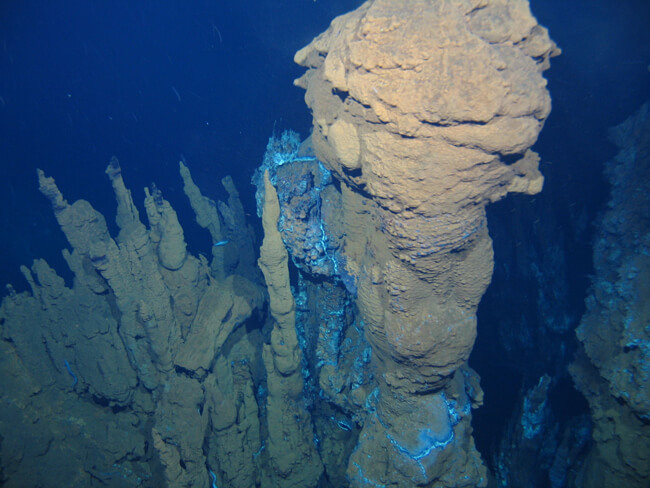
Giant dormant vent on the Moytirra field
John Joyce, Marine Institute
An Irish-led team of scientists from Ireland and the UK has discovered a previously uncharted field of hydrothermal vents along the Mid-Atlantic Ridge – the first to be explored north of the Azores. The VENTuRE mission, led by Dr Andy Wheeler of University College, Cork (UCC), together with scientists from the National Oceanography Centre and the University of Southampton in the UK, NUI Galway and the Geological Survey of Ireland (GSI) spent twenty-five days at sea on board the national research vessel RV Celtic Explorer on an investigation 3,000 metres below the surface of the sea, using the Remotely Operated Vehicle (ROV) Holland 1.
The team comprised many disciplines including marine geologists and geochemists to study the hydrothermal vents, as well as marine geneticists and biologists whose main interest was the new and unusual life forms that live in this harsh and forbidding environment.
Hydrothermal vents, which spew mineral-rich seawater heated to boiling point by volcanic rock in the Earth’s crust below, are home to a rich variety of marine life that thrives in complete darkness on bacteria fed by chemicals. At the press briefing on board the vessel in Cork, Dr Wheeler explained how such high concentrations of toxic chemicals and near-boiling point temperatures would have killed most living things not adapted to this unique environment:
The dark abyss
“On the first dive we found the edge of the vent field within two hours of arriving on the seafloor. The ROV descended a seemingly bottomless underwater cliff into the abyss. We never reached the bottom, but rising up from below were these chimneys of metal sulphides belching black plumes of mineral-rich superheated water. Often the search for vents takes much longer; our success is a testament to the hard work and skill of everyone on board,” he said.
Speaking from the RV Celtic Explorer when the vessel returned to Cork, in early August, Simon Coveney, Minister for Agriculture, Food and Marine said the work was an example of an exciting new discovery made by the Celtic Explorer and its crew of Irish and international scientists:
“Thanks to vessels like the Celtic Explorer, Irish academics and scientists can work with other international experts to explore the seabed in the Atlantic and make groundbreaking discoveries. Ireland is positioning itself as a centre for marine research from a European and international perspective, and this work should be supported and welcomed.”
Understanding planet earth
Dr Bramley Murton of the UK National Oceanography Centre who first saw clues of possible vents on an expedition in 2008 and who led the mineralisation study on the expedition, said the discovery was the first deep-sea vent field known on the Mid-Atlantic Ridge north of the Azores:
“Although people have been crossing this ocean for centuries, we are the first to reach this spot beneath the waves and witness this natural wonder. The sense of awe at what we are seeing does not fade, and now we are working hard to understand what our discovery tells us about how our planet works.”
Patrick Collins from NUI Galway’s Ryan Institute, who led Ireland’s marine biological team investigating this unique ecosystem, is working in collaboration with Jon Copley of the University of Southampton to catalogue and characterise the species found at the vents.
“Everyone on board is proud of this Irish discovery, which we have called the ‘Moytirra Vent Field. Moytirra is the name of a battlefield in Irish mythology, and appropriately means ‘Plain of the Pillars.’ The largest chimney we have found is huge – more than ten metres tall – and we have named it ‘Balor’ after a legendary giant. In comparison with other vent fields, Moytirra contains some monstrous chimneys and is in an unusual setting at the bottom of a cliff—a real beauty,” he said.
“Using the ROV’s high-definition video camera, we’ve watched unusual orange-bodied shrimp crawling around the chimneys, among clusters of tiny green limpets,” said Jon Copley. “Elsewhere there are writhing scale-worms, swirling mats of bacteria and eel-like fish – a riot of life in this unlikely haven on the ocean floor.”
|
This Deepwater ROV was co-funded by the European Regional Development Fund (ERDF) and is named after John Phillip Holland from Liscannor, Co Clare, who was an early inventor and builder of submarines. It was designed and built by SMD Ltd (Newcastle, UK) and is designed to accommodate a wide range of user equipment without modification. Ample space is available within the vehicle frame to accommodate scientific payload, numerous survey ports for a range of equipment including multi-beam, CTD, and nutrient sensors. Numerous spare serial and I/O ports have been incorporated into the system to allow various scientific sensors to be deployed. The vehicle is equipped with a high level of auto control features, including auto hold which is invaluable in the completion of delicate scientific tasks. The vehicle is also equipped with the latest underwater camera equipment, including a HDTV camera and recording system to allow capture of high-definition footage for a variety of uses.
|
Background
The investigation was supported by the Marine Institute through the ‘2011 Ship-Time Programme’ of the National Development Plan under the Sea Change national marine research strategy, and by the National Geographic Society who filmed the work for inclusion in an upcoming National Geographic Channel series: Alien Deep, premiering globally in 2012.
“This project clearly demonstrates Ireland’s capacity to undertake world-class marine research on a significant scale – a capacity created through strategic national investments in facilities such as the Celtic Explorer and the Holland 1,” remarked Dr Peter Heffernan, Chief Executive of the Marine Institute.
“This targeted use of research funding by our organisation, which has enabled senior Irish scientists to lead this survey in partnership with international colleagues, has resulted in scientific discoveries of global interest that will enhance Ireland’s growing reputation in deep-sea exploration.”
Animal colonies
In addition to its major discovery on the Moytirra Vent Field, the VENTure expedition has also mapped significant areas of deepwater corals in the Mid-Atlantic Ridge area. Like their tropical counterparts, deepwater (or coldwater) corals are colonies of simple animals resembling sea anemones that secrete calcium carbonate to protect themselves, forming extensive and delicate reefs.
Over millennia, these reefs build up to form ‘carbonate mounds’ on the seabed which can be detected using sound waves. Because their delicate nature makes coldwater coral reefs susceptible to damage from dredging or deepwater fishing, and because they form unique ecosystems offering shelter to a wide variety of marine life, many coldwater coral reefs around the Irish coast have been declared ‘Special Areas of Conservation (SACs).’ The VENTuRE expedition has mapped the coral reefs on the western Moira Mounds and deployed the ROV Holland 1 to estimate the abundance and density of live coral.