Irish team investigates past climate change in Artic region
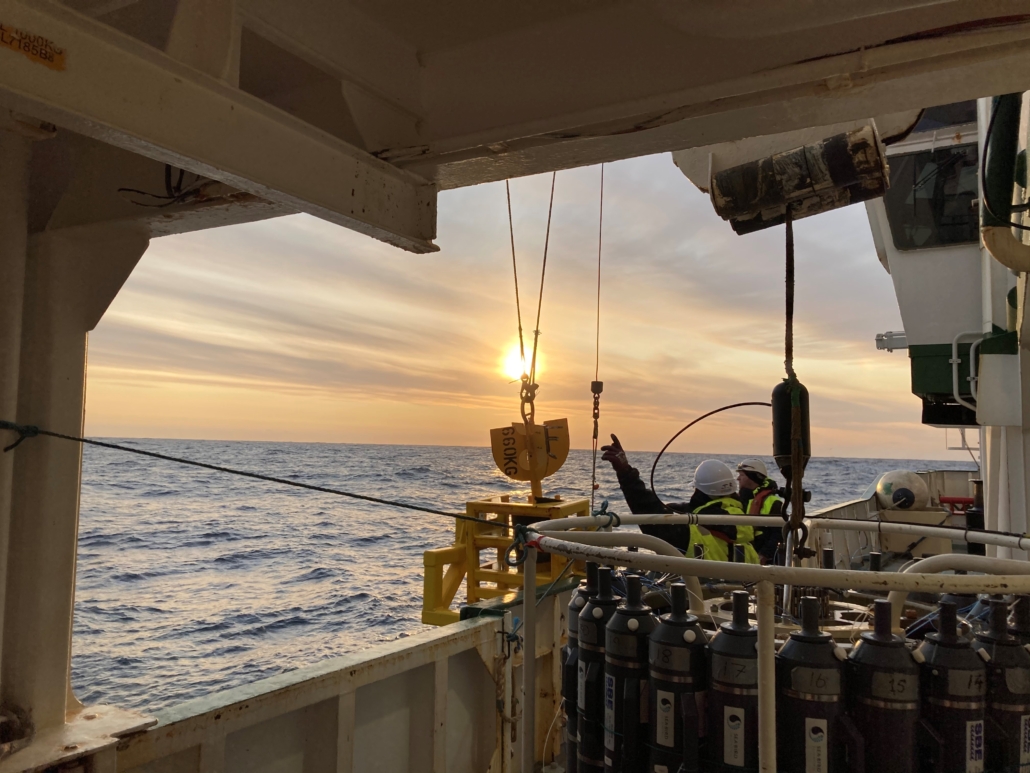
An Irish-led team of scientists on board the Marine Institute’s RV Celtic Explorer has spent 24 days in the Nordic and Greenland Seas investigating past climate change in the Arctic region.
Scientists from NUI Galway, University of Southampton UK, University of Bremen, Germany, and Bergen University Norway, have been monitoring and capturing temperature, salinity and the carbonate system, to improve understanding of essential climate variables in the Nordic and Greenland Seas, and how they are recorded in geologic archives.
One of the key challenges in climate change science is assessing the magnitude of future climate change, due to short observational records limited to the past 150 years.
“Our research is unique, as we are not only observing modern essential climate variables, we will also look into the past to assess how essential climate variables have evolved since before pre-industrial conditions,” remarked lead scientist, Dr Audrey Morley, School of Geography and Archaeology, NUI Galway.
“This long-term perspective is crucial and will help us to better understand our environment and the environmental consequences of human activities.”
The CIAAN survey (Constraining the Impact of Arctic Amplification in the Nordic Sea: A biogeochemical approach), aims to define a more comprehensive description of the Nordic Seas ecosystem and provide insight into how essential climate variables are recorded in geologic archives.
“Assessing the impact and magnitude of past (pre-industrial) climate changes is critical to further our understanding of how the climate system will respond to a rapidly changing Arctic ecosystem.”
Polar Code Certification
“The Arctic is a sensitive and vulnerable environment with regards to global warming. The North Atlantic and Nordic Seas are a key region for the formation of North Atlantic Deepwater and the uptake of atmospheric carbon dioxide.
“Whether or not this region will remain a carbon sink during rapidly warming climates is a question that remains to be answered,” added Dr Morley.
As part of this research survey, RV Celtic Explorer travelled to 79°N in the Greenland Sea, which is the highest latitude reached by the marine research vessel.
To operate in the Arctic region, RV Celtic Explorer was required to obtain a Polar Code Certification, and was the firstIrish vessel to receive this certification and greatly increases the vessel’s ocean research capabilities.
Dr Paul Connolly, CEO of the Marine Institute noted the growing need for international scientists to work together to get a better understanding of the Arctic region, “particularly in relation to what happened to climate variables in the past. The RV Celtic Explorer is crucial to facilitate this type of international research.
“This research will deepen our knowledge of the region and will improve models that can forecast changes to our oceans and climate. This will inform effective policy and management decisions to meet the challenges posed by climate change.”
Dr Audrey Morley is also President of the Network of Arctic Researchers in Ireland (NARI), which was launched by the Marine Institute and the Department of Foreign Affairs and Trade in February 2020.
The Network aims to create, maintain and develop an informal all-island network of Arctic researchers in Ireland to facilitate collaboration of scientific activities linked to the Arctic, and to provide independent scientific advice to the public and policy makers.
The CIAAN survey received funding from the Marine Institute’s National Research Vessels Ship-Time Programme.

