
Is Ireland’s renewable energy programme folly, or based on fact?
Pat Swords
The potential of Ireland becoming a leader in marine renewable energy research and production has received much coverage within these pages, most recently on the front-page of the last issue announcing that the world’s largest research centre – the Beaufort Centre – will be operating by 2013.
There are those, however, who challenge these claims as being ‘folly, not based on fact, and even contend some elements are questionable on legal grounds.
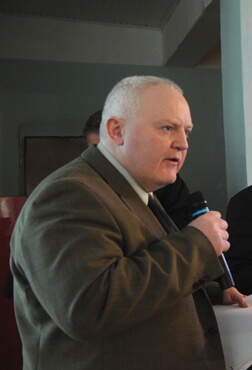
Pat Swords, Fellow of the Institute of Chemical Engineers
To debate the issue, Inshore Ireland invited a representative from opposing viewpoints; namely Pat Swords, Fellow of the Institute of Chemcial Engineers and a Chartered Environmentalist, and Peter Coyle, Chairman of the Marine Renewable Energy Association which represents many of those currently involved in the sector.
While looking for the supporting evidence to the Irish renewable energy programme, I instead found a litany of illegalities; failures to inform the public or provide them with their democratic right to participate in decision-making; deliberate dissemination of non- transparent information leading to contracts worth billions handed out on an inaccurate basis.
To explain, not only have I over 20 years experience in the design and regulatory approval of industrial projects, since 1999, I have worked extensively in Central and Eastern Europe on EU Technical Aid projects, implementing the legislation relating to industrial pollution control and control of major accident hazards.
When I have been asked in public meetings, why it is different now to the days of communism, I explain there is a system of transparent governance, based on merit.
Non compliance
Not only would I never have the nerve to say this in a public meeting in Ireland, it is completely shocking to witness the resistance the Irish administration has to complying with the minimum standards set out in EU law regarding transparency and public participation.
The most damming example of this is Ireland’s renewable energy project, which is entirely based on a fixation that 40% of the country’s electricity can be wind powered.
In January 2012 the United Nations Economic Commission for Europe’s (UNECE) Aarhus Convention Compliance Committee will publish its draft findings and recommendations on my Communication ACCC/C/2010/54. This investigation is against the EU, as Ireland will not ratify this UNECE Convention on Human and Environmental Rights.
However, the Convention applies to Community legal order here since the EU ratified it in 2005. If one wants to implement a significant industrial policy or project, the public has to be provided with information related to costs / benefits / impacts and allowed to properly participate in both the policy development and individual planning decisions.
Community law ignored
Nevertheless, the EU and the Irish administration have implemented the renewable programme with total disregard to the Convention and Community law which implements it:
- 20% renewable energy by 2020: Nice rhyme; but no economic, technical or environmental assessment completed by EU. Member State targets assigned based on GDP
- Ireland’s electricity can be generated without any renewables for €1.7bn per annum
- The capital cost of 4,000 wind turbines, an additional 5,000 km of high voltage lines, interconnectors to the UK, smart meters, etc, is over €30bn Lucky if turbines last 15 years
- Then there is the environmental impact of this project
- Still need the thermal plants, but now these are running in a highly inefficient manner to compensate for the variability of the wind input
So, why are we doing this?
There are no figures to answer this. The administration failed to complete the mandatory environmental assessment, and the programme was adopted without the necessary public participation.
No verification is available on emission / fuel savings to date, or estimates on savings associated with 2020 target.
Administration ignored the 2004 engineering analysis by Eirgrid, which pointed out the massive induced inefficiencies on the grid. Instead in the 2006 EU application for tariff approval, the Department of Energy put down double the value for CO2 savings – utilising ‘wind industry theoretical norms’.
Currently with 12% of Ireland’s electricity from onshore wind, fuel and emissions savings are at best 50% of this theoretical norm and no additional savings will occur if we install more turbines towards our 40% target.
Yet the programme continues with unreliable variable marine energy at €140 per MWh for wind and €220 per MWh for wave to further replace conventional reliable electricity generated at €45 per MWh. We have essentially zero information on the environmental impact of CO2 established by the EU; no information established as to the quantity of CO2 to be avoided; no information on costs other than a blank cheque. Public consultation on the 2020 renewable programme was limited to two weeks on the Department’s website and submissions were then, in standard Irish practice, ignored with the decision taken at cabinet with no record available to the public.
Environmental benefits
EU State aid for environmental protection, such as feed in tariffs, is strictly limited to defined environmental benefits, while by-passing public participation is a clear breach of EU law. When a Member State or an EU institution fails to comply with EU law, there is an established mechanism to sue for damages. There are huge liabilities in relation to tariffs already approved; to approve further tariffs in light of the illegalities established would lead to massive legal exposure.
There simply is no legal or environmental justification for doubling the cost of electricity to fund this programme. Industry is already paying nearly twice the charges to that of France and Finland. Massive job losses will occur as Ireland’s manufacturing industry walks to other countries with a rational and evidence based energy policy.
Response
Peter Coyle, chairman, Marine Renewable Industry Association
There are several factors driving the interest and investment in renewable energy world-wide.
The oil resource is depleting. The major German construction company, Strabag, estimates it will be used up by as early as 2047, and natural gas too will be used up before the end of the 21st century.
Firstly, it is argued that shale gas and oil will meet our needs; however the early signs are discouraging as they are extracted using a technique called ‘fracking’ which has raised a lot of environmental concerns. (A recent ‘fracking’ effort near Blackpool in Lancashire caused a minor earthquake, according to British Government consultants.)
Secondly, oil and gas tend to be located in unstable parts of the world. Indeed, energy insecurity is a big issue for Ireland. For example, the ESRI notes that the bulk of the natural gas used to generate electricity is delivered via just one pipeline from Scotland. If the pipeline was to suffer damage, the result would be a catastrophe for our economy and our society.
Thirdly, the evidence supporting the ‘Greenhouse’ effect is compelling and is one of the drivers behind the EU’s targets for renewable energy.
One-third of resource
Ireland is the ‘lucky country’ when it comes to renewable energy. We have one-third of all of Western Europe’s renewable energy – principally wind and wave, according to Siemens.
We have the opportunity to lead the world in the complex area of legal consenting offshore, with new legislation currently on the drawing board in the Department of Community, Environment and Local Government.
Indeed, the Department is determined that development of the seabed will be conducted in a planned way and with suitable consultative and legal safeguards.
Ireland’s emerging network of research and development facilities, particularly for ocean energy (energy generated by waves and tides), at IMERC in Cork, as well as the test facility in Galway Bay and the planned test facility at Belmullet, Co Mayo, are world class.
Eirgrid is held in international regard for its work on future grid planning and is particularly featured in the field of offshore grid. Our supply chain for the emerging renewable technologies, notably in ocean energy, is developing nicely with, for example, Irish companies forming a large bloc in the international first division of wave energy conversion device developers.
Currently, renewable energy in Ireland arises principally from wind. The growing network of onshore wind farms is necessary to meet both EU targets and to act as a modest bulwark against our current dependence on largely imported gas.
Indeed, this author was in Eirgrid’s National Control Centre one day last summer when 40% of the demand was being met by wind.
Emerging technology
Waves off the west coast are the most energy intensive in the world, and the technology – much of it Irish – to exploit this gift of nature is emerging rapidly. We are next door to the UK – one of the largest energy markets in the world and one that is facing major shortages which will be met from imports – and that could include Ireland.
In contrast to the UK where a major boom is underway in both the North Sea and the Irish Sea, we have not yet started to exploit the major ‘reserves’ of offshore wind – initially in the Irish Sea and later off the west coast.
Tidal energy resources are limited in the Republic but more extensive in Northern Ireland where a competition to lease the seabed to developers will be launched shortly. (Much of the technology may come from a leading tidal device company, Open Hydro, located in Greenore, Co Louth.)
Down the line
So what will the future look like in terms of Ireland and energy? The indications are that in 10-15 years time (a short time-period in the hugely complex energy industry):
- Ireland will be on the way to energy self sufficiency
- Ireland will be able to overcome its traditional insecurity in energy, and
- will be a major energy exporter via interconnectors to the UK and to continental Europe
Backing this up will be a supply chain to support our international energy industry; device developers; researchers; lawyers; financiers; operations and maintenance operators and many more.
Indeed, a report commissioned by the Sustainable Energy Authority of Ireland estimates that 70,000 new jobs will be created on the island of Ireland by 2030 in ocean energy and offshore wind power alone!
Traditional institutions will also be impacted. The Naval Service, for example will have to develop a new role of providing surveillance and protection to the multi billion Euro offshore energy facilities.
Renewable energy should, and will be, surrounded by legal and democratic safeguards, and could be a major source of two of the most important rights of all: the right to have a job and to have access to electricity.
As the Chief Executive of Siemens said recently; ‘Renewable energy is the project of the 21st century…..’
Let us make Ireland the lucky country which takes a big slice of this project and change the course of our economic history.
