
Kelp forests: the multi-faceted seaweed in nearshore marine habitats

Kelp forests populate the rocky shorelines of Ireland, hosting a wide diversity of marine life throughout the year. These forests are not only an important habitat in the nearshore environment, they also provide many ecosystem services, some of which have been around for centuries.
For instance, the use of potash as a fertiliser and other uses just coming to light as our concern about global climate change drives us to propagate natural carbon storage or sequestration from the atmosphere.
In Ireland, very little was known about these ecosystems before a short-term monitoring project (1.5 years) funded by the Irish Research Council began to investigate diversity and productivity of these habitats.
Today we continue this work with the Environmental Protection Agency to describe the distribution of these forests along Ireland’s coastlines and investigate the ‘resilience’ or ability for the kelp forest to recover from extreme events like storms and harvesting.
Harvesting industries
Kelp in the temperate North Atlantic include cuvie (Laminaria hyperborea; Fig 2), oar weed (L. digitata), dabberlocks (Alaria esculenta), furbelows (Sacchoriza polyschides), and sugar kelp (Saccharina latissima), many of which are of interest to aquaculture and harvesting industries.
Other species that have been found in Ireland include wakame (Undaria pinnatifida, a non-native kelp introduced from East Asia) and the golden kelp (L. ochroleuca, warm-water European kelp); these have yet to dominate kelp forests or harbours as they have done in areas of the UK and Europe.
All Irish kelp species have adapted to seasonally cold water along Ireland’s coastline, and are vulnerable to changes in ocean temperature (see Australia and Northern California) and chemistry, driven by man-made climate change.
Ecosystem services of marine forests
These can be grouped into four categories: production of food and sustainable water resources, climate regulation, nutrient cycling, and cultural benefits such as recreational use.
Our understanding of kelp forest food chains is still very basic, but it is likely that commercial and recreational fisheries rely on these primary producers. Recreational kayakers and scuba divers delight in the communities fostered by kelp, and their distribution along the coastlines of Norway has been shown to dampen wave energy and sand movement on shorelines.
Kelp forests cover temperate areas of the world’s coastlines; in many areas such as the North Pacific habitats are threatened by high grazer pressure (generally urchins) as well as warming oceans. This is also a major concern along the north coast of Norway where purple urchins (Strongylocentrotus droebachiensis) decimate L. hyperborea communities in the rocky subtidal.
In Ireland, echinoderms like the common urchin (Echinus esculentus), common star (Asterias rubens), spiny sea star (Marthasterias glacialis), and cotton spinner (Holothuria forskali) dominate species assemblages but have never been observed to negatively affect the forests they inhabit.
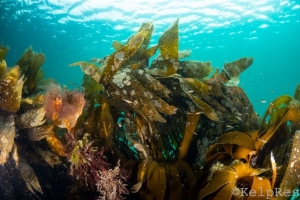
Cross section of a kelp forest canopy highlighting the different species found (furbelows, cuvie, and stipe epiphyte dulse) and the abundance of juvenile gadoids and two-spot gobies within the canopy. Photo taken in summer 2019 at An Cheathrú Rua, Co. Galway. ( Photo K Chan)
Natural marine forests are home to multiple commercial fisheries including juvenile and adult gadoids (Figure 3), crustaceans, and can occasionally include charismatic species like the basking shark (Cetorhinus maximus) and bobtail squid (Sepiola atlantica).
Monitoring programme
A short-term kelp forest monitoring programme in west Ireland captured the diversity of kelp forests in comparison to other nearshore habitats (maerl beds, serpulid worms, reefs, tidal loughs, and sediment bottoms bays).
This work discovered that kelp have the greatest number of species using the habitat (over 310 species throughout the year). Kelp forest diversity parallels that of serpulid worm reefs (Serpula vermicularis), which are of high conservation interest in Ireland and the UK.
Further, larval and juvenile stages of invertebrates settle inside kelp forests in abundance, thus suggesting an important rookery for a range of fish species, which has also been noted in Norwegian habitats (Figure 3).
Kelp forests are also important for other seaweed species that inhabit the sub-canopy or the stipe (like the trunk of a tree) of the kelp itself (see dulse, Palmaria palmata, in Figure 3).
The monitoring programme also highlighted the productivity within these communities, which can reach over 11 kg of kelp biomass (fresh weight) m-2 of forest in late summer and at shallow depths (~2 m). Much of this biomass is lost in storm and high wave action in winter (creating wrack; Figure 4), where biomass can reach only 0.2 kg m-2 of forest, especially at deeper depths (~ 10 m).
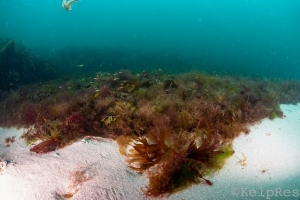
Broken or dislodged seaweed (wrack) lies on the seafloor next to the edge of a kelp forest in An Cheathrú Rua. This habitat often hosts many invertebrate and fish species like the two-spot gobies pictured, and wrack is composed of seaweeds from intertidal habitats as well as kelp forests. From autumn to winter kelp contribute ~ 70% of the biomass in wrack communities, likely due to high storm activity and natural annual patterns in kelp life cycle. (Photo K Chan)
Reproduction
Kelp have what are called a heteromorphic, haplo-diplontic, life history cycle which simply means reproduction happens in two ways. This life history strategy is incredibly important and is responsible for regenerating kelp forest habitats over multiple years, and generations.
Laminaria hyperborea can grow to a great age; individuals in Norway have been found up to 18-years-old, while in Ireland the oldest individual found was 15-years-old. This species becomes reproductive from autumn to winter, beginning in November this year in the west of Ireland. Juvenile kelp began appearing in abundance from late winter to spring, replacing individuals that have been lost in the storms that can wreak havoc on these habitats.
Interestingly, our surveys noted that juvenile kelps appear year-round, which indicates there may be some analogue to terrestrial seed banks found in marine communities, what we call ‘spore banks’.
From spring onward, a new blade begins to grow on L. hyperborea, forming a waist-like pinch between last year’s blade and new growth. The old blade on individuals are shed by late May, perhaps explaining another common name for the species, May Weed.
Because kelp are of interest to industry, it is very important to understand all aspects of wild populations including which species rely on them for food (kelp are linked to food chains from the strand line on beaches to the deep sea).
We need to understand kelp population regeneration throughout the year, along with natural production rates and phenology of target species, and the genetic resources or makeup of these communities.
Like other ‘crops’, populations of kelp harbour varying genetic diversity; in Australia this became apparent when very few strains of kelp were resilient to heat waves, and most populations died off.
Ireland’s L. hyperborea populations may have similar genetic patterns and thus have far reaching applications in conservation, aquaculture, and restoration of future communities. With warming oceans and the arrival of non-native species, our basic understanding of Irish kelp forest ecosystems needs to expand in order to respond to change.
Investigate and monitor
The KelpRes team at NUI Galway continues to investigate and monitor kelp forests in Ireland, and to better understand their historical distribution so we can look for changes in the distribution of these habitats along the coastline.
We are also investigating genetic diversity within and among L. hyperborea populations from Wexford round to N. Ireland. Preliminary findings indicate the southwest coastline, (Co. Cork) harbours the most diverse L. hyperborea which was previously predicted through species distribution models.
We are testing the presence and viability of ‘spore banks’ within these kelp forests, and monitoring reproduction of the sporophytes in Co. Galway and Kerry throughout the year to capture patterns in these benthic communities.
Our work aims to create a remote sensing tool for monitoring these habitats, using satellite networks from NASA and ESA. We continue to gather data on kelp forest distribution by encouraging recreational swimmers, kayakers, and divers to contribute to this effort through an online survey form.
Our collaboration with recreational divers and Seasearch Ireland has facilitated our subtidal research programme and enabled discoveries such as the presence of L. ochroleuca (the warm water, European kelp) in Bellmullet, Co Mayo, which was the first record of this species in Ireland.
This research also contributes to the Joint Programming Initiative for WATER, Thematic Annual Programming action (JPI-WATER TAP) which is a network of national projects in the EU, focusing on research and development to promote education and research on the ecosystem services provided by aquatic systems in the EU (AQUATAP-ES).
The future of L. hyperborea in Ireland could be threatened if we continue our ‘business as usual’ emissions trajectory; warmer waters and greater storms are detrimental to reproduction and persistence of this species in subtidal habitats.
Kelp however could be an ally in climate change because it has the potential to capture large amounts of carbon from the atmosphere that is then stored in marine sediments or transferred to the marine food webs.
Regardless, it is essential to understand the current condition of these forests to facilitate monitoring, conservation, and potential restoration of these critical habitats.
Dr Kathryn Schoenrock, NUI Galway

