Leenane by the sea
Dr Martin O’Farrell
Leenane and Killary Harbour – is there anywhere more beautiful in the world? I worked there during the 1980s on the River Erriff Research Programme, which focused on salmon and sea trout fisheries management.
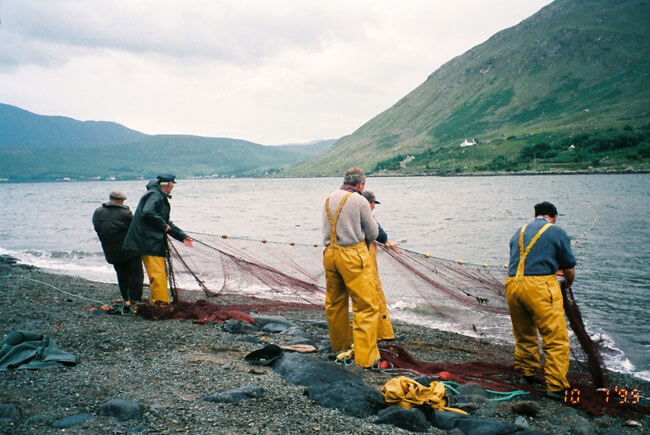
Thomas (sailor) Flaherty (second left) and crew hauling their draft-net on the Point, Killary Harbour
One of the elements of the programme involved monitoring the draft-net fishermen who operated from the north shore of Killary Harbour between the mouths of the Erriff and Bundorragha rivers. I usually left Aasleagh in the early afternoon – fortified by vittals from the Aasleagh kitchen. These usually included a couple of delicious scones baked by the late Bridgie Keane – which were intended for angling guests!
The draft-net fishing crews on the north shore of the Killary were a summer tourist attraction. Local men would spend ten months of the year tending sheep and the months of June and July chasing after salmon. On winter nights after hours of playing nines in Hamilton’s or the Rock, John Boyle, Martin Butler and myself often returned to Aasleagh with half a wether – thanks to those men who looked after sheep on the hillside commonages.
Indicators
Parked cars and bicycles indicated the presence of a draft-net crew. My arrival would be acknowledged but would not interfere with the fishing operation. Crew members would be positioned at varying distances from the water; each member had his own section of sea to scan for moving fish.
If there was seaweed in the currach I knew a catch had been made. I would enquire about the other stations: “They had a few hauls back at the Point” I might be told. After about 10 minutes of pleasantries I would ask to examine the catch and receive permission with the warning that I better shift out of the currach fairly smartly if they needed to make a haul.
With my measuring board, spring balance, knife, scale envelopes and pencil I would get to work. After examining each fish, I would make a distinctive clip in the caudal fin. I did not want to examine the same fish later on during the same day!
While I worked in the currach I was always alert for shouts of “in-over” or “out-back” – which indicated that a member of the crew had spotted swimming or jumping fish. When the shout came, I was out of the currach as the crew members shifted at alarming speed down the Killary slopes − two or three of them boarding the currach while the remaining crew member held the rope at one end of the net.
The currach would speed out to the rhythm of oars on gunnels as the net was paid out by the man in the stern. When the other end of the net was returned to the shore, one of the crew usually stayed in the currach, patrolling just outside the ringed net and slapping the water surface with an oar in an attempt to discourage any captured fish from leaping out over the net.
Across the waves
On a still day, the sound of an oar slapping water could be heard for miles around. After the haul was made, there might be a handful of salmon or a lump of sea trout or nothing at all. Either way, the net had to be gathered up and put on the stern of the currach in readiness for the next haul.
For the remainder of the day and often well into the evening I would visit and often re-visit each crew at their stations – Frogs, The Point, Gobeen. I might be asked: “How are they getting on back at the Point?” I would never give accurate statistics but would say they had a good few salmon as the man asking the question had seen them hauling and he would have a fair idea of how the hauls had gone.
I got to know and like many of the draft-net fishermen of Killary Harbour. The late Paddy Coyne from Glennagevlagh was always welcoming. He once made me a willow basket and his nickname echoed his talents for mending nets and weaving baskets.
The late Thomas (Sailor) Flaherty from Renvyle was profiled in a recent issue of National Geographic. He fished until he was eighty years of age and passed away a few months before the article was published.
The late Jackie Keane from Rossroe travelled with his currach and crew to Ardnacrusha power station on the River Shannon during the early 1990s. The objective was to collect ‘ranched’ adult salmon, which had passed their homing point – Parteen Hatchery − from the headrace canal. It was not the first time that Connemara men had worked on the headrace canal either – they had played their part in the construction of the scheme during the 1920s.
Regrets
It was a privilege to live and work among the people of Leenane. Unfortunately, living in Dublin now, I have lost contact over the years. I regret that I never took the opportunity to thank people for their kindness while I lived among them.
Bridgie Keane and her husband Mickey were like foster parents to me, and I would never have survived the winter/spring of 1983/1984, living alone in Aasleagh Lodge with only the ‘cookaire ban’ for company, without them. I was working in Scotland when Bridgie passed away in June 2005. I was unable to attend her funeral and I can’t make up for that.
The late Mickey Keane – who was both ghillie and gardener at Aasleagh Lodge until his retirement in 1985 – once showed me a photo from the 1960s of a draft-net crew beside their currach on the Killary.
“That was a grand salmon,” Mickey observed.
I took a closer look at the photo. “Mickey,” I said, “Where’s the salmon?” “Murt, aren’t we eating him,” he said mischievously…
During my work monitoring draft-net catches I often enjoyed – in the company of the Killary draft-net fishermen – fresh Atlantic salmon poached in seawater. Is there anything to beat that?