Lifeline for Ireland’s inshore fishermen
Following previous failed attempts at implementing a management framework for Ireland’s inshore fisheries, marine minister Simon Coveney has launched a dedicated platform and suite of measures for this sector which comprises over 80% of Ireland’s fishing fleet.
The development package consists of three parts: establishment of a National Inshore Fisheries Forum (NIFF); a funding package of €1m in 2014 and conservation measures to support lobster and shrimp stocks.
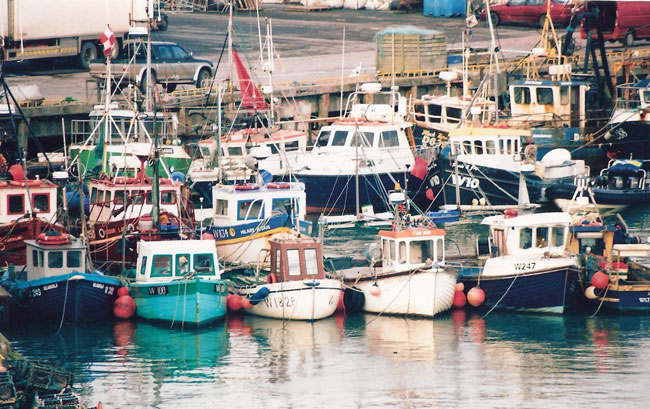
Inshore boats tied up at Dunmore East. Over 80% of Ireland’s fishing fleet comprises vessels of less than 12m. Photo Gillian Mills
“Ireland’s inshore fishermen are poorly represented by current structures and need a dedicated platform where they can discuss and develop common initiatives,” remarked Minister Coveney.
The NIFF will enable inshore fishermen using small fishing boats (less than 12m overall length) to participate in fisheries management within six nautical miles of the coast. A network of Regional Inshore Forums (RIFs) based on and linked to the FLAGs (coastal wide, community-leg Fisheries Local Action Groups) will nominate delegates to bring forward regional proposals for national discussion.
The €1m funding programme is aimed at providing financial assistance for ‘sustainable, environmentally friendly fishing practices and the recent safety equipment and training initiative,’ according to the Department of Agriculture, Food and the Marine. Support will be available under the new Sustainable Inshore Fisheries Scheme for measures including:
- an enhanced v-notching programme with greater coverage around the coast (grant aid increased to 75%)
- gear and equipment to support responsible fishing practices (e.g. mackerel jigging, crayfish potting)
- improvements in quality, hygiene and on-board standards
Additional measures
A supplementary Shellfish Pot Replacement Scheme will provide extended assistance to fishermen who lost pots during the 2013/14 winter storms. The pot limit is being increased from 50 to 200 pots for boats less than 12m length and from 100 to 250 for boats 12-15m in length.
(Existing applicants to the current scheme will automatically be increased, and a call for new applications will be advertised.)
Revised conservation measures for lobster and shrimp will see a maximum landing size for lobster of 127mm introduced through legislation shortly. During the first two years of the initiative, fishermen will be paid up to 75% of the market price for v-notching ‘oversize’ lobsters and returning them live to sea. Grant aid for voluntary lobster v-notching is being increased from 55% to 75% A revised closing date for the shrimp fishery of March 15 (replacing May 1) will commence from 2015 to provide stock protection during the spawning period.
“I am asking the Regional Inshore Forums as a first initiative, to identify lobster stock enhancement areas within their regions where hatchery-grown juveniles could be released. Lobsters are one of the most important species to the inshore sector, and we need to dedicate resources to ensure the long-term future of this valuable stock,” Minster Coveney added.
BIM’s fisheries development director Michael Keatinge said that with this initiative, Minister Coveney was trying to ensure a structured format in which the voice of the coast could be brought to bear on policy decisions.
“And while recognising the existing representative organisations and the wonderful role that they currently play, it remains a fact that the vast majority of the 2,000 inshore fishing vessels fall, to some extent, outside. I believe it’s the broader voice that must be included because fishing communities are more than simply fishermen,” he said.
While BIM staff will be required in the initial stages as ‘facilitators’, Keatinge sees the agency’s role as very much in the background.
“I would like to think in a short space of time a chairperson will emerge who will take leadership at local level. It would be a failure, to my mind, if the State or if State agencies have to remain at the centre because really all we’d have done is in a sense localised central management.”
Industry reaction
Francis O’Donnell, CEO of the Irish Fish Producers’ Organisation said the initiative must be considered as a “positive move” and a new platform they have been seeking for some time. But he cautioned that representatives from the FLAGs who are appointed to the NIFF must have an inshore fisheries background or expertise in this area.
“Inshore fisheries management is in a complete mess in Ireland. In my opinion if any one of the FLAGs is lacking this expertise, they need to seek the correct personnel to ensure that the NIFF has every chance of succeeding.
“This new forum needs to address lack of policy and regulation and start with fisheries management plans to ensure long-term biological and economic sustainability in coastal communities across Ireland. BIM and the Marine Institute can provide the technical and scientific expertise to compliment what stakeholders want and more importantly what stakeholders need,” he said.
Caitliín Uí Aodha, Irish South & East Fish Producers Organisation, has welcomed the initiative saying their hope is to see it work successfully through “intelligent decisions acted upon quickly, thus ensuring the future growth and development of this sector.”
Pleased with the announcement that the replacement pot limit is being increased from 50 to 200, she expressed concern however that affected fishermen will initially be required to source private funds to replace their gear before being reimbursed.
“This could cost small vessel owners anything up to €12, 000,” she warned. “The inshore sector is governed by Irish legislation and it is therefore our responsibility to ensure its efficient management. Perhaps the NIFF will give the sector an opportunity to bring forward, develop and act upon their ideas, creating a well-managed, well developed and viable sector,” she said.