
Multi-billion Euro offshore wind energy potential in Irish waters

Ireland’s offshore wind energy could create 2,500 jobs over the next ten years and attract in excess of €42bn in lifetime investment. But the wind farms will not be built in Ireland unless strategic investment decisions are made now.
These findings are included in a report, Harnessing our Potential, published by the Carbon Trust for Irish Wind Energy Association. The report is based on ‘impartial analysis’ of primary and secondary sources, and stakeholder consultation.
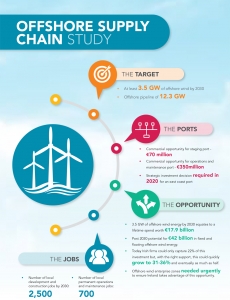
Offshore supply chain study
Offshore wind farms will provide ‘enormous amounts of clean energy’ to power homes, farms and businesses and is at the heart of government’s Climate Action Plan to cut CO2 emissions in the electricity sector by two-thirds and to increase the renewable energy share demand to 70 per cent by 2030.
Ireland currently produces around 35 per cent of annual electricity needs from renewable sources.
‘With the necessary level of interconnection there is no reason why Ireland’s offshore wind industry cannot provide increasing amounts of power to its neighbours, turning Ireland into a consistent net energy export for the first time.’
But is Ireland about to miss another major natural resource opportunity?
To deliver just the 3.5GW of offshore wind energy required under the Climate Acton Plan, an initial investment of almost €9bn will be required, the authors contend.
‘Unless investment is provided – either from the Government or private sector – not a single Irish port will be capable of servicing the requirements to install an offshore wind farm, and developers will be forced to look to ports such as Belfast or those on the British coast for assistance.’
At best, they believe, Irish firms would only be able to attract 22 per cent of the lifetime multi-billion euro investment. They foresee ‘substantial skills shortage’ in Ireland’s labour force in engineering, financial services, logistics and technical expertise.
‘Ireland has neither the infrastructure nor the resource capacity to capture the benefits of the coming energy revolution and this creates a question mark over Ireland’s ability to develop the 3.5GW it needs by 2030 to deliver on the Climate Action Plan.’
Current forecasts estimate that by 2030, ‘Europe could increase its offshore wind installation capacity to 99GW with the UK alone aiming to install 30GW.’
And global markets are also aiming to grow significantly (China, USA, Japan, Taiwan) contributing towards an estimated global installed capacity of 120GW by 2030, the report notes.
Echoing the concerns raised, Dr David Connolly, chief executive of the Irish Wind Energy Association, said Ireland should “seize the opportunity to bring together industry, policymakers and coastal communities to identify a suitable port on Ireland’s east coast and to make it a base for Ireland’s newest industry”.
While the report identifies many difficulties, it offers solutions and ideas, and identifies the tools with which to build the necessary infrastructure.
Key recommendations
- Strategic investment driven by government or the private sector must be directed into one or more Irish ports to take advantage of the commercial opportunity of delivering 3.5GW of offshore wind by 2030
(The report analysis the suitability of 16 ports that could provide operations and maintenance services.)
- Government must bring together industry, ports and local communities to develop offshore wind enterprise zones. These should be located around suitable ports and must serve as hubs to attract international investment and create links to Irish businesses and suppliers
- Enterprise Ireland should be supported to continue its work to develop offshore wind clusters for Irish companies. This would enable businesses to develop their resources and capacity to a point where they can not only support domestic development but also compete effectively in the European and global markets.
- Ireland must address the skills shortage faced by maximising local employment opportunities. Government must coordinate the work of schools and universities, existing training bodies and skills development programmes, to identify the most cost-effective ways to eliminate the skills gap. Central to this must be the development of specialist marine apprenticeship schemes and working with academic institutions to develop a skills development plan for offshore wind.
If Irish ports and businesses cannot take advantage of this opportunity, ‘there is no doubt others will step in and the money invested will flow out of Ireland,’ authors warn.