
Blueprint for offshore wind to green Ireland’s energy supply

The EirWind project conducted over two years by team of researchers at MaREI, offers the first comprehensive blueprint for offshore wind in Ireland.
The report notes that Ireland, despite having one of the best offshore wind resources in the world, has been a slow entrant to the sector.
Nevertheless, and better late than never, the report is optimistic and says ‘things are now progressing rapidly’ and that Ireland is very much on track to be totally self-sufficient in green energy – even becoming an energy exporter – by 2050!
Ocean Focus spoke to Dr Valerie Cummins, a Principal Investigator on the EirWind project, about how Ireland’s pathway from being a renewable energy laggard to a significant energy exporter, might progress over the next thirty years.
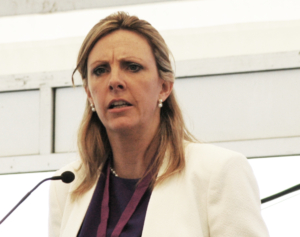
In conversation
Launching the EirWind report, why did you say that despite having one of the best offshore wind resources in the world, Ireland was coming late to this sector?
Firstly, Ireland has been playing catch-up, we’ve been responding to the European Commission in terms of developing national targets for renewable energy.
In relation to environmental issues, we’ve responded to the leadership shown by the European Commission but weren’t necessarily taking leadership in relation to the opportunities for offshore wind.
Secondly, in Ireland the marine has been the poor relation for quite a while, and we’ve taken a long time to sort out planning issues for the marine environment.
However, publication in July 2012 of Harnessing Our Ocean Wealth: an Integrated Marine Plan for Ireland, was not only an important milestone it was a wake-up call to recognise Ireland’s potential and the vast marine resource that we have.
There were also major blockages: not having a clear, up-to-date and modern consent system, for example. We have been stuck with the foreshore legislation which meant developers couldn’t invest in Ireland with any degree of confidence because the policy signals and the processes just weren’t there.
But now we have a situation where Ireland is ambitious and is not just responding to Europe, we’re really ironing out all the wrinkles in terms of marine planning, and offshore wind is now attracting investment.
What are the issues around consent?
Consent for any kind of development is currently restricted to just our territorial sea. You can apply to the relevant department for a foreshore lease to access the seabed, or for a foreshore licence to install an offshore wind turbine, but because the legislation is so out of date, you can only do that to within 12 nautical miles.
That meant there was a concentration of effort and interests around the Irish Sea for bottom-fixed offshore wind. In the last couple of years however, floating wind has come into the mix as an emerging marine technology that has been proven and demonstrated in different parts of the world such as Portugal and Scotland in Europe.
Floating wind needs deeper water so you might want to go out beyond 60 meters to maybe 120 meters, or even much deeper. There are projects being proposed in Asia for water depths of 1,000 meters. That pushes you much further offshore, and beyond the 12 nm territorial sea boundary.
This is what is changing now in terms of the legislation that is pending regarding the Marine Planning and Development Management Bill, which basically overrides everything that went before in terms of consent. But really, what’s important is it extends the area for permitting beyond 12nm out to 200 nm.
You referred to major changes at government policy level especially in terms of Ireland’s Climate Action Plan 2019. How is that impacting on the pace of progress?
Climate Action Plan 2019 has been absolutely pivotal. When it was published, Ireland had for the first time a target for offshore wind of 3.5 GW. It also set clear targets across a range of measures regarding where Ireland needed to be going.
These were really important signals to industry ― that government was now thinking seriously about offshore wind and wanted to see it progress and develop. The Plan has also been hugely important as an instrument for setting absolute clear targets as to where Ireland needs to be going.
The new Programme For a Partnership Government has expanded that target from 3.5 to 5 GW by 2030 for the Irish Sea and the south coast, and indicates an ambition for 30 GW off the west coast.
Climate Action 2019 has also inspired confidence and has signaled that Ireland is ‘open for business’ in terms of renewable energy. But it was really just the first step; the Programme for Government is going to be even more ambitious. It will continue to use the Climate Action Plan as an important vehicle to be updated on a yearly basis.
It’s an opportunity for new targets to be set and for policymakers to get a better handle on all of the pieces of the equation that need to be brought together to develop this sector in a sustainable way and with the community on board.
EirWind points to ‘route to market’ as being critical. What is meant by that?
Route to market is absolutely critical, and the EirWind Project has a dedicated work package.
The fundamental challenge is the fact that Ireland is a small island nation with a relatively small population and a relatively limited demand for electricity, but with a massive offshore wind resource.
We have the potential to produce a lot more energy than we can consume. The trends modelled by EirGrid indicate there will be increasing demand for electricity, in particular over the decade ahead, and a lot of that demand is going to be driven by data centers, which will be critical in an Irish economic context.
But beyond that, where does the energy go? Once we’ve reached saturation point where can we export surplus energy to and how?
The existing infrastructure is via the four inter-connectors that connect Ireland to the UK and France, and there needs to be a discussion around investment in more inter-connectors.
But it’s not about converting all of our wind energy to electricity; there is another opportunity which essentially uses electricity to split water through the process of electrolysis to produce hydrogen.
Hydrogen can be used for transport; it can be used as an alternative to methane for heating and it can be used for maritime transport. But the industries that currently use hydrogen like petrochemicals and refining industries use either ‘grey’ or ‘blue’ hydrogen.
‘Green’ hydrogen contains no carbon; in other words, you use the offshore wind to produce the electricity to do the electrolysis to produce the hydrogen.
We have been excited about the hydrogen idea from the start of the EirWind Project. Incidentally, Dr Eamon McKeogh (UCC) who had an article in the Irish Times in 2000 about hydrogen as an important vector for energy, has been hugely influential in the whole EirWind project. Now, fast forward twenty years, and the EU Strategy on Hydrogen has just been published.
So, I think things are aligning in a really exciting way with regards to thinking about hydrogen production from offshore wind in an Irish context, being a whole new market and economic opportunity.
You have said that government resources will need to be doubled within the next two years to cope with the extra workload for the Irish Sea projects. Is that a realistic time span to be working towards?
That’s a good point. What’s really interesting about that study is that it was one of EirWind’s smallest, but for me, one of the most significant and important reports. EirWind looked at how adequately resourced were Ireland’s key departments and agencies.
We can have all the energy resource in the world, we can figure out the engineering, we can figure out the route to market, but fundamentally, nothing is going to move or shift unless we have the resources in government to help evolve the policy and the decision-making that’s required to cover the whole spectrum.
We’re going to need twenty-five to thirty new personnel in key government departments and agencies in the next 18 to 24 months – just to move on the relevant projects for the Irish Sea.
An Bord Pleannála, doesn’t have any in-house marine expertise, and there is a real need to increase the number of inspectors to deal with the strategic infrastructure applications that will be coming from the Irish Sea projects.
There’s also a shortage of personnel in key agencies such as the SEAI (Sustainable Energy Authority of Ireland). But we understand that the Marine Institute is about to appoint eight marine and computer scientists to help with the work that’s going on at a national level around marine planning. That’s absolutely fantastic and another signal that things are going in the right direction.
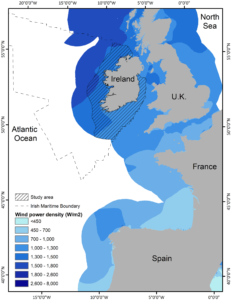
Modelled wind resource relative energy density data source global wind atlas 2019
Is that very specialist skillset available in Ireland?
We say Ireland has been slow to the party, but the advantage of moving now is we can potentially reap the benefit of what has been learnt by many other countries.
And in order to be able to do that it makes sense to ensure we have the right strategic connections with the UK or Norway, or wherever else it might be, to make sure there’s an opportunity for knowledge transfer.
Whether that’s about recruiting personnel into government departments and agencies from the UK or elsewhere, or having people seconded or simply just having processes and mechanisms to make sure there’s engagement so that knowledge can flow. There are many different ways that it could happen. But it needs to be done.
So, the short answer to your question is we will probably need to import expertise as well as relying on what can be developed at home.
What have you sensed so far regarding the public’s perception of these plans? It will be important to win and maintain their support for wind energy projects of such scale and visibility.
EirWind conducted the first national survey of public perception of offshore wind about 12 months ago and found that 87% of the general public were in favour and would support the idea of offshore wind.
When you drill down into the reasons why, most people do see the positive link between offshore wind energy and climate change.
People are very much on message in terms of understanding that climate change is the crisis that needs to be dealt with now.
People also understand the opportunities that may emerge regarding employment, and the results also showed that the public understands the connection with energy security.
In terms of the data that came back, climate change jumps to the top of the page, indicating there is a strong awareness and appreciation of the fact we need to take action to deal with its issues.
People may be sensitive to issues around visual impact if the turbines are going to be built very close to shore. But that can be mitigated by having buffers and a certain distance from shore.
Floating technology naturally lends itself to deeper waters and so more likely will be over the horizon and ‘out of sight’. But again, what’s really important is helping the public to understand the different options that are available.
We know that a wind turbine or a wind farm being developed in the Irish Sea may have different implications and a different public reaction to a development off the south or the west coast for example.
And that can be linked to the difference between having to be close to shore for certain types of conditions: bottom-fixed versus floating further offshore.
So, at the end of the day, it’s about informed decisions, it’s about informing perception, and I think, goes back to the government’s White Paper on energy.
Port capacity will be crucial, where will the investment come from?
It’s important to identify that different ports can serve different purposes. There are very large ports such as Green Port Hull in the UK where the turbine blades are manufactured and where Siemens Gamesa opened a factory that delivered 2,000 jobs.
But not every port is going to get a manufacturing facility. It all depends on the scale of what’s being planned in terms of offshore development and the companies coming in and thinking about a strategic opportunity linked to that supply chain.
If you’re thinking about a manufacturing opportunity for Ireland, you might think about Shannon Foynes and the opening up of the Atlantic coast, which is extremely strategic regarding the potential for a western economic development corridor.
But first you have to demonstrate there’s an opportunity for technology to survive and to be techno-economically viable in the kinds of conditions that you get off the west coast of Ireland.
We might not see a scenario like that unfold at any meaningful scale until after 2030. Nevertheless, we need to start planning for it now, and it’s really encouraging to see Shannon Foynes Port Company doing exactly that.
In the context of EirWind recommendations, we flagged Shannon Foynes Port and the potential for a manufacturing hub, in time.
There is also the need for a port for installation and assembly such as Rosslare to have very special characteristics such as water depth, length of the quay, cranage etc. All of these parameters are really important for offshore wind and usually, they require significant investment.
Firstly, manufacturing is the golden ticket; secondly, installation and assembly possible in Rosslare, Cork, Shannon Foynes and Killybegs.
The third tier is operations and maintenance – O&M. And almost any port or harbour around the country has an opportunity to play a part as a port for O&M with regards to offshore wind.
You said that the foreshore legislation will be dealt with by the end of 2021. Do you expect that deadline will be met?
That was an assumption we made on the basis of discussions we had with policymakers, and I’m glad you brought it up, because the Programme for Government has been published, and there’s a commitment to that now. One of the commitments is to have the Marine Planning and Development Management Bill enacted within the next 9 months.

