‘Out of date, marine licensing apparatus’ behind poor progress in marine sector
& Gillian Mills
A major conference in March organised by IMERC (the Irish Maritime and Energy Resource Cluster) focused on maritime security and shipping, logistics and transport. Addressing delegates, Val Cummins, IMERC director said it was important to take a holistic view of maritime economics in Ireland and commended the marine minister, Simon Coveney TD, for the ‘much needed’ Integrated Marine Plan for Ireland.
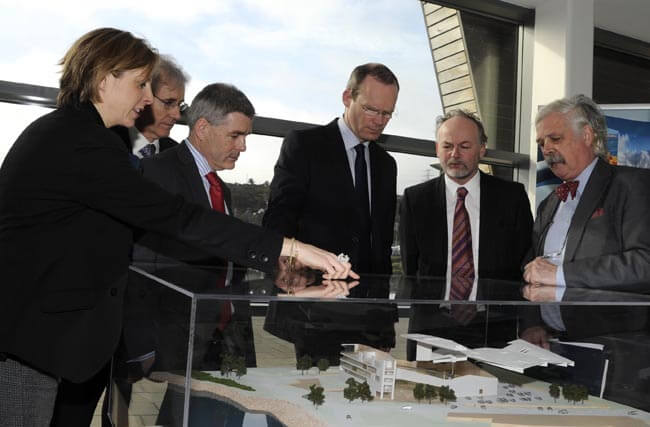
Dr Valerie Cummins; Dr Brendan Murphy; Mark Poland; Minister Simon Coveney; Niall McAuliffe and Prof Tony Lewis
“Up until now, we have lacked political leadership and vision for maritime Ireland. It is great to have a Minister at the helm committed to the development of ambitious, long-term growth plans”, she stated.
Cumbersome and disjointed
Addressing deletes, Minister Coveney warned that Ireland could not afford to “rest on its laurels” if it’s to become a world leader in the production of offshore energy generation, and blamed an “out-of-date, cumbersome and disjointed maritime licensing apparatus” for holding back progress up to now.
“It will be such a missed opportunity if Ireland doesn’t develop as the world leader in relation to offshore energy generation. We’re already threatened in that regard because of our tardiness in relation to foreshore licensing, and for not getting cables in place to link up to offshore testing facilities,” he declared.
Minister Coveney added however that despite these past difficulties, there was good reason for optimism, one being the development of the National Maritime College of Ireland.
“The emergence of the NMCI is definitely something that will see us to the forefront of the international race for dominance in areas such as renewable ocean energy,” he said.
Adding that despite its fairly quiet emergence – both regionally and even within Cork itself – he predicted the College’s time “has come at last as a place that is going to grow into a real campus for research and commercial activity, driving the maritime and marine agenda in Ireland in a hugely ambitious way.
Intellectual capital
Predicting that the NMCI campus would soon have test tanks in place of a scale and depth that will be the envy of marine researchers in countries with a lot more resources than Ireland, “the intellectual capital developing at the NMCI is a huge attraction,” he said.
He added that the unique relationship developing between the college and the Irish Naval Service was crucial, and also praised the drive towards involving the private sector.
“It’s refreshing to see a real willingness to work with the private sector, with universities and the CIT and hopefully now with commercial interests involved in the tidal or off-shore wind energy projects. There’s something special happening here,” he declared.
Minister Coveney also revealed that between now and May 15, the European Commission wants the five key countries on the Atlantic coast of the EU to provide ideas and projects that they want to see developed around the so-called ‘Blue Economy’.
“From Ireland’s point of view, that will be everything from Our Ocean Wealth document to broader issues such as monitoring the Atlantic in relation to global climate change trends; monitoring wave size, consistency and energy potential in different parts of the Atlantic,” he said.
The Minister noted the level of funding available in terms of EU Structural Funds, which could be allocated to the Blue Economy.
“I see a major opportunity here for Ireland to be the strategic leader at a European level in terms of the future Atlantic Strategy of the European Union,” he said.
IMERC response to the Our Ocean Wealth public consultation
While it is useful to pose the question concerning a sufficiently ambitious yet realistic target for our ocean economy by 2020, non-expert guestimates provided as part of this consultation process need to be regarded with extreme caution.
A systematic macro-economic expert-led approach must be used to define the targets, which should also help to identify priority areas for public and private investment. The communication of these types of targets will be necessary to indicate that Ireland is open for business in the maritime space and to project the right message concerning trajectories of growth to potential investors.
Setting an ambitious yet realistic target for 2020 will be important for focusing the national effort in the short-term on the development of the ocean economy of Ireland. However, given the severe public finance difficulties likely to prevail for the rest of this decade, it may be necessary to set additional targets for 2025 and 2030.
The economic outlook indicates that overcoming the current weakness in domestic demand will be a slow process. Positive trends show a strong export performance, coupled with improvements in cost competitiveness. However, other factors must align, including restructuring of the public finances, a return to the market, and an up-turn in the global economic outlook.
The development of a knowledge-based, high value-added ocean sector will be influenced by all of the above. The Ocean Wealth Process must deliver quick wins linked to short term, rapid growth of high potential areas, such as the job creation targets linked to the development of the offshore aquaculture sector, yielding up to 4,000 new jobs by 2020.
It must also take a longer term perspective on the evolution of established sectors such as the shipping and maritime transport sector, as well as the maturing of emerging sectors, such as marine renewable energy. Ocean Energy alone could yield 17,000-52,000 jobs for Ireland by 2030 (SQW, 2010).
It will be important to develop a fully comprehensive suite of progress indicators that can be used internally to gauge if Ireland is on track for evolving as a maritime economic state. Traditional economic indicators, such as GDP, need to be applied together with coastal sustainability indicators that can demonstrate the value added dimension of doing business in maritime Ireland i.e. efficient decision support systems, political stability, appropriate planning frameworks in place etc.
Reference should be made to the vast volume of literature on the subject of coastal progress indicators, including the work done on the European Working Group on Indicators and Data for DG Environment in this regard.
The private sector is the critical enabler to achieving growth potential in the maritime area. The role of this sector is largely neglected in the Ocean Wealth documentation. Even though the term ‘governance’ is referred to on numerous occasions, the governmental aspect of governance are discussed, with little or no reference to the roles of markets or civil society in shaping the way plans and decisions are made. Good governance provides the focus for government, the seedbed for business, and the supports for civil society, necessary to develop the Irish maritime economy. All three should be considered equally.
The role of the private sector must be considered in the development of the Ocean Wealth vision in a more integrated way. The role of industry is multifaceted, from identifying market opportunities, to attracting investment, developing niches, creating jobs, promoting Ireland overseas, supporting communities, and influencing government.
The contribution from the private sector can be looked at from the perspective of multiple scales. For example Multinational Corporations setting up shop in Ireland have a well-established record of delivering transformative impacts in regional and national economies in sectors such as pharmaceuticals, ICT and medical technology.
A concerted effort needs to be put in place by the IDA and associated partners to develop a cluster of MNC activity in the maritime sector. Initiatives such as IMERC are poised to attract MNC investment on the back of the infrastructure and ecosystem of innovation on offer. Initial success in this area could be a game changer for growing GDP targets by 2020.
The indigenous sector equally has significant potential to influence, not least in the creation IP that can be marketed and sold both locally and globally. Levels of innovation in the indigenous maritime sectors of both Norway and Finland have helped to position those countries as world leaders in niches within shipbuilding and offshore hydrocarbons respectively.
The same position should be emulated in Ireland, where a better balance needs to be achieved between dependence on foreign direct investment, and levels of exposure to the global markets. Attention needs to be applied to a process of identifying niche markets where Ireland can position itself to accrue long term benefits. Industry has to work closely with government to steer this market identification process, so that limited opportunities for government investment can be targeted for the maximum impact possible.
Industry speakers at the IMERC Conference (Geostrategic Thinking for Maritime Ireland, March 9th 2012) identified market trends in Shipping, Logistics and Transport, as well as priority areas for further indigenous development. These included ship finance, ship owning, and project logistics.
The recent structuring of Science Foundation Ireland (SFI) presents an opportunity for greater engagement by industry in developing research capacity focused on new areas of opportunity. Industry has an important responsibility in this regard, not only in setting research topics, but in providing research match funding to enable the development of new innovations to be accelerated. Well-developed approaches to industry participation in research and development need to be rolled out across multiple programmes including EPA, MI and PRTLI funded marine initiatives.
Industry associations such as the Federation of Irish Fishermen and the Marine Renewables Industry Association also have important roles to play. The role and potential of these industry associations should be considered in the formulation of the Integrated Marine Plan for Ireland.
More than anything else, the government will have to signal to private investors that it is willing to prioritise support for job creation in the marine sector, by putting enabling infrastructure in place, from coastal access (piers, slips, jetties), to the marine grid. An economic valuation of the levels of public investment required across multiple marine sectors from now to 2020 is currently lacking. It is proposed that this is an essential piece of work that needs to be undertaken as a national priority.
As well as direct investment for critical infrastructure, innovative approaches to economic incentivisation must be developed to order to tip the balance of trade to allow the home-base to grow. Ireland’s tonnage tax regime, combined with the low corporate tax rate, continues to enable new enterprise as well as attracting inward investment from international shipping companies.
This model shows how the public sector can fundamentally contribute to job creation and growth, by creating the right conditions for the development of private industry. Surely, similar models can be pursued for high potential marine sectors including ocean energy and financial services for shipping?