Ranched salmon – a blueprint for future management?
A proposal to allow hatchery-reared ranched salmon to be captured by draft net in the Erne Estuary, which has the potential to develop into a lucrative operation, is gaining widespread local support; however local politicians and government so far appear to lack the enthusiasm for the project.
A consultant-prepared draft management plan entitled ‘A proposal for the management of the salmon on the Erne Estuary’, which has been seen by Inshore Ireland, makes a convincing argument that Ballyshannon’s once substantial draft-net salmon fishery should be revived, but for hatchery-reared ranched fish only.
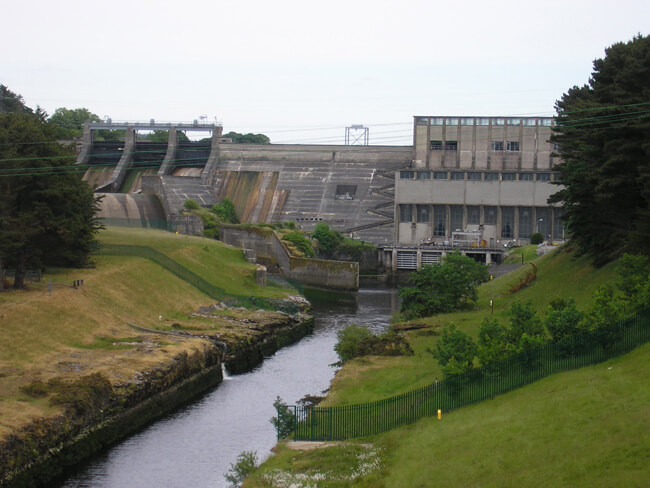
Kathleen Falls Dam with tail race and outflow pipe from hatchery. Photo Brendan Connolly
The report proposes that wild salmon and seatrout would not be targetted and that only ranched salmon released as hatchery-reared smolts to the open sea, identifiable by a clipped adipose fin, would be caught.
“We only want to be allowed to fish for hatchery-reared fin-clipped salmon,” John McIntyre, a member of the Northern Regional Fisheries Board and secretary of the Erne Estuary Draft Net Traditional Fishermen’s Association, which is behind the idea, outlined to Inshore Ireland.
“Traditionally, wild salmon return to the Erne during May, June and July. So therefore, by waiting until early August before putting our nets in the water, the chances are we will catch very, very few wild salmon,” McIntyre explains.
Stringent policing
He is anxious also to point out that if the plan goes ahead, draft fishing would be strictly policed by the Association’s members who “would adopt a pro-active approach to the management of the fishery and work closely with fishery board staff, scientists and staff from the ESB hatchery”.
And he is emphatic that any wild salmon and seatrout captured accidently in draft nets would be carefully removed and released unharmed to continue their journey up river to spawn naturally.
“We are only interested in capturing clearly identifiable fin-clipped salmon that attempt to return to the hatchery and therefore do not spawn naturally, and I want to make that clear. Unlike wild salmon, the hatchery-reared ones do not continue on to the spawning beds. Genetically they are the same as the wild variety but they do not add anything directly to the salmon population on the Erne.”
McIntyre claims that every year hatchery-reared salmon are “dying in their thousands” in the Erne because they have nowhere else to go once they arrive back in the estuary.
“They actually try to swim back up the pipe and into the tanks where they were reared in the hatchery. And those that swim on as far as Assaroe Lake between Beleek and Ballyshannon eventually fall back downriver through a most inadequate salmon pass that is a real bottle-neck. Over two consecutive nights last year, more than 2,500 of these fish died in this way.
“It’s a shocking waste; however if we were allowed to catch them there could be huge knock-on benefits for Ballyshannon – and that is the basis of our proposal.”
Revelations
The report itself makes the following stark observations:
Despite numerous requests during the 2007 season from the Erne draft fishermen to be allowed harvest the hatchery fin-clipped salmon, all were met with negative responses. This utter waste of a valuable resource is a mindless act, which benefits nobody.
It also blames the construction of Ballyshannon and Belleek hydro-electric power stations between 1946 and 1955 for ‘irreversibly damaging the spawning and nursery beds between the two stations’ and effectively sounding the death-knell for a substantial and generation’s old seasonal fishery.
The reports adds that a ‘sustainable business on our door step providing badly needed jobs, producing one of the most healthy foods available, warrants serious consideration at a time of economic uncertainty and job losses’.
Government inertia
In the meantime and despite a lukewarm response from government to date, John McIntyre is not giving up and says he will continue to lobby for the proposal. He concedes however that despite growing support from the townspeople of Ballyshannon it will require greater enthusiasm from local and national political representatives if it is to become a reality:
“For the last two years I’ve brought the idea to the notice of all politicians across the political spectrum regionally and nationally,” he says.
“The result is a lot of correspondence all indicating support for it. But at the end of the day, I feel like I’ve been sent round in circles. The minister responsible, Eamon Ryan, indicated his hands were tied, and pointed to the Standing Scientific Committee.
“They all appear to me to be very blinkered to the notion. They advise government on wild salmon alright, but as far as I can see they have not looked at the issue in any real way regarding hatchery-reared fin clipped ranched salmon.”
Agitation to continue
McIntyre concedes he is not optimistic about the chances of seeing his Association’s proposals implemented, but is quick to add they are determined to press on:
“Dealing with the politicians and scientists has been very difficult, it’s been a bit like hitting a brick wall,” he says.
”It just seems to be impossible to make any headway with them; however we won’t be giving up. I will now be taking the matter up with An Táiniste, Mary Coughlan. She supported the idea while she was Minister for Agriculture Fisheries and Food but said at the time that she had no responsibility for inland fisheries.
“She will have to take notice now however because the idea is gaining momentum and the Ballyshannon community are fully behind it.”