Seafood, science and skills showcased at 2015 maritime festival
With over 10,000 people turning out for Seafest 2015 in Cork Harbour, Ireland’s first national maritime festival is being heralded as a great success by the coordinators, the Marine Institute. The event brought together State agencies and organisations to showcase the marine and maritime sectors across key themes of ocean literacy, marine leisure, seafood and science.

Cookery demonstrations from Gerard Collier, Fishermens’ Catch and TV chefs Martin Shanahan and Rory O’Connell
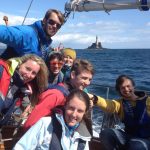
“Seafest was an enormous success in that it showcased the many fantastic benefits that the sea brings us,” remarked Dr Peter Heffernan, Marine Institute, CEO. “We experienced exceptional seafood; boating and sailing; open-water swimming; marine simulators; Irish Defence Force displays and tours; sea-life exhibits; educational videos and talks, and all sorts of marine-related activities.”
And in a purpose-built pavilion organised by BIM, TV seafood celebrities Martin Shanahan and Rory O’Connell gave day long demonstrations on how to cook prawns, lobsters, mussels and oysters.
Inshore Ireland attended the conference and talked to some of the key speakers:
JOHN EVANS, DIRECTOR OF POLICY AND RESEARCH SUPPORT SERVICES, MI
II: Outline the highlights of the second Harnessing Our Ocean Wealth conference
From the MI’s point of view, we were very keen to see publication of SEMRU’s progress report Ireland’s Ocean Economy and both reports by the Inter-Departmental Marine Coordination Group: Our Ocean Wealth Development Task Force and Enablers Task Force on Marine Spatial Planning.
I would also highlight the robust economic work presented by Dr Cathal O’Donoghue of Teagasc which demonstrates that if the goals set out in Harnessing Our Ocean Wealth are realised, there would be actual material benefit to the economy of an order which, if mentioned in any other part of the economy, people would be saying should be vigorously targeted.
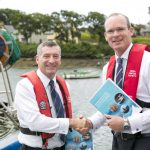
It was also great to see all the State agencies ― Marine Institute, BIM, Bord Bia, Enterprise Ireland, the IDA and Science Foundation Ireland – coming on board. And of course, having Minister Coffey there to launch the reports and to hear his comments.
II: Did this year’s conference succeed in delivering what it set out to do?
If you go back to 2012 when Harnessing Our Ocean Wealth was published by the Inter-Departmental Marine Coordination Group, you will see it contains an overall vision and three goals towards a thriving maritime economy: healthy ecosystems for a sustainable marine ecology and environment; and engaging with the sea. I believe that each of those goals came through at this year’s conference.
II: The Marine Coordination Group has a huge task. Has it been a success?
Responsibility for marine matters is spread across many government departments and State agencies. Over the last year I have heard that some people might have been somewhat dismissive and critical of the Group, viewing it as a faceless group of civil servants. That is definitely not case. They have been working in their own way and this year’s conference demonstrated the progress. The themes running through this year’s conference were very much their ideas.
II: Outline some of the progress
The Enabler’s Task Force is all about Marine Spatial Planning which is the life blood needed for making progress in the marine economy. Without MSP the building blocks cannot be assembled to create sustainable development. We were obviously very pleased to hear from Minister Coffey about the Licencing Authority into which the Marine Institute will give technical support. This will not be a question of enforcement, it’s about having the knowledge of the sector and being able to put together rational plans.
II: The conference was very well attended. Is it important to have public support for Harnessing Our Ocean Wealth?
We had a relatively short time to organise the events and I was initially worried we might not get a high attendance. But as it turned out, the numbers were around ten thousand. All the problems on the day were good problems; we could have filled twice the 500 seats available. We turned a lot of people away.
II: Did the financial community show interest?
Yes, we had two evening events: one for networking and the other to inform investors of the potential opportunities in the marine sector. The information event was organised by the IDA and the IMDO, and was a particularly good session involving about fifty attendees. It was all about creating awareness of the opportunities that exist in the marine world. The Smartocean Ireland networking event attracted technology companies and people working in the ocean energy sector. Nearly two hundred people attended – from companies who previously might not have considered getting involved in the marine sector.
*********************************
SUSAN STEELE, CHAIR, SEA-FISHERIES PROTECTION AUTHORITY
The shared visions that were outlined at the conference and within the Harnessing our Ocean Wealth report point to an Irish fishing industry that has huge potential for significant expansion into the next decade and beyond. It is widely recognised by stakeholders across the sector that the opportunities being presented to both the fishing and seafood industries come with significant responsibilities.
The marine resource is a shared resource for which many actors – large and small – compete. Good regulation is required to protect it and ensure a sustainable future for generations to come. Ireland’s fish products meanwhile are acknowledged globally as healthy and nutritious foods.
Robust confidence in an effective regulatory service plays a key role in maintaining that reputation too and ensuring consumers around the world can enjoy Irish seafood safely. As the independent statutory body charged with the State’s sea-fisheries law enforcement functions, the SFPA is committed to fair and effective regulation of sea-fishing and seafood sectors. We recognise the importance of regulating in a way that assists growth and innovation within the sector, rather than blocking it.
Operating as we do within a constantly changing environment, the challenge, from a regulatory perspective, is how to keep pace with the many developments taking place. The fishing industry is being transformed. We’re seeing continuous introduction of new fishing methods and equipment, thanks to research and the latest technology.
There have been important changes too from a regulatory perspective. At the beginning of the year, for example, the phased introduction of Landing Obligations under the new Common Fisheries Policy began with new requirements for pelagic fisheries. More changes will follow. Recently, the Naval Service estimated that approximately 85 per cent of the fish caught within Ireland’s EEZ never lands here; it goes straight out of Ireland to other ports. This represents an important and potentially lucrative opportunity for the economy of the many coastal communities that rely on the fishing industry, as well as for the Irish economy as a whole.
The SFPA would welcome and encourage increased landings at Irish ports. We operate a risk and intelligence based approach to delivering an effective and credible sea-fisheries and seafood regulatory service in conjunction with national and international control partners, including the Irish Naval Service and Air Corps.
For our part, the question is how we could facilitate the increased number of inspections that this would require to ensure fair and sustained compliance by all vessels operating in and landing at Irish ports. We need to ensure that we have the necessary resources to fulfil our responsibility as a regulator and allocate those resources prudently and effectively. The challenges that we face as a regulator are not unique to the SFPA. They are being faced by regulators across the world as countries seek to utilise their marine resources to develop a sustainable blue economy.
I recently attended a conference with regulators from across the world, where we discussed these questions. We explored ways that will ensure we can support and promote growth and innovation within the sector while delivering fair and effective regulation of our respective resources. An effective regulatory service is vital to a sustainable industry. The last thing any of us want is regulatory failure. In Ireland, we have witnessed at first hand what can happen when there is regulatory failure: the crisis of confidence; reputational damage and the economic impact that ensue. We need to move forward together with good governance to realise and sustain the bright future that promises for the Irish sea-fishing and seafood sectors.
**************************
TARA MCCARTHY, CEO (DESIGNATE) BIM
II: You emphasise that Harvest 2020 isn’t a government but is an industry plan. What’s the significance of that point?
All of its targets were set by industry. It wasn’t as if the Civil Service produced an economic report and was now making recommendations to industry. It was the industry telling Government what it felt was possible and asking for help to achieve these targets. This resulted in an industry buy-in from the very beginning which is a completely different approach to trying to sell a high-level government plan. Harvest 2020 is the ten-year plan announced in 2010, and Foodwise 2025 is the ten-year plan that’s continuing and building from that, announced recently.
II:You refer to the food industry as having ‘local roots, global reach’. What do you mean?
It’s an appreciation that the food industry – including seafood – is an industry embedded locally in every part of the country. All sections of our economy and all communities are connected to the food industry – be they farmers, fishermen, manufacturers, processors or retailers.
When you look at its export potential, food has a global reach. What happens to dairy in New Zealand will have an impact on the milk price in Mitchelstown. But just as importantly, the milk in Mitchelstown could end up in the infant formula feeding babies in China. It’s the global reach of our food industry that has to be appreciated.
We must always keep in mind that the market is our master. The market will drive that outward-looking global reach.
You talk about the critical need for innovation within the food industry. What do you mean by that in relation to the State agencies?
In the first instance, focus on innovation must be market-led and consumer-led and it must also have a technology-driven approach. If you look at the definition of innovation, it’s about having a product that the consumer is looking for; a product that is technologically advanced and innovative from a technical perspective, and something for which the market is willing to pay.
There’s no point having a product that is technologically brilliant if no consumer wants it. There’s equally no point producing products that the consumer wants if all your competitors can compete with you to drag down the price.
Similarly, there’s no point giving something the consumer wants if there are not enough of them to pay for it. These considerations working together must be the structure of the innovation. . None of these platforms on its own will produce the sweet spot of innovation.
Which of these agencies will drive that innovation to ensure cooperation?
If I look at which of the agencies is looking to develop the seafood industry it would have to be BIM. That said, the seafood development agency would be very conscious it can’t do it alone. For example, it needs the technology that the Marine Institute and Teagasc deliver, and it needs the consumer insight that Bord Bia will bring to every part of the innovation. It will also need investment that the IDA will attract, and it’ll need to work to unite the competency of the companies to meet and appreciate these demands.
There is a huge realisation now that no individual agency can do this on its own.
*******************************
CHRISTOPH PELLETIER, FOOD FUTURIST
II: Are you optimistic that the world’s rapidly growing population can be fed?
Some people are already saying that to feed nine billion people will require two, three or even four planet earths! But, as we have only one earth that is not the answer. Writing my books I have found that we already have the potential to cover the nutritional needs of nine billion today.
That said however, we are particularly inefficient in certain areas of food production, and there is huge wastage. I am more optimistic now than when I started writing, and the marine offers enormous potential for food production.
II: How do we avoid making the mistakes with marine food production as were made with agriculture?
That will depend on political leadership, and that in turn will depend on the pressure that consumers are prepared to put on their politicians. Information is going to be very important to get this right. We need to be fully aware of the challenges that lie ahead, but we need also to understand the possibilities. We have to challenge our leaders and keep them accountable.
II: What should be done immediately to ensure a sustainable food-producing marine environment?
I doubt we can achieve instant results, but we can make a start by addressing issues in a very objective and honest manner, and ideally, without political agendas. Much of the responsibility lies with consumers rather than politicians. Consumers can influence how their food is produced. If consumers start to reject unsustainable food production, these practices will soon disappear. It’s important however for consumers to be aware they are part of the problem and part of the solution.
II:How should the aquaculture industry deal with those who oppose it?
I worked in aquaculture for several years in British Columbia where opposition to aquaculture was very strong. Opposition comprises different groups: people who are opposed in principle, and dislike aquaculture for whatever reason. That’s their right and they will do everything they can to block it. It’s just about impossible to have a conversation with this group.
But, there are lots of other people, especially consumers, who just want more information about the industry. You really need to engage in a candid conversation with this group. The aquaculture industry has always been too defensive. It needs to be more proactive. Nothing is perfect, and the industry will have to understand that criticism is a form of feedback – perhaps not the most pleasant – but nonetheless, it’s feedback and you have to listen to if and bring solutions to it.
Why do the opponents of aquaculture seem to ignore scientific findings?
Most people don’t care about science. If you want to address the issues that concern people you have to confront them, you need to show empathy and not try to answer everything. Stop coming at them with science like you know everything better than everybody else. That translates as tremendous arrogance and it does not work. Actually, it works the opposite way.
*Christophe Pelletier is the author of Future Harvest and We Reap What We Sow.
(The Food Futurist: www. http://hfgfoodfuturist.com/)