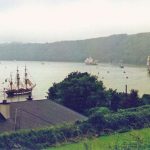
Separated by sea but united by common maritime culture
Dúthchas na Mara/Dúthas na Mara (Belonging to the Sea) is an exploratory work into conflict that two separate Gaelic-speaking island communities – one in Ireland and one in Scotland– are currently embroiled in concerning processes by government bodies whose remit it is to protect aspects of the natural environment in which the islanders live.
Authors Iain McKinnon (Scottish Crofting Federation) and Ruth Brennan (Scottish Association of Marine Science) describe the concerns of fishermen who believe their livelihood and way of life is being threatened by ‘powerful institutions who are not listening to them.’
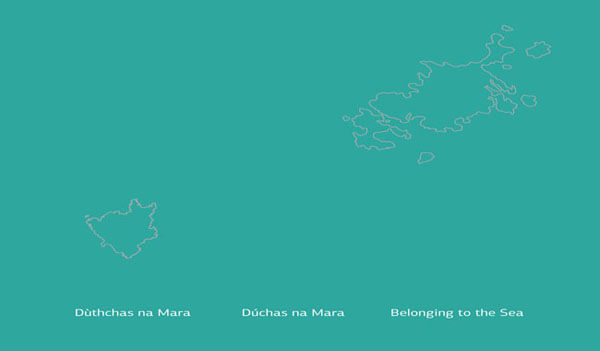
On Barra the dispute centres on proposals by the Scottish Natural Heritage to designate two European marine conservation areas in waters off the island. Meanwhile on Donegal islands, including Arranmore, communities are opposed to the moratorium on drift-net fishing for salmon in their local waters.
The authors stress that the purpose of this work is to neither justify nor invalidate or argue for or against their concerns but instead to ‘look behind the political antagonism and to explore share maritime traditions and principles of belief and conduct in these two Gaelic speaking communities, divided by State boundaries but united in aspects of language and culture.’It also examines international policy instruments relevant to traditional knowledge and cultural heritage.
Sense of belonging
According to the authors their research suggests that at the heart of these beliefs and conduct is a particular Gaelic expression of a feeling universally potential in human beings: the sense of belonging to a home place, and of responsibility for that place. ‘In the Gaelic context, this feeling – described by the great Scottish Gaelic scholar John MacInnes as a form of “emotional energy” – is encapsulated by the not easily translatable word “dúchas” (Irish) or “dúthchas” (Scottish).’
The authors add that while dúchas/dúthchas is a word of the land, it derives from the Gaelic word “dú/dúth” which can mean “earth” or “land”.
‘Our research suggests that the emotional energy of belonging and responsibility the word conveys extends to the waters around the homeland. Therefore what we are seeking to describe is dúchas/dúthchas na mara – the sense of belonging to the sea – and the role this sense of belonging plays in the life of these island communities.’
The narrative created by McKinnon and Brennan is of island life; knowledge of the sea and its place in their stories, histories and legends.
‘How they made a living from the sea; of how they have named and renamed it to suit their needs on and from the sea; of how it has helped to shape their conduct and beliefs; of the change that technologies have brought to their relationship with it.’
McKinnon and Brennan say that while fishermen’s knowledge of the seas may not have the ‘perceived precision’ characteristic of natural science’s understanding of the marine environment, ‘fishermen’s knowledge is arguably, more complete in that it is closer to a total field of understanding, having both practical and emotional power’.
Local knowledge Arranmore islander Jerry Early explains how he is able to tell by the state of the water visible from his kitchen window on the east side of island whether he will be able to fish that day to the west, several miles away and out of sight of his home.
‘The west side is generally less fished because the chances of loss are greater. If the water is breaking white on the Mallagh Rocks, then I will fish to the east side but if the swell is not breaking on the rocks then I can fish further to the west.’
The authors also examine the meaningful information about the seas often found in Gaelic place-names, which they say would be hidden to the non-Gaelic speaker.
‘For instance, in some parts of the Western Isles of Scotland, it is not uncommon to hear islanders talking about going “down” to the north and “up” to the south. The same way of describing direction is also used on Arranmore where one of the older fishermen said that as a young man he used to fish “down to Malin” – which is to the north of Arranmore – and “up” as far as Mayo to the south.’
The reason, explain the authors, may be that describing direction in this way is ‘natural in a culture in which maps (where north is “up” and south is “down”) were not the primary source of travel information.
‘Instead…much of the knowledge needed to ensure safe passage at sea was held in the head and gathered from careful observation of the natural world. It may be that the direction of the prevailing winds (from the south-west) influenced their thinking. Or perhaps the sun, as a point of reference was looked “up” to – and for the Gael when it appears in the sky at all, the sun is generally to the south.’
Elder wisdom
Under the heading ‘Voices from an older generation’ a sense of changing attitudes was expressed by elder fishermen, one of whom prefaced his remark: “Life then, it was hard but was fun because everyone was in the same boat. Nowadays everyone is in their own boat, and that’s the difference.”
For him, when he would have fished by sail and oar in his youth, change came when the power of boats increased to the extent they could “tow nets the size of football pitches”, which combined with “the greed of man” was responsible for the loss of stocks.
It is generally felt among this generation that the ‘marriage of technology and a human propensity for greed’ has contributed to the demise of the herring and salmon fisheries around the Arranmore. Similarly they contend the salmon drift-netters were affected by this change.
“They were cleaning up all the salmon. There was maybe forty of fifty boats at this carry-on…they weren’t coming in with a hundred salmon at all, they were coming in with a thousand salmon.”
But greed however was not confined to fishermen but extended to salmon anglers ‘and also to farmers putting chemicals on their fields without taking into account the consequences’.
The authors note a ‘real fear’ among island people that if the ability to fish is removed then the island’s very reason for being a place of human habitation begins to unravel.
In summary, the authors contend that the existence of a strong body of traditional knowledge alongside international law that gives value to this knowledge has the potential to connect different ways of knowing the marine environment.
‘It is likely that the current lack of connection between these different ways of understanding the world contributes fundamentally to the ongoing conflicts on the islands. We believe that finding a place for each of these “worlds” within the other could give rise to a richer way of knowing and understanding the seas in which we belong.’
Note: The UNESCO Convention on the Safeguarding of Intangible Cultural Heritage 2003 provides international protection for the intangible aspects of cultural diversity. The ICH Convention entered into force on 20 April 2006 but as yet to be ratified by the UK or Ireland. Electronic version is available at http://wwwl.crofting.org/uploads/news/CCS_ebook.pdf