The gandelows of the Shannon Estuary
Darina Tully
The indigenous wooden boat of the Shannon Estuary is a dory-style boat known locally as a ‘gandelow’. The boats have a flat bottom and are clinker-planked although there is also a yawl type that is carvel built.
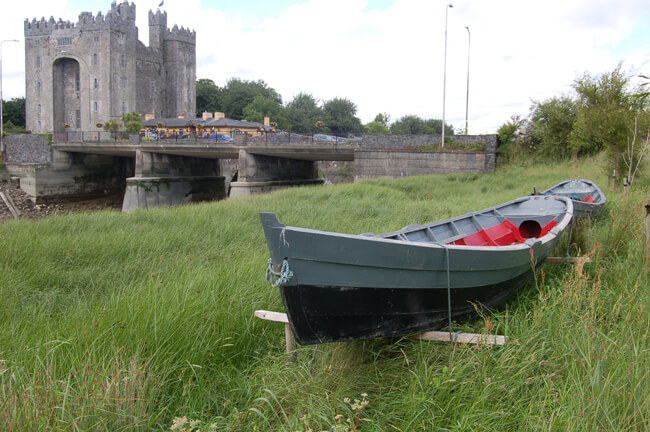
The gandalows could have evolved locally, as the boat’s shape enables fishermen and farmers to expolot the tidal areas of the estuary. Photo Darina Tully
Just like a dory, there is considerable sheer in the bow. Different styles of gandelow can be found within the Shannon Estuary. Boats found in the Cashen, Clarecastle, Killadysert, Bunratty and Limerick City areas all display regional differences, mainly in the shape of the stern.
In Limerick, the boat tapers into a narrow triangular transom, which has changed little in 160 years, the only significant modification being the addition of a piece of wood to give a flat surface to take an outboard engine.
The gandelow could have developed locally or have been imported and adapted to local requirements. The boat itself is similar to the Grand Banks dory, and it is felt that it could have been introduced as a result of the considerable trade between Limerick and North America.
Local design evolution
Notwithstanding, because boats often develop in relation to their environment and function, the gandelow could possibly have evolved locally whereby the boat’s shape enables fishermen and farmers to exploit the tidal areas of the estuary. The flat-planked bottom is not only considerably rockered it is also dished from side to side.
This characteristic means that when the boat dries out only a small surface area is left in contact with the mud. The boat can then be manoeuvred and slid across the mud if required.
Evolution of the gandelow is a subject that will need to be studied by future researchers. The name ‘gandelow’ is also open to much speculation. One story is that when the coastguard was introduced in the early 19th Century, they nicknamed the local boats ‘Irish gondolas’ because of the similarities of their shape.Then the word gondola was corrupted locally to gandelow.
The Limerick Harbour Commissioners always referred to the boats as a ‘gondola’. The boats were raced and would regularly participate in regattas of the Royal Western Yacht Club in the early 19th century. Gandelows were also sailed as well as rowed; some areas used a sprit-type rig while others used a ‘leg-o-mutton’ type sail.
Down river, the odd boat still has a hole in the forward thwart for a short mast. Before the hydroelectric dam was built at Ardnacrusha in the 1920s, hundreds of families in Limerick City alone made their living from fishing. While some boats were used by farmers to access the islands, the gandelows were mainly involved in the drift-net fishery.
The redundant boats are now mainly lying idle along the banks of the Shannon; a few boats are still reed-cutting, eel fishing and angling. Fishermen however feel that with the ending of the drift-net fishery, the gandelow will die out quickly.
In these changing modern times, perhaps consideration should be given to the introduction of some limited sustainable heritage fishing around the coast to promote and support the building and usage of our traditional boats.