Gauntlet thrown down for marine development
Dr Peter Heffernan, CEO the Marine Institute told delegates attending the first annual conference of Our Ocean Wealth that the financial impact to Ireland’s recovering economy from its expanding maritime sector will be maximised only if we learn to think beyond the existing barriers and learn to do things differently and by focusing more on international collaboration in technology and research.

Inshore Ireland spoke to Dr Hefferan and asked him to assess the progress to date of the government’s integrated maritime policy and where it has taken us so far.
While the first OOW conference was well attended, it was not covered well by the national media. Is this a concern?
The fact it was very highly attended reflects a great interest and a great response, and the positive energy was palpable. Participants were very aware of the depth of marine opportunities. The fact that one of the main news outlets didn’t cover the conference was notable, but that was counterbalanced by a very significant level of in-depth radio coverage.
What do you hope to achieve at these annual events and why is benchmarking so important?
It’s absolutely vital to establish benchmarks. Our Ocean Wealth is a medium to a long-term integrated plan. The plan is a work-in-progress and is very transparent. It has published a progress report on schedule, and has held its first annual event. Hopefully, the annual process will develop and diversify to give a continuous sense of updating, renewing and benchmarking and dealing with new issues and problems as they evolve.
Why do you say that international collaboration will be critical to the success of this project?
Very simply, the level of effort and investment needed on the scientific front to develop a forecasting capability for the major trends in the ocean requires a trans-Atlantic partnership. That partnership, with the support of the Irish Presidency, was brought to bear in the Galway Statement last May, and is being implemented. I’m very happy that it’s on course in the context of Irish investment in ocean observation.
You have said we must begin to think more ambitiously and be brave enough to think beyond existing barriers. What did you mean?
Fundamentally I think if we want to a have a predictive capacity we have to think beyond the limitations of such systems. We don’t have the same predictive capacity for the ocean which we take for granted for weather forecasting.
We need to have predictive capacity for the oceans, so that’s what I mean in the context of thinking beyond current capacity limitations and system limitations. But we can, if we enter into a trans-Atlantic initiative.
Along with Canada, the United States and Europe we can generate that capacity on the Atlantic by deploying the appropriate observation systems, and by developing an appropriate mapping programme to underpin the accuracy of modeled forecasts to generate the computing power and output to fire those models. I think that is very possible.
That’s what I mean by thinking beyond the boundaries, and being brave enough in Ireland, as an early mover, to invest and move in that direction.
Has our understanding of these complex processes progressed significantly in the past decade, and how might this process look a decade from now?
I think we’re at a good launch point. There’s a solid foundation of technologies which can be deployed and deliver the key parameter observations required.
Now it’s a matter of designing and building up capacity, deploying the systems and then generating computer output. I believe it’s very doable within the next decade to arrive at that predictive capacity.
You highlighted Ireland’s relationship – through the Marine Institute – with the Newfoundland government in particular. You say we have an asset and a valuable proposition. Outline what you mean by asset, and what was the proposition you made to Canada?
With the Celtic Explorer we have a vessel that is capable of carrying out very sophisticated acoustic fisheries surveys and associated mapping work which the Provincial government of Newfoundland required to intensively study the state of their cod stocks.
So we arrived at a very mutually-beneficial arrangement whereby we have made available the Celtic Explorer to the Newfoundland government over the last four years.
They have built up great expertise in knowledge on the state of their cod stock, and together, we have undertaken trans-Atlantic oceanographic transect work and have built up a very strong track record in that type of work.
This positions us very well in the context of Ireland being an important player and partner in the trans-Atlantic science area.
When you called for a bold and ambitious outlook to sustainable development in the marine, were you speaking to the politicians, the scientists or to the public?
All three. We are now planning ambitious large scale and innovative programmes and funding them jointly. And we clearly saw strong signals from Science Foundation Ireland of their openness to investing in key marine areas, and I think that scale of concentrated effort will be required to move the dial in the direction that the OOW plan sets out.
We have persisted in investing in the marine research and infrastructure capacity build-up through the worst of economic times and now have a solid foundation that has proved itself by competing very well and by winning excellent resources from Europe.
Why do you describe the Map of the Irish seabed as being of unique value?
If you want to develop predictive capacity, by essentially taking broad- scale ocean models and honing and fine-tuning them to give a very clear localised picture right down to the bay level, the accuracy of those models will be tremendously improved because they have an accurate map that includes bathymetry detail.
Not only will that improve the accuracy of modeled and forecasting outputs, it also showcases Ireland as a unique selling point as a test bed for ocean technology experimentation, test and demonstration.
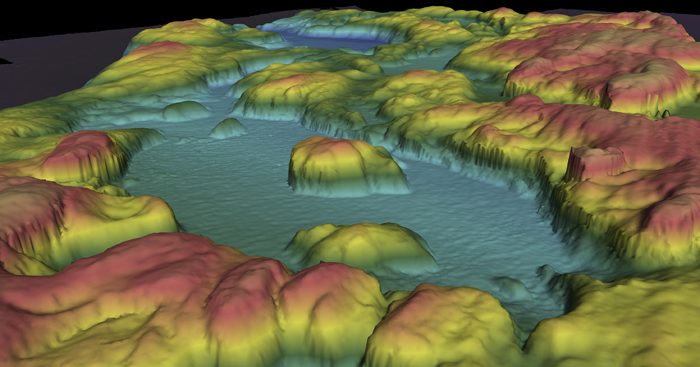
You said also that the map will be of immense value to the insurance sector, and that it would encourage investors. What do you mean?
I’m referring to any large-scale deployment of infrastructure in a hostile environment, for example, the north-east Atlantic.. If you have improved ocean observations; if you have greater modeling capability and if you ultimately have a forecasting capability, you are ensuring a much greater degree of certainty and risk evaluation for insurers and their underwriters. It should also lower such costs and increase confidence on the risk portfolio for investors.
You say that the new broadband connection to the ocean energy test site in Galway Bay is the only such connectivity in Western Europe. Why is it so significant?
Because it provides a platform from which technology developers can deploy their systems and generate data streams. It also allows real time video-monitoring acoustic-monitoring and other parameters that sensors can pick up.
This gives developers the critical two-way interactivity and will be unique. There is also the advantage of being on a wave energy test site whereby wave energy device developers have a unique broadband cable linkage. Likewise, sensor device developers will similarly have a unique platform on which to test and demonstrate.
You spoke about company clusters and how they generate ideas, synergies and ultimately growth. Why are clusters so important?
The Marine Institute facilitates what we call SmartOcean Ireland a forum and a collective cluster mechanism where we enable companies to meet one another to exchange ideas, to explore potential, to tease out issues and challenges and simply have a trusted environment where they can explore possibilities.
This includes many of the biggest multi-nationals in the ICT space resident in Ireland. We enjoy having eight out of the top ten such companies, many with their headquarters in Ireland, together with the universities and small Irish companies all working together.
We’re already seeing evidence of this with Cathx Ocean, and with the groupings in the IMERC cluster. This is very much the current state-of-the-art approach to innovation. You create these cluster mechanisms whereby people can interact, explore and come up with often very unexpected cross-linkages, convergences and disruptive technology development.
How important is it now to inject the concept of the wider maritime sector into the national psyche, and is it succeeding?
It’s fundamentally important. There has been somewhat of a ‘blind spot’ in Ireland to maritime affairs in the past but I think the attendance of An Taoiseach and four ministers speaking at this conference demonstrates that the marine sector is now at the high end of government awareness and priorities.
And also, one of the three over-arching goals set for the strategy is to promote the engagement of Irish society with the maritime dimension.
The evidence is very solidly there that marine is now receiving an unprecedented level of very positive political focus and attention.