A case of ‘NIMBY-ism’ or justifiable concern?
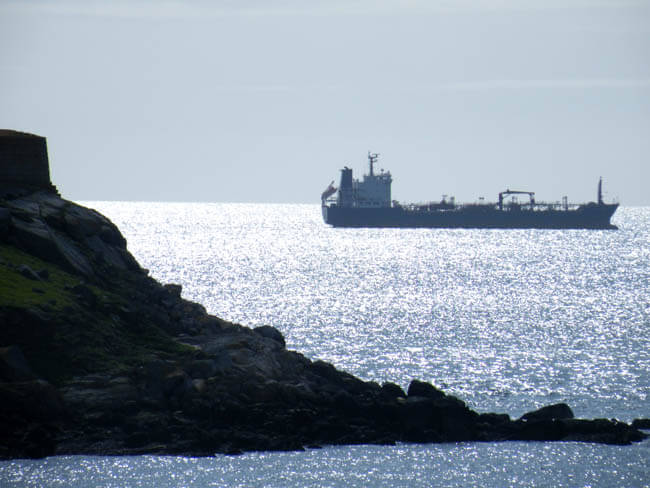 In this view of a vessel passing Dalkey Island, it shows an approximate direction of the proposed exploratory drill-rig, some 6km offshore of the Dublin Bay coastline. Photo Jehan Ashmore
& Gillian Mills
Upwards of 500 residents, business people and politicians turned out for two information meetings in Dalkey and Dún Laoghaire, Co Dublin last month, and agreed unanimously to call on Phil Hogan, Minister for Enterprise and Local Government, to hold a Public Inquiry into the application by Providence Resources for a foreshore licence to explore the potential of an oil and gas prospect circa 6km off the coast of Dublin in an area known as the Kish Bank Basin.
Providence Resources were invited to attend both meetings but declined, saying in a statement they were willing to discuss the issue with small groups at their Donnybrook Headquarters.
Insufficient debate time
Consensus from both meetings was that the public consultation process timeframe was insufficient for a full debate and that the information provided was inadequate and failed to address principle concerns.
A major concern was the potential damage from oil spills. It was suggested from the floor that the Providence application had presented only the lowest risk level scenarios for three given examples based on no spill, minor and major oil spills.
The same speaker also contended that under the company’s emergency contingency plan, in the event of an oil spill reaching the shore, Providence Resources would not be legally responsible and that ultimately the clean-up costs would be borne by local authorities and third parties.
The application for the exploratory licence requires a site and seismic survey in an area that could see a drill rig sited some 6km off Dalkey Island.
Providence documentation states that the kind of exploration is at a ‘relatively early stage and subsequent activity would require further licensing’. They claim all activities will be at a ‘significant distance from any Special Protection Area (SPA) and Special Area of Conservation (SAC) with minimal risks to wildlife and marine mammals.’
Other concerns highlighted include proximity to a large population; potential impacts to wildlife, tourism and businesses in Dublin Bay, which is considered a unique amenity held by few European capitals.
Tax benefits
Regarding financial benefits to Ireland Inc. there was confusion over the level of government tax on profits. What is certain is that Ireland has one of the lowest oil tax regimes in the world, claimed People before Profit T.D. Richard Boyd Barrett. (See sidebar Q&A)
The deputy said he was “absolutely opposed” to the proposal “which is not just an issue for Dalkey but for Dublin Bay” and called “at the very least for a public inquiry” before any decision is taken to grant the licence. “The risks far outweigh the benefits” he said, as there were no guarantees that any oil would be discovered or that the potential financial benefits of a find would go to the Irish people, he added.
At the Dalkey meeting, Tánaiste Eamon Gilmore also supported the general consensus of opinion; however he emphasised that the application was only at ‘exploratory’ stage and that another application would be necessary should oil be find.
Green Party environment spokesman Tom Kivlehan said that risks and benefits must be balanced. “I would rather see investment spent instead on developing alternative wind and power renewable technologies.”
Stakeholder comments
Peter Ryan of the Dún Laoghaire Commercial Fishermen’s Group raised concerns over the proposed site for the drill-rig platform claiming it would be in the centre of their fishing grounds in the Kish Bank basin. He felt that the 500m exclusion zone “would be closer to a 1km” radius and close to a “busy shipping lane”.
The fishing grounds are an important source for whelks and scallops, whose habitat depends on banks between Dublin Bay, the Kish Bank and Greystones and as such support livelihoods not just in neighbouring fishing communities but also as far as Kilkeel, Co. Down.
Ryan pointed out that “fish don’t like loud noises” adding that the survey area would take up to 85% of their fishing grounds. “Even a minor oil spill would wipe out our fishing grounds particularly during northerly sea swells,” he said.
According to a fishing consultant report (commissioned by Providence Resources), fishermen are extremely concerned about seismic surveys involving towing acoustic equipment beyond the 3sq km survey area as the equipment has the potential to snag buoys lines resulting in pot losses or at the very least pot damage.
Dolphin distress
A statement from the Irish Whale & Dolphin Group (IDWG) noted the presence of cetaceans (whales, porpoises, dolphins) around the Kish Bank basin which are ‘important for cetaceans’. Sightings of bottlenose dolphins have increased dramatically in the area since the arrival of a group of three individuals in August 2010.’
The IWDG is also concerned over potential effects caused by disturbance from increased traffic but more importantly due to noise generated from the drilling process. While they say there is considerable data on noise effects of pile-driving, blasting and noise generated by wind turbines “there is little published data on the intensity and effects of sound generated by drilling”.
Joining the chorus of opposition, Birdwatch Ireland said the granting of a licence before “robust screening” was completed would not be in keeping with EU Habitats Directive requirements. The application fails to mention locally important, though undesignated, colonies such as Bray Head, Wicklow Head and Dublin Port, which is part of an SPA, they contend.
No plan
Ireland’s national co-ordinator of Coastwatch Europe, Karin Dubsky said the drilling proposal once again highlighted how “ill prepared we still are as an island nation to manage and plan wise use of our marine, especially inshore resources”.
She added that whilst the government’s move to address deficits within the new Foreshore Bill were imminent, and that coastal zone management and strategic planning were promised, “anyone who now applies for a significant impact marine use, should be told to come back later, when Ireland is ready.”
“If I was in government I would refuse the foreshore application as being premature, and focus on the positive and use it as a good foundation for our EU presidency starting in January 2013”.
With a need for jobs, particularly in the Dublin area, “oil and gas so close to shore would be a huge national asset in years to come when these carbon resources will have a much higher value, she contends.
Q&A responses
Inshore Ireland submitted the following questions to the Department of Environment, Community and Local Government; Department of Communications, Energy and Natural Resources and Department of Transport, Tourism and Sport.
- What is the response of the DoE following the overwhelming call by Dalkey residents for a public enquiry into Providence Resources application for a foreshore licence?
- What are the potential costs of an exploratory oil drill survey?
- Should the survey prove commercially viable, will the oil be piped ashore and where would be the landfall and what would be the costs and timeframe?
- If landfall is not an option, would the oil be transferred by tanker using a floating platform storage and offloading (FPSO) vessel and to where, or would the oil be processed at sea using an offshore oil refiner and if so, where?
- What would be the minimum number of barrels per day required to underpin commercially viability?
- In the event of a potential or real oil spill, who would be primarily responsible, what would be the contingency plan and cost of a clean up? Will there be a mandatory obligation for an Emergency Towing Vessel (ETV) to be stationed in Dublin Port?
- What mitigating assurances can be provided given the proximity of the project to a capital city and special areas of conservation including EU recognised protected species in Dublin Bay?
- There is confusion in the public domain over the level of government tax (20% or 40%) on profits from the exploration industry. Can you clarify? Secondly, can tax rates rise in subsequent contracts if substantial reserves are found? Thirdly, what are the terms of conditions?
- What agencies will be involved in the seismic survey and what are the guidelines?
- What will be the economic benefits to Ireland?
DoE responds:
Primary policy responsibility for the exploitation of offshore natural resources, including the tax regime applicable to such projects, is a matter for the Minister for Communications, Energy and Natural Resources. Such projects are subject to a number of statutory consents under the Gas Acts, and the Petroleum and Other Minerals Development Act. Projects involving works within the 12 nautical mile outer limit of the foreshore are also subject to consent under the Foreshore Acts.
The application was the subject of a public consultation procedure which commenced on 5 January 2012, with a closing date for receipt of submissions by the Department of 2/2/2012.
The application has been referred to standard prescribed body consultees including the Marine Institute, the Marine Survey Office, the Sea Fisheries Protection Authority, Inland Fisheries Ireland and the National Parks and Wildlife Service.
In addition, and owing to the nature of the proposal, the application has also been referred to Dun Laoghaire Rathdown County Council, Wicklow County Council, Dublin Port Company, Dun Laoghaire Harbour Company and the Department of Communications, Energy and Natural Resources.
Given the nature of the application, the fact that it is the subject of a public consultation process, and that the decision and related documentation, including the submissions received under the public consultation process, will be published on the Department’s website, it is not considered that a public inquiry is necessary.
DCENR responds
The operational elements of the query (specifically questions 2-5) relating to costs and development options in the event of a commercial discovery being made are primarily a matter for the operator.
The attached briefing note [with editor, space restriction] sets out the background to the licence and the regulatory framework surrounding the drilling of an exploration well and answers a number of the queries, in particular Q6 in relation to the oil spill contingency plan and Q8 approval of seismic surveys.
A tax rate of between 25% and 40% would apply in the event of a commercial discovery. The actual rate would depend on the profitability of the field. If the exploration drilling were successful and resulted in a commercial discovery then the principal economic benefit would be in the form of the tax paid on profits from the field.
Before any project could proceed from the exploration to production stage the developer’s proposals would be subject to a number of statutory consent processes, including assessment under the Environmental Impact Assessment Directive and these processes would involve a comprehensive public consultation phase.
Q&A with Department of Tourism, Transport and Sport
Providence Resources Oil spill contingency plan refers, inter alia to:
Section 1.6 ‘Roles and Responsibilities of Interested Parties
If an oil spill was to occur during operations, the fundamental legal responsibility for clean-up would rest with Providence as the Operator. Government Authorities would in most cases monitor the clean up activities while reserving the right to intervene actively if the operations were not being appropriately carried out or if it became apparent that the problem was beyond Providence’s capability to resolve. IRCG have the oversight role as far as cleanup is concerned and would monitor the clean up activities in all cases whether at sea or on the shoreline
Further Section 4.4.4. ‘Inshore Oil Spill Clean-up’ states inter alia:
In Ireland, the local authorities are responsible for onshore clean-up of spills via the Joint Response Committee. The details of the shore clean up priorities are given in the national and local authority oil spill contingency plans…..
Q: Can the department confirm and clarify the above that Providence has no liability to the clean-up operation whatsoever if a spill reaches the shoreline?
DTTS:
The company does have liability in the event of a clean-up operation. The reference to Section 4.4.4. is incorrect. It should read: (The Local Authorities are responsible for oil coming ashore. The details of the shoreline clean-up operations will be in accordance with the Authorities’ Oil Spill Contingency Plans [OSCPs]).
Q. Please outline liability in the context of the corrected Section 4.4.4.
DTTS: The Company has to have insurance in place to cover the eventuality of a spill and subsequent clean-up. The Company does have liability.
Q. The reference is directly quoted from Providence’s Oil Spill Contingency Plan. Is there a difference in the interpretation of responsibility as stated by Providence and your clarification?
DTTS:
The Irish Coast Guard is consulted on foreshore licence applications and its interest centres on the safety of life at sea e.g safety of navigation. In the processes involved with oil and gas exploration, the company first need to do a survey of the area being considered, and it is during this survey that the Irish Coast Guard needs to monitor the movements of the survey vessel and to safeguard other maritime traffic in the area.
There is no need for an Oil Spill Contingency Plan (OSCP) at this stage. Further down the line the company will need to submit an OSCP to the Irish Coast Guard for consideration and approval before proceeding with drilling. This cannot be done until the survey is completed. As Providence have not submitted a plan for this prospect the one that they appear to be showing is an EXAMPLE of what would be contained in their final submission to drill. The wording that has been quoted in your question would not be permitted to be included in an OSCP.