A new hand at the helm of the marine sector
& Gillian Mills
One of the youngest members of the new government, Simon Coveney displays a genuine interest in his portfolio, and above all for the marine sector, based on personal interest and experience of things maritime.
Whilst only a few short months as Minister for Agriculture, Food and the Marine, he brings a sense of urgency that just might see an end to bureaucracy and logjams that have stymied development across many elements of the marine sector.
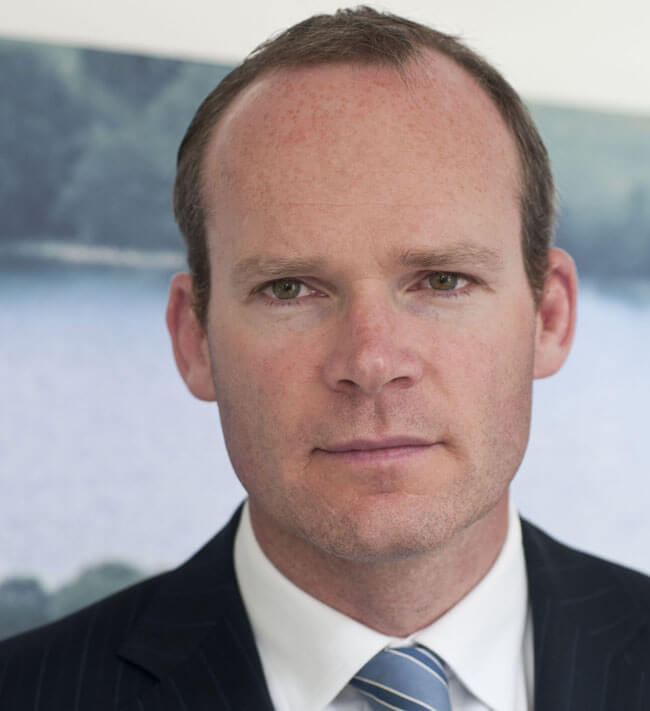
Inshore Ireland spoke to Minister Coveney to tease out his ambitions for a sector that has long since sought Cabinet recognition to achieve its full potential.
There were two things I was determined to do for the marine: one – and which I lobbied for in opposition – was a seat at the cabinet table. And I wanted that portfolio not only to encompass fisheries but also ocean energy; marine leisure; tourism; search & rescue, and so on. The marine industry rightfully demands influence and a voice at the cabinet table, and I want to provide that – and I think we have been successful in doing that.
The Taoiseach made it clear he wanted a marine cabinet minister. He made that commitment in opposition, and he’s followed through on that. I’m delighted he chose me because it’s something I feel very strongly about and have an affinity for given my connection to boats ever since I could walk. I also believe I have a reasonable understanding of the fishing industry.
It’s a job I’m looking forward to, and perhaps my commitment is evident in that I am personally going to chair the Inter-Departmental Marine Coordinating Group. The Secretariat will be provided by the Department of the Taoiseach – and that’s deliberate because we want the Group to be taken seriously by all departments.
Represented on that group are the Department of Defence, Naval Service; the Department of Environment (foreshore and planning); the Department of Communications, Energy and Natural Resources (offshore energy); my own department, the Marine Institute and the departments of Transport and Tourism.
We’ve already had two very constructive meetings to put in place a set of marine strategy targets that will focus on development – along the lines of Food Harvest 2020.
I hope there’ll be a new focus for developing the marine sector across all areas – whether it’s somebody wanting to establish a marina in the West of Ireland and has problems with foreshore and planning issues having to work with different agencies, or whether it’s someone who wants to establish an offshore wind farm and has issues around foreshore and grid connection etc. Or whether it’s grant-aid to different sectors, or developing a licensing system that works on a timelier basis for the aquaculture industry.
There are many barriers to growth and development, and whilst we’re not going to have much capital or current expenditure for the next two to three years, we can do a lot in terms of streamlining processes to make it easier for the private sector to develop and grow.”
The first draft policy for Integrated Coastal Zone Management was published in 1997, and government since then has been accused of lacking the motivation to develop a policy for Ireland. Fourteen years on and there is still no ICZM policy. What are your intentions to bring about a national initiative?
That’s what the coordinating group is all about; that’s why we are setting targets for ourselves in the same way as we’ve targets in the food sector. Across all of the sectors, whether it’s research; energy; fishing; aquaculture; sport, leisure or tourism.
There are many areas that the broader marine brief touches on – and the challenge will be to coordinate these activities. For example, with ICZM where there are planning and foreshore issues, these will be integrated into a single application that will be handled by one department.
It is widely accepted that the Common Fisheries Policy has many failings. Ireland has its own specific concerns: stakeholder involvement in decision-making; relative stability in Irish waters; methodology of scientific assessments and fisheries management. Is it realistic to believe Ireland’s concerns will be safeguarded and that its recommendations will form part of the new CFP?
Well certainly it’s my intention to make sure that Irish concerns are part of any new CFP; that is one of the reasons why I believe it’s very important we have a senior minister responsible for fishing and the marine. We need to deliver a very strong signal that the Irish government takes this industry seriously, and that we will rigorously pursue our concerns as part of the negotiation process.
Two issues of concern are already on the table: the concept of a Transferable Quota System which the Commission is pursuing whereby individual boat owners would actually have the capacity to transfer their quota – in other words, sell their quota elsewhere.
I would be fearful that this could result in Ireland’s fishing quota essentially being sold out of Ireland; for example, by Spanish, French or Dutch interests coming to Ireland, setting up a company and purchasing or leasing quota.
This is why I am happy to be in this portfolio; I have a reasonably good understanding about how Brussels works – being an MEP for three years. Decisions are taken following lots of consultation, lots of debate, lots of lobbying. And it will be my job to put together alliances that can result in a good deal for Ireland.
The other big issue is fish discards. It is simply not sustainable that we throw between 20-40% of the fish we catch back into the water – dead – because they are caught out of quota or because they’re juvenile fish, or are too small, or they’re species that aren’t valuable. This system needs to be changed.
The proposals to date aren’t practical so Ireland is suggesting a pilot study in the Irish Box (waters off the south west coast) because they are very sensitive areas as regards spawning and the development of juvenile fish.
I want to work with the industry to create a proposal that can work in a practical way for fishermen, so that we can show the Commission HOW it can be done.
You are quoted as saying Ireland needs to encourage landings of non-Irish caught fish for on-shore processing to maximise added-value. Would this not bring attendant problems of scale, continuity, markets, trade agreements, etc? What incentive would there be for the Spanish and French catch to be landed and processed in Ireland?
The incentive actually doesn’t need to be generated by us at all. The incentive is there because of fuel prices. It’s becoming a more difficult economic proposition for trawlers to steam back with fish to Spain and France from Irish waters. So rather than fish being landed in Irish ports and then trucked back to Europe to be processed and sold onto the markets, I want to see more being landed to Irish processors – to add value to the million tonnes that are caught off the west coast of Ireland. That’s where the employment is, that’s where the value is.
Most of the employment in the fishing industry is in processing not catching. Whereas obviously we’ll be fighting for a bigger and fairer share of the quota, we must develop a fish processing sector here that isn’t just reliant on fish caught by Irish trawlers.
So we are now talking to French fishing interests in particular, trying to encourage them to land to Irish processing plants and then import back into their markets.
A recent study suggests that a ‘fully developed’ all-Ireland energy sector could be worth €9bn and create up 52,000 jobs. Is there a willingness by government to realise this potential?
I think there is enormous potential within Irish waters. Ninety per cent of Ireland’s territory is under water and I am hopeful we will manage to find and exploit, in an environmentally-responsible way, natural resources beneath the seabed, whether it’s gas or oil. There is potential; however we need to actually realise that potential – which may take time. We need to put the conditions in place that encourage exploratory drilling for oil and gas, and investment in renewable energy offshore – whether it’s tidal, wave energy, or wind.
The government is anxious to encourage that potential and to work through State agencies to make it happen, which is why I think it’s very important we resolve issues around foreshore for example, to allow – primarily the private sector but also the State in certain instances (Marine Institute or Marine Energy Research Centre) those agencies and educational institutions working with the private sector to actually ensure we realise the full potential of our offshore natural resources.
With Mercosur*, budgetary issues and the significant power and size of the agriculture sector, how much time can you afford to give to fisheries and aquaculture?
I am making and prioritising time for the marine sector. It’s an area I’m personally interested in as well as committed to, politically.
I have broad responsibilities around agriculture and the agri-food sector; however I have good people – in terms of advisors – and a good Minister of State in Shane McEntee. As far as possible I will be taking personal control of the decision-making regarding aquaculture and fisheries and the marine sector generally. That’s a choice I’ve made, and it means increasing my workload, but I’m comfortable with that.
Have you had discussions yet with Minister Deenihan to expedite the pace of work by the NPWS in setting conservation objectives for designated SACs and SPAs?
This is going to take time but I don’t accept it’s going to take the time frame that’s suggested. I would hope the industry will see the progression of new and expanded licences shortly. We do however need to go through a process – otherwise we threaten the industry in a very serious way if the Commission takes legal action against the State.
Fine Gael’s Programme for Government under the heading: Coastal Communities, Fisheries and the Marine Environment states, inter alia: ‘We will support the development of sustainable aquaculture and fish farms by streamlining the licensing process and reducing associated bureaucracy’ What is meant by this and what is the timetable for such streamlining?
I’ve just come back from the biggest seafood fair in the world in Brussels. Many of the nineteen Irish companies were in the aquaculture sector. They’re very frustrated as there’s a market out there that wants to buy Irish fish.
It’s one of the few markets in the economy to which we actually can’t provide enough raw material. We need to expand our aquaculture industry – whether it is shellfish or farmed salmon, there’s a real appetite to buy Irish product, and it’s got a very good reputation abroad.
I’m determined to try and do everything we can to fast track the decisions that we need to make on licensing. But this isn’t a simple process. The reality is we have to introduce a licensing mechanism that is legally sound and doesn’t result in the Commission taking court challenges against us.
An awful lot of the bays that want to see aquaculture expansion are NATURA areas or Special Areas of Conservation, and when you develop aquaculture in these areas there is a process to be gone through.
Between the National Parks and Wildlife Service which is in Jimmy Deenihan’s department and my own department, we collectively have responsibility to assess these bays and therefore need to increase resources where necessary to get this done as quickly as possible.
We need to fast track this process and work with the Commission to ensure the flexibility required to get the assessments carried out as quickly as possible, to enable the aquaculture industry to grow and expand and take advantage of the potential that’s out there.
Looking at salmon farming alone we produce between 8-9,000 tonnes; in Scotland it’s 150,000 tonnes; in Norway it’s 800,000 tonnes. So, there’s huge growth potential here – not just in salmon but in all sorts of farmed marine products.
We need to allow this industry to breath and grow and expand – but obviously in a way that’s consistent with protecting the environment. And I will be insistent on that. This isn’t a case for cutting corners.
- *MERcado COmún del SUR. Customs union of four Southern-cone countries (Argentina, Brazil, Paraguay, and Uruguay) established under the 1991 Treaty Of Asunción. Formed on the pattern of European Community’s Treaty Of Rome, it allows duty free inter-Mercosur trade and levies a common external-tariff (0-20%) on non-member countries. In 1996, Bolivia and Chile joined it as its associate members.