
 https://oceanfocus.ie/wp-content/uploads/2020/05/Ocean_Focus_marine_Publication.png
0
0
Guest Writer
https://oceanfocus.ie/wp-content/uploads/2020/05/Ocean_Focus_marine_Publication.png
Guest Writer2014-02-25 17:05:522019-02-14 14:53:29Marine Institute stands over quality and accuracy of its research
https://oceanfocus.ie/wp-content/uploads/2020/05/Ocean_Focus_marine_Publication.png
0
0
Guest Writer
https://oceanfocus.ie/wp-content/uploads/2020/05/Ocean_Focus_marine_Publication.png
Guest Writer2014-01-22 08:17:162019-02-14 14:41:34Statement from BIM
https://oceanfocus.ie/wp-content/uploads/2020/05/Ocean_Focus_marine_Publication.png
0
0
Guest Writer
https://oceanfocus.ie/wp-content/uploads/2020/05/Ocean_Focus_marine_Publication.png
Guest Writer2014-02-25 17:05:522019-02-14 14:53:29Marine Institute stands over quality and accuracy of its research
https://oceanfocus.ie/wp-content/uploads/2020/05/Ocean_Focus_marine_Publication.png
0
0
Guest Writer
https://oceanfocus.ie/wp-content/uploads/2020/05/Ocean_Focus_marine_Publication.png
Guest Writer2014-01-22 08:17:162019-02-14 14:41:34Statement from BIM
Publisher apologises to Marine Institute for contentious sea-lice article
A controversial article in a prestigious scientific journal that accuses the Marine Institute of ‘incorrectly’ concluding that sea lice play a minor role in the survival of wild salmon, has been downgraded significantly by its publishers who have also apologised to the agency for denying it a right of reply prior to publication.
This is the latest twist in what has been a highly charged debate involving some of Ireland’s environmental State Agencies as well as the scientific community here and abroad.
Sea louse under the microscope
First published in August 2013 in the widely respected Journal of Fish Diseases, the article, written by a team of scientists led by Dr Martin Krkosek of the University of Toronto alleges that based on its own research, the Marine Institute incorrectly concluded ‘that sea lice play a minor, perhaps even negligible, role in salmon survival’.
Allegations of misleading and false information surround salmon farm debate
Two formal complaints to the Office of the Ombudsman which could stall the planning process for a large salmon farm in Galway Bay have been slammed by the project’s promoter BIM as a “deliberate attempt designed to confuse the general public”.
The office confirmed to Inshore Ireland that it was dealing with two separate complaints by the Friends of the Irish Environment (FIE) against two government departments. The complaints concern the parts played by both departments during a recent EU Commission investigation into sea lice and salmon farms.
“Complaints by the FIE in relation to the Department of Agriculture, Food and the Marine (DAFM) and the Department of Foreign Affairs (DFA) are still open and on-going,” a spokeswoman for the office confirmed to Inshore Ireland.

Debate ‘darkens’ over proposed salmon-farm project
For the second time this year, BIM’s proposal to site a large salmon farming operation in theoutreaches of Galway Bay near Inis Oírr is the subject of our front-page story. By now, no one can be in any doubt that this proposal has managed to raise the volume – if not the quality - of debate as it works its way through the planning system to an eventual Ministerial decision.
Those who oppose sea-based fin fish aquaculture have again shown themselves to be formidable opponents, and the closer we get to a decision, the more intense their arguments become.
As Inshore Ireland went to press we learnt that the Office of the Ombudsman had opened preliminary investigations into two formal complaints from environmental lobby group, Friends of the Irish Environment against two government departments: the Department of Agriculture, Food and the Marine for allegedly deliberately withholding information from an EU Commission investigation; and the Department of Foreign Affairs for its alleged stance in dealing with the EU Commission.
Scientists at odds over how to interpret sea-lice results
A Canadian scientist claims that errors by the Marine Institute in analyzing its own scientific data means it has substantially underestimated the impact of lice on wild salmon. Dr Martin Krkošek from the University of Toronto’s Department of Ecology and Evolutionary Biology alleges that scientific papers published by the Marine Institute in 2011 and 2013 ‘incorrectly lead the reader to a conclusion that sea lice play a minor, perhaps even negligible, role in salmon survival. Such a conclusion can be supported only if one is prepared to accept at least three fundamental methodological errors’.
Krkošek further claims in his scientific paper published in The Journal of Fish Diseases, 2013 that his‘re-analyses’ of the same data ‘departs substantially from those reported and interpreted’ by the Marine Institute. ‘Whereas they assert that sea lice cause 1% of mortality in Atlantic salmon, the correct estimate is actually a one-third loss of overall adult recruitment,’ he states.
https://oceanfocus.ie/wp-content/uploads/2020/05/Ocean_Focus_marine_Publication.png
0
0
Guest Writer
https://oceanfocus.ie/wp-content/uploads/2020/05/Ocean_Focus_marine_Publication.png
Guest Writer2013-08-28 16:22:002019-02-14 12:38:42Let’s tone down the loud voices in the salmon licence debate
Seaweed as an unrivalled, healthy source of iodine
Dr Simon Faulkner and Dr Stefan Kraan
Discovered in 1811, iodine is a chemical element required by humans and animals for the synthesis of the thyroid hormones thyroxine (T4) and triiodothyronine (T3). These hormones are multifunctional and have important roles in the regulation of growth, development and metabolism. Iodine is therefore an essential trace element that affects almost every physiological process in the body.
Although iodine can be obtained from a number of food sources, deficiency of the element is a common global problem and is considered to be the primary cause of impaired cognitive development in children by the World Health Organization.
Sustainably managing and harvesting Ireland’s ocean wealth
IFA’s Aquaculture section has welcomed the publication by EU Fisheries Commissioner Maria Damanaki of a new strategy to cut red tape and boost fish and shellfish farming ‘which will create thousands of jobs and reduce Europe’s huge dependence on seafood imports’.
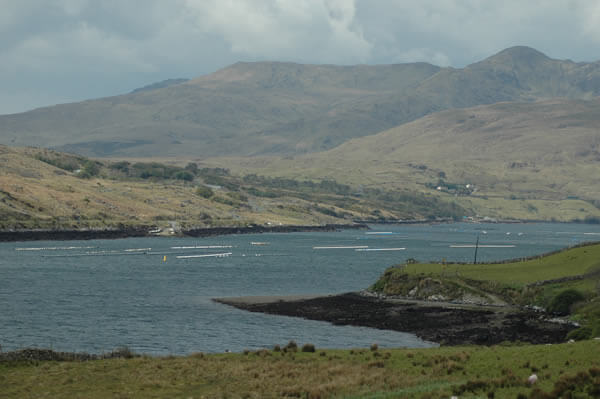
mussel farming in Killary fjord. Photo G Mills
By identifying the key strategic link between providing home-grown quality seafood and direct employment benefits, “the Commissioner has shown that common-sense and direct action is the way to break the long-standing log jam in farmed seafood production,” remarked IFA aquaculture executive, Richie Flynn.
He added that by forcing each member state government to follow-up the EU policy “with a progressive and realistic national plan”, the Commission proposals showed a “clear path to the Irish government to reduce red tape, simplify procedures and produce high-end quality exports”.