
Coastal initiative for the southwest
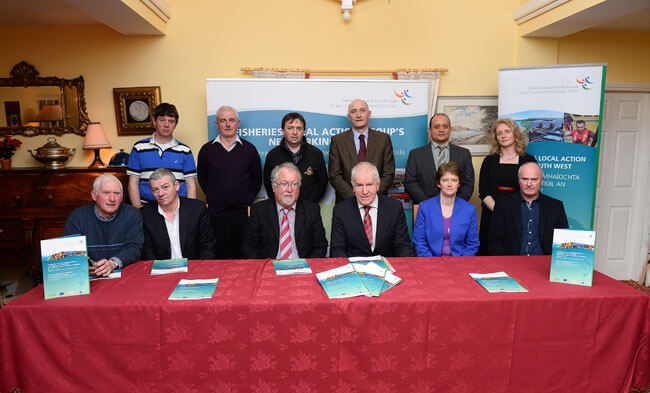
The Minister for the Arts, Heritage and the Gaeltacht, Jimmy Deenihan and the South-West Fisheries Local Action Group (FLAG) have launched a Strategy for Small and Fishing Dependent Communities in the south-west.
The South-West FLAG is one of six FLAGs that are part of a nationwide iniative coordinated by BIM and funded under Axis 4 of the European Fisheries Fund which aims to empower local communities to develop opportunities and grow existing infrastructure within their own coastal areas.
Pictured with Minister for Arts; Heritage and the Gaeltacht Jimmy Deenihan; T.D are:
Back row: Joseph O’Shea; Inshore Fishing; South Kerry; Seamus O’Grady; Inshore Fishing; North Kerry; Finian O’Sullivan; Aquaculture West Cork; John Walsh; Community Islands Cork; Huan Tan; BIM; Vera O’Donovan; BIM and Frank Fleming; Responsible Irish Fish
Front row: Artie Clifford; Artisan Food Community; West Kerry; Kevin Flannery; Environment Community West Kerry; Tomas Hayes; Kerry Enterprise Board and Maire Ni He; Udaras na Gaeltachta
Compensation call for storm battered fishermen
The Federation of Irish Fishemren (FIF) has called on marine minister Simon Coveney to put in place an adequate compensation scheme for fishermen who have suffered "significant losses" as a result of severe weather conditions since mid December.
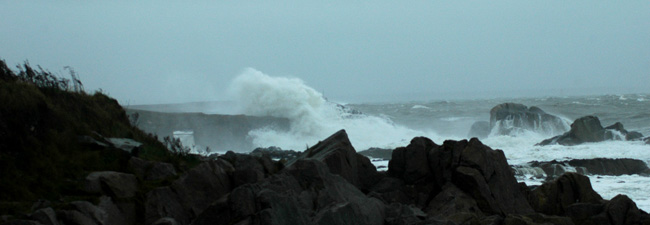
Relentless Atlantic storms that battered Ireland's western and sourth seaboards were also felt in Dún Laoghaire, Co Dublin. Photo Gillian Mills
"We welcome the scheme for inshore fishermen announced by Minister Coveney last week; however we pointed out that we feel the scheme is inadequate in the wake of the losses experienced by fishermen," remarked FIF chair, Sean O'Donoghue.

Is Ireland’s inshore fisheries sector ‘destined to fail’?
“The Irish inshore fishery is on the brink of collapse due to a lack of proper policy and regulation. Going as far back as the 1990s, BIM produced a number of reports outlying in clear terms, pathways to deal with this issue. Those blueprints have gathered dust in the interim, in tandem with the decline in economic potential of the crab and lobster fisheries.
“The Federation of Irish Fishermen (FIF) and others have made this point clear when making submissions to a joint subcommittee on fisheries in March 2013,” Francis O’Donnell, CEO of the Irish Fish Producers Organisation and former chair of the FIF has told Inshore Ireland.
Inshore fisheries is vital to the survival of coastal communities such as Roundstone in Connemara. Photo Gillian Mills
Also speaking to this paper, Eamon Dixon of the Erris Inshore Fishermen’s Association said it was only in the last two years that the Sea-fisheries Protection Authority (SFPA) has been in a position to address the problems.
But he cautions that the current level of control is not a deterrent as the agency is under-resourced, with too many areas to cover: food safety, sampling, EU audits and fisheries control.

Political agreement reached on the European Maritime and Fisheries Fund
A political agreement on EMFF has been reached following protracted negotiations between the European Parliament, the European Commission and the Council of Ministers. The fund is worth €6.5 billion to the fisheries and aquaculture sectors in the EU during 2014 to 2020. Negotiations had brokem down before Christmas due to a disagreement over the allocation of funding for data collection and control.
"I am pleased that a broad political agreement is in place for the EMFF, which is the last major EU fund still to be formally adopted for the period 2014 to 2020. The EMFF is vitally important to coastal communities throughout Ireland as it is designed to support the implementation of the Common Fisheries Policy," remarked MEP Pat the Cope Gallagher.
"I believe that the main aspects contained in the EMFF agreement will help maintain employment in the fisheries sector and in peripheral coastal communities dependent on fisheries. I am particularly pleased that an amendment, which I had riginally tabled in the European Parliament calling for the provision of funding for small ports has been included. My amendment will allow the Government to ring fence funding for small ports that have experienced declining fish landings.

Diary of a Cornish fisherman 1962-1967
One way or another, Trevor Simpson has had salt in his veins for most of his life. He joined the Royal Navy at just sixteen as a Boy Seaman, 2nd Class, ‘surely the lowest form of life on the planet!’ he suggests.
Nine years later in 1956 at the rank of Able Bodied Seaman he joined ‘Civvy Street’ and proclaimed he would do just about anything but ‘Me and the sea is finished’! For several years he worked at various jobs until a ‘life-changing’ experience as Head Lifeguard at the Cornish town of Newquay set him on a new course.
Every day as I patrolled the beaches, I breathed in the salt air and my ears were full o the sound of the surf and so, bit-by-bit, the sea was calling me back.’ Following a few more adventures in the labour market he shipped on as a crewman on a small lobster boat in Newquay and never looked backed.
 https://oceanfocus.ie/wp-content/uploads/2014/01/Howth.jpg
259
650
Guest Writer
https://oceanfocus.ie/wp-content/uploads/2020/05/Ocean_Focus_marine_Publication.png
Guest Writer2014-01-29 17:26:002019-02-14 14:49:31Fleet decommissioning must follow ‘bad’ deal for Ireland
https://oceanfocus.ie/wp-content/uploads/2014/01/Howth.jpg
259
650
Guest Writer
https://oceanfocus.ie/wp-content/uploads/2020/05/Ocean_Focus_marine_Publication.png
Guest Writer2014-01-29 17:26:002019-02-14 14:49:31Fleet decommissioning must follow ‘bad’ deal for Ireland
Poor representation for inshore fishermen at national level
Francis O'Donnell, IFPO
I travelled to Inis Oirr on January 14 for the launch of the report Sustainable Rural Coastal and Island Communities in Ireland which was presented by the Chair of the Joint Sub-Committee on Fisheries, Deputy Andrew Doyle, on behalf of the committee: Deputies Andrew Doyle; Martin Ferris; Michael McNamara; Thomas Pringle; Noel Harrington; Sean Kenny and Senators Brian O Domhnaill, Ned O’ Sullivan and Denis Landy.Deputy O'Cuiv also played an integral role in developing this report.
The Sub-Committee had made twenty-nine recommendations based on submissions from various stakeholders involved in the marine area. That submission process took place last year. The focus of this report is to recommend strategies to equip island and coastal communities to face the many socio-economic challenges that lie ahead and affect their everyday lives.

'Sustainable Rural Coastal and Island Communities in Ireland' report launched on Inis Oírr
Many of those challenges ― such as the ban on the drift netting for salmon in 2006 ― are historical. Nonetheless, the result of that ban saw an increase in effort in the lobster and crab fisheries. Many of those compensated at the time bought large numbers of pots. The lobster fishery is now on the brink of collapse in Ireland due to the lack of policy and regulation in this fishery.

Automatic, float-free EPIRBs becomes mandatory for inshore fleet
A revised Code of Practice for the design, construction, equipment and operation of small fishing vessels (less than 15 metres length) comes into effect on March 3, 2014.
Small fishing vessels are already required to carry EPIRBs (Emergency Position-Indicating Radio Beacons). The revised Code requires them to also carry automatic, float-free EPIRBs, and for everyone on board to wear Personal Locator Beacons (PLBs).
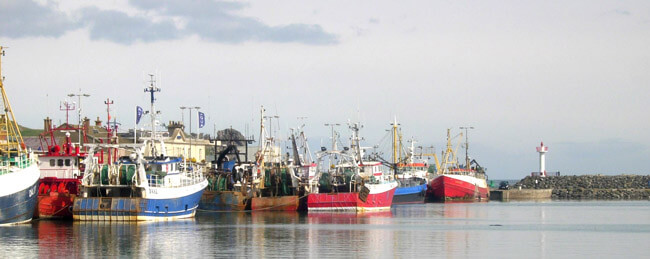
Inshore vessels of less than 15m such as the Dunmore East fleet will be required to carry automated, float-free EPIRBs from March 3, 2014. Photo Gillian Mills
These changes follow several reports from the Marine Casualty Investigation Board (MCIB) recommending the use of float-free EPIRBS and the wearing of PLBs by all on board. (Float-free EPIRBS are now much smaller and cheaper than earlier models.)
https://oceanfocus.ie/wp-content/uploads/2014/01/roaringwater_bay_edited-1.jpg
226
650
Guest Writer
https://oceanfocus.ie/wp-content/uploads/2020/05/Ocean_Focus_marine_Publication.png
Guest Writer2014-01-06 20:40:092019-02-14 14:42:50No consultation with inshore fishermen on Roaringwater Bay SAC