Trade restrictions sought against Iceland and Faroes
At the July Council of Ministers, Simon Coveney, Minister for Agriculture, Food and Marine supported by the UK, France and Spain, called for trade restrictions to be imposed “immediately by the EU Commission against Iceland and the Faroe Islands for their “continued unacceptable and irresponsible fishing of mackerel”.
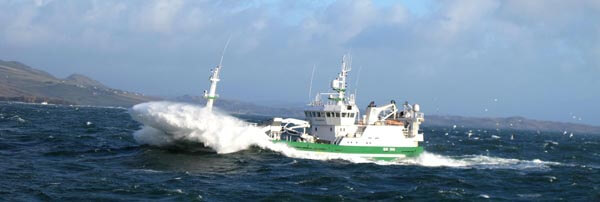
MFV Vigilant steaming into a westerly gale. Photo J Cunningham
Iceland and the Faroes have set “large unilateral quotas at unsustainable levels in 2013. Their unilateral quotas amount to 52% of the recommended scientifically advised catch of mackerel in 2013,” he said.
“This is the fifth year in which Iceland has refused to engage in meaningful negotiations with the EU and Norway, the recognised major shareholders in this fishery. Iceland and the Faroes have developed a large and unsustainable fishery of mackerel from a situation in 2006 when they had a combined total share of only 5% of the fishery,” he added.
Multi-agency initiative to tackle high loss of life at sea
& Gery Flynn
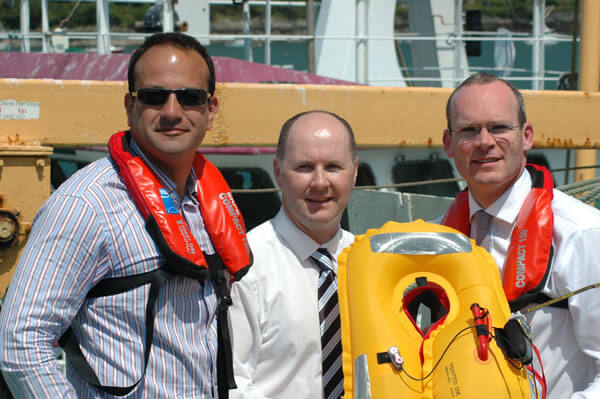
Ireland’s first national maritime safety strategy launched by the Minister for Transport, Tourism and Sport Leo Varadkar (maritime safety and emergency response) and Simon Coveney (fishing industry) is about “closing the gaps in services, preventing accidents at sea”.
Leo Varadkar, Minister for Tourism, Transport and Sport; Jason Whooley, BIM chief executive and Simon Coveney, Minister for Agriculture, Food and the Marine at the launch in Union Hall. Photo Gillian Mills/Inshore Ireland
Speaking at Union Hall, Minister Varadkar said it was “appropriate” that the initiative, which is targeted at the fishing industry, was being launched where the “tragic events of January 2012” had left a huge impact on the nation.
To be administered by BIM, the scheme, back up by changes to the Code of Practice and a “continued commitment to regulation and compliance with safety standards will help to engrain a culture of ‘safety-first’ on the water,” he added.

Fishing Industry warns five-year seafood strategy could be a pipe-dream
BIM chairman Kieran Calnan; Minster for Agriculture, Food and the Marine, Simon Coveney; Jason Whooley, BIM chief executive and Tom Moran, secretary general, DAFM at the strategy launch
The Irish sea-fisheries board has launched an ambitious five-year strategy to deliver 1,200 jobs and €1bn in seafood sales by building scale and enhancing competitiveness in the seafood sector.
Capturing Ireland’s Share of The Global Seafood Opportunity is “grounded in Ireland’s ideal position” to take advantage of the projected increase in seafood demand of an additional 42 million tonnes per annum, by 2030.
With constraints on wild fish catches to meet this demand, “informed market analysis” predicts a 50% increase by 2020 in the current annual production of two million tonnes of farmed salmon,” remarked BIM chairman, Kieran Calnan.

Landmark agreement secures long-term viability of fish stocks
Ireland’s presidency of the EU which concludes on June 30 delivered one of its ‘highest priorities’ when it secured agreement on a new Common Fisheries Policy in the early hours of May 30.
“At the very beginning I set out an ambitious and demanding work programme; it was imperative that reform of our fisheries had to happen now,” remarked Simon Coveney, Minister for Agriculture, Food and the Marine.
The package, which is being heralded as ‘practical and implementable’, places sustainability centre-stage and will see an end to overfishing of most stocks by 2015 and all stocks by 2020.
For the first time too, agreement had to be reached by 27 Member States and three institutions: the EU’s Parliament and Commission, and Council of Fisheries Ministers.
The reformed fisheries policy will help secure a future for whitefish ports such as Castletownbere, Co Cork. Photo N Duffy
“It is a policy that will provide for a vital, vibrant industry and healthy fish stocks long into the future, and puts fishermen at the core of developing technical and conservation measures to protect juvenile fish and vulnerable species [under] a completely new regionalised decision-making approach,” Minister Coveney added.
Minister targets political agreement on fisheries policy reform within Irish EU presidency
Minister for Agriculture, Food and the Marine, Simon Coveney, in his capacity as President of the European Council of Fisheries Ministers, has welcomed the European Parliament’s endorsement on the reform agenda for the Common Fisheries Policy, prioritised for delivery by the end of June.
The vote is seen as a major step forward in the process to deliver on maximum sustainable yield (MSY); elimination of the controversial practice of discards (dumping at sea) and a switch to long-term (scientifically based) planning for fisheries.
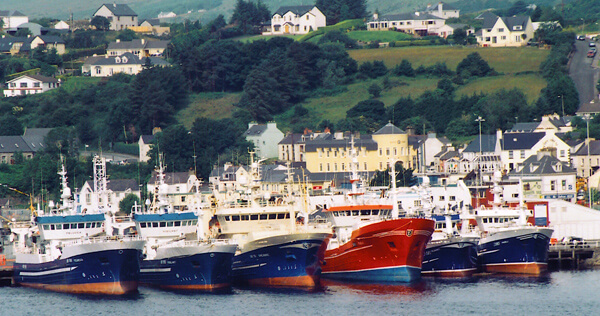
The Killybegs pelagic fleet. Photo Gillian Mills/Inshore Ireland
“I’m particularly pleased this vote occurred during the Irish EU Presidency; this shows the pivotal role Ireland can play in influencing broader European Policy and in bringing together divergent views towards an agreed reform package.
Launch of south-East coast local fishery action group
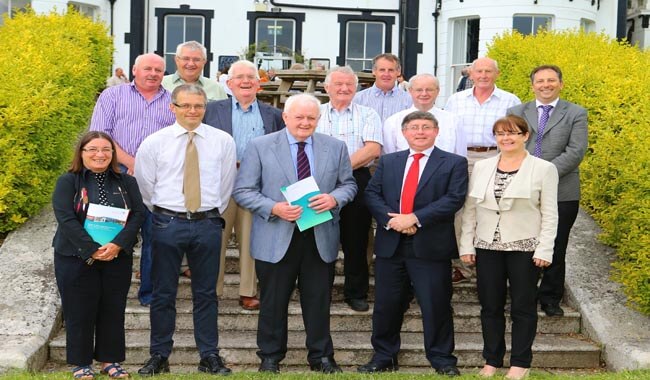
The latest BIM FLAG group to be launched covers Wicklow, Wexford and Waterford, under Axis Four of the European Fisheries Fund, which enables fisheries communities to create new and sustainable sources of income.
Speaking at the launch, BIM chairman Kieran Calnan said the agency was "fully committed" to the development and support of local coastal communities.
Pictured left, Mary Walsh, Waterford VEC, John Hickey, BIM, Kieran Calnan BIM’s Chairman, Michael Keatinge, Fisheries Development Manager, Cliona Mhic Giolla Chuda, Irish Shellfish Association.Back Row from left, Risteard Breathnach, Fisherman Waterford West, Tony Kelly, Kilmore Quay, Eugene Bates, Fisherman Wexford West/South, Noel McDonagh, Fisherman Waterford East, John O’Hagan Fisherman Wexford East/North, Tom Greegan, LEADER Wicklow, Donal O’Brien, Community Forum, Padraig O’ Gorman, Wexford County Council
EU pelagic fishermen accuse Iceland of a ‘disingenuous propaganda exercise’ over mackerel dispute
Iceland stands accused of attempting to justify ‘reckless and irresponsible actions’ on the Atlantic mackerel stock, and of trying to create a divide between EU seafood processors and the pelagic fishing sector.
The European Association of Fish Producers Organisation (EAFPO) says the Icelandic Ministry of Industries and Innovation is arranging ‘propaganda briefings’ throughout the EU in a bid to justify a ‘massive, unjustified, unilateral increase in mackerel quota.’
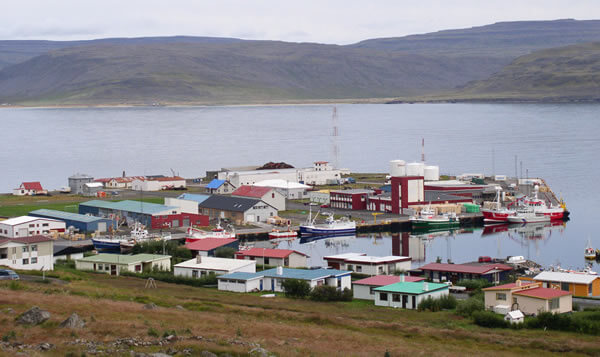
Patreksfjordur – Europe‘s westernmost fishing port. Photo A Magnusson
Iceland who caught 363 tonnes in 2005, ‘set themselves a quota of 145,000t in 2012 (40,000% increase), is putting the health of the stock in jeopardy,’ it contends.
Department to review emergency call service over Tit Bonhomme sinking response
Lorna Siggins
Department to review emergency call service over Tit Bonhomme sinking response Neither Irish Coast Guard nor State investigators aware two calls were made from sinking vessel Lorna Siggins Serious issues arising from the emergency response to the Tit Bonhomme sinking have prompted a review of the 999 service by the Department of Communications, Energy and Natural Resources.
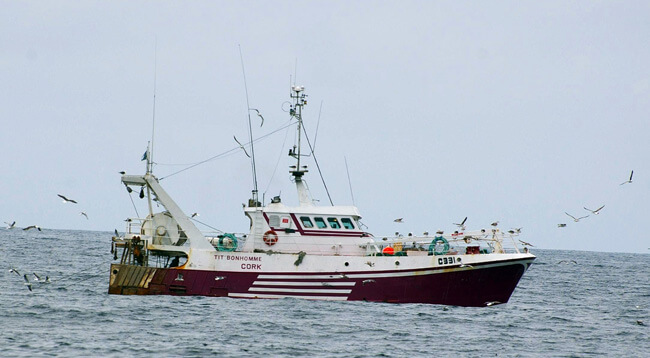
Tit Bonhomme. Photo Nially Duffy
Full details of that initial response was revealed at the recent inquest into the loss of five crew on board the vessel when it was confirmed that not one, but two, emergency calls were made from the vessel as it sank off Glandore, west Cork, in January 2012.
Day breaks on a new 10-year deal for Europe’s fishing community
& Gillian Mills
Against the odds, EU Fisheries Ministers agreed a range of measures to form a new 10-year Common Fisheries Policy (CFP) that concluded on May 30 in Dublin.
And while the details are still being mulled over by the 27 Member States, the overall package has been widely welcomed, even hailed as a major milestone on the road to a complete reform process, which began in July 2011.
At the heart of this policy is the first genuine attempt to solve the problem of fish ‘discards’ ― how to immediately reduce, and eventually eliminate them altogether. It was clear that Europe-wide, the public was growing impatient at what was regarded as the obscene and willful waste of food.
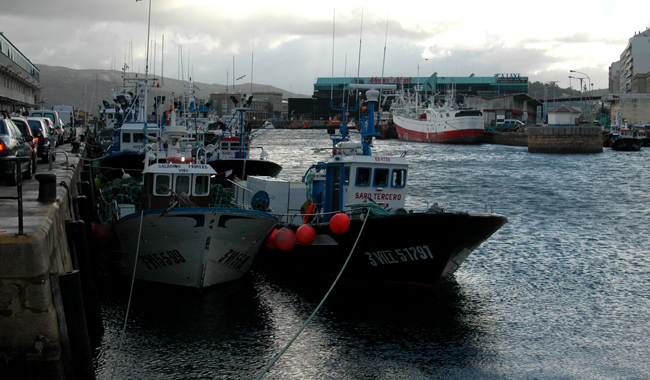
Photo: The Port of Vigo is the biggest fishing port in the world. Hundreds of vessels operate annually from 30 quays, landing over 600,000 tonnes of frozen fish and close to 90,000 tonnes of fresh fish. Photo G Mills