
Fourth helicopter completes Irish Coast Guard upgrade
The fourth and final Sikorsky S92 helicopeter has joined the Irish Coast Guard and completes the upgrading of the fleet to one of the most modern worldwide.
Speaking at the launch, Minister for Transport, Tourism and Sport, Leo Varadkar, said the S92 was tailored specially for search and rescue operations and has an extended range of 270 nautical miles.
"It is also faster, safer can carry more casualties and can fly at higher altitude and in much worse weather," he added.
Launch of S92 at Dublin Coast Guard base
The S92 fleet also allows the Coast Guard to exand its role to providing emergency medical transport for the HSE.
Safeguarding Ireland’s coastline
As stormy conditions continue around Ireland's coastline with intermittent calm periods, the Commissioners of Irish Lights are on standby to respond to any marine emergency in Irish waters.
CIL is responsible for the maintenance of physical and electrical Aids to Navigation around the Irish coast and for ensuring safe navigation of passenger and cargo traffic in the event of wreck or other new dangers.
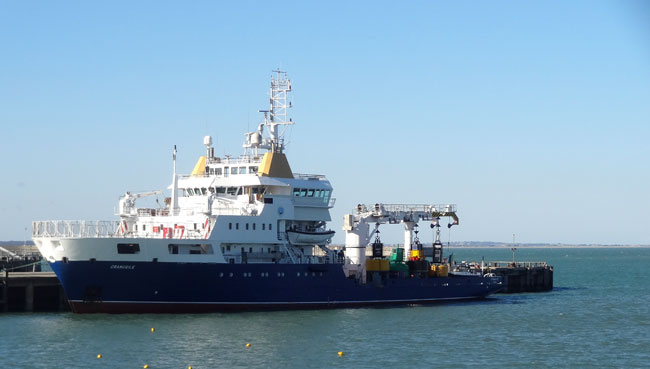
Granuaile lying alongside in Dún Laoghaire Harbour, Co Dublin. Photo Gillian Mills
CIL has provided AtoN services in Ireland for over 200 years. While the time of the lightkeeper is no longer since automation in 1996, ensuring safe passage is essential to CIL's service to mariners.
Irish and UK AtoN are monitored 24 hours-a-day via sophisticated network of remote coastal communication links. This ensures that Ireland's coastal navigation network of 72 lighthouses, 29 beacons and 118 buoys meets the international availability standard of 99.8%, giving all mariners a high degree of confidence and security for passage planning.

Publication of new Ship Registration Bill
Ireland's Minister for Transport, Tourism and Sport, Leo Varadkar has announced the publication of the Merchant Shipping (Registration of Ships) Bill 2013.
The Bill is one of the Minister’s legislative priorities and is part of an overall objective to update and enhance the national maritime legislative code, and to ensure the safety of maritime transport services.
This Bill is set to bring Ireland's ship registration system in Ireland up to date and will replace the existing arrangements that have been in place since 1955
According to the department, the importance of ship registration is that it confers Irish nationality on ships, allowing them to fly the Irish flag and to register ownership. The new Bill will provide a basis for the introduction of an updated and modernised ship registration system in Ireland.

Ireland challenged to become a global maritime leader
At the annual IMERC conference at the National Maritime College of Ireland , Chris Roche, Chief Technical Officer of EMC, EMEA (Europe, Middle East, Africa), challenged participants to ‘make the leap’ to disruptive innovation to help Ireland realise its ocean potential. The government aims is to increase turnover from the sea to €6.4 billion by 2030.
A disruptive innovation is an innovation that disrupts, improves and replaces an existing product, process approach or idea over time in unexpected ways.
Commodore Mark Mellett, Irish Naval Services; Michael Delaney, Acting Head of College, National Maritime College of Ireland; Dr Val Cummins, Director IMERC; David Stanton TD; Major General Ralph James, Deputy Chief of Staff, Irish Defence Forces
“It’s fantastic to see a cluster around such an obvious potential benefit to the country. The major question is [whether] IMERC will move at enough speed and really embrace disruptive innovation?”
He added that while Ireland was not among countries with the longest coastlines it does however have the largest maritime to land mass area in the EU and is the third largest territory in the EU when its seabed is included. This means the maritime sector has huge growth possibilities for the Irish economy.

Killiney hotelier appointed as new chair of Dún Laoghaire Harbour Company
Eithne Scott Lennon, CEO of Fitzpatrick's Killiney Castle Hotel, has been appointed chairperson of Dún Laoghaire Harbour Company by the Minister for Transport, Tourism and Sport, Leo Varadkar.
Ms Scott Lennon's five-year appoinment, the first female chair of the harbour company, has been an active member of the harbour company board since 1994. She played a significant role in the development of the Masterplan, which aims to realise the harbour's potential as a 'major marine, leisure, cultural and tourism desitnation', as well as securing its long-term viabiity.
Eithne Scott Lennon, chair, Dún Laoghaire Harbour Company
"Dún Laoghaire has been designated as a centre for marine-related tourism under the National Ports Policy. I believe that the harbour has huge potential as a tourism destination...
Maritime Spatial Planning from a fisheries perspective
Francis O’Donnell, Federation of Irish Fishermen
Maritime spatial planning is an important concept but what does it actually mean? The language itself can be technical and jargoned for those not attached to the various marine sectors. In the main it means having a plan to share our marine space between stakeholders interested and involved in commercial fisheries, aquaculture, shipping, ecosystem conservation, hydrocarbon extraction, renewable energy, marine tourism and leisure.
Demand for space in the marine environment across Europe is increasing, as we turn to the sea to answer the many economic challenges we are facing. As the demand grows for that space, conflict will surely follow. It is envisioned that maritime spatial planning will attempt to reduce potential friction between sectors and identify sustainable uses of the maritime space with climate change being a fundamental pillar to guide this process.

Dedicated research and innovation hub opens at maritime centre of excellence
The launch of the Halpin Centre for Research and Innovation at the National Maritime College of Ireland (NMCI) has been welcomed as an exciting development that will further enhance the NMCI’s growing international reputation as a centre of maritime excellence.
“This completes the internal development of the NMCI,” Cormac Gebruers, Deputy Director of the Irish Maritime and Energy Resource Cluster (IMERC) and manager of the Halpin told Inshore Ireland.
(L-R): Cormac Gebruers (Manager, Halpin Centre); Dr Brendan Murphy (President, CIT); Minister of State Sean Sherlock; Commodore Mark Mellett (Flag Officer commanding the Naval Service); Michael Delaney (VP Development CIT, Acting Head NMCI), Dr Val Cummins (IMERC Director) and Commander Dave Barry (Associate Head of College, NMCI)
“I see the Halpin Centre for Research and Innovation as a key pillar of the rapidly developing iMERC Campus at Ringaskiddy and will greatly facilitate and enhance the research inputs of both Cork Institute of Technology (CIT) and the Irish Naval Service in overall research effort in maritime and sustainable energy,” he added.

Dublin hosts Tall Ships 2012
An estimated 1.4 million people from across the island of Ireland and beyond gathered in Dublin in August for the four-day Tall Ships Race 2012 festival.
The 40-strong fleet comprising many different classes of vessels lined the city’s north and south quays, creating a maritime scene reminiscence of times gone by.
The Naval Service LE Emer led the parade of sail out of the port on departure Sunday along a course towards Dún Laoghaire before taking a 21-gun salute that saw the fleet disperse towards Howth on the north side of Dublin bay.
‘Radical overhaul’ of National Port Policy
Government is to have a more 'hands-on role' in the maritime ports sector under a new National Ports Policy outlined by the Minister for Transport, Tourism & Sport, Leo Varadkar.
Shareholders will be encouraged to take an 'activist approach' to managing their ports 'to ensure the State gets best value...whether that shareholder is the government or the local authority', according to the department.
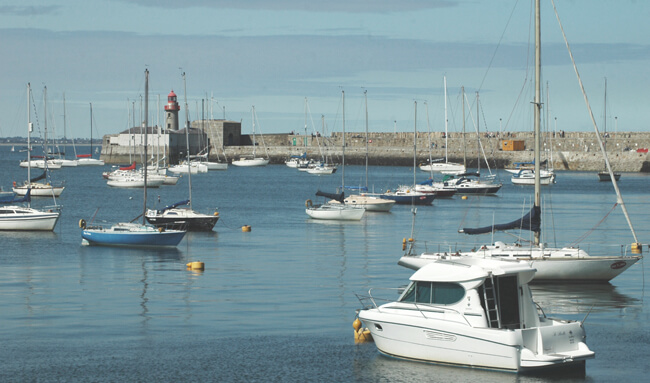
Dun-Laoghaire - Port of National Significance under new National Ports Policy - will be placed within a local authority-led governance structure with local authorities taking a shareholding. Photo Gillian Mills
It adds that previous policies 'have not recognised the huge diversity among the 19 ports that handle commercial freight.' The core objective is to facilitate a 'competitive and effective market for maritime transport services'.