
 https://oceanfocus.ie/wp-content/uploads/2020/05/Ocean_Focus_marine_Publication.png
0
0
Guest Writer
https://oceanfocus.ie/wp-content/uploads/2020/05/Ocean_Focus_marine_Publication.png
Guest Writer2012-09-03 22:19:522019-02-14 09:23:40Ports and shipping identified as ‘important engines’ for economic growth
https://oceanfocus.ie/wp-content/uploads/2020/05/Ocean_Focus_marine_Publication.png
0
0
Guest Writer
https://oceanfocus.ie/wp-content/uploads/2020/05/Ocean_Focus_marine_Publication.png
Guest Writer2012-09-03 22:16:522019-02-14 09:23:32Marine biomass to play major role in supplementing world energy requirements?…
https://oceanfocus.ie/wp-content/uploads/2020/05/Ocean_Focus_marine_Publication.png
0
0
Guest Writer
https://oceanfocus.ie/wp-content/uploads/2020/05/Ocean_Focus_marine_Publication.png
Guest Writer2012-09-03 14:49:112019-02-14 09:23:25Small is beautiful, but fluffy round the edges…
https://oceanfocus.ie/wp-content/uploads/2020/05/Ocean_Focus_marine_Publication.png
0
0
Guest Writer
https://oceanfocus.ie/wp-content/uploads/2020/05/Ocean_Focus_marine_Publication.png
Guest Writer2012-09-03 14:46:352019-02-14 09:23:14As Lough Corrib degrades, who supervises the supervisors?
https://oceanfocus.ie/wp-content/uploads/2020/05/Ocean_Focus_marine_Publication.png
0
0
Guest Writer
https://oceanfocus.ie/wp-content/uploads/2020/05/Ocean_Focus_marine_Publication.png
Guest Writer2012-09-03 22:19:522019-02-14 09:23:40Ports and shipping identified as ‘important engines’ for economic growth
https://oceanfocus.ie/wp-content/uploads/2020/05/Ocean_Focus_marine_Publication.png
0
0
Guest Writer
https://oceanfocus.ie/wp-content/uploads/2020/05/Ocean_Focus_marine_Publication.png
Guest Writer2012-09-03 22:16:522019-02-14 09:23:32Marine biomass to play major role in supplementing world energy requirements?…
https://oceanfocus.ie/wp-content/uploads/2020/05/Ocean_Focus_marine_Publication.png
0
0
Guest Writer
https://oceanfocus.ie/wp-content/uploads/2020/05/Ocean_Focus_marine_Publication.png
Guest Writer2012-09-03 14:49:112019-02-14 09:23:25Small is beautiful, but fluffy round the edges…
https://oceanfocus.ie/wp-content/uploads/2020/05/Ocean_Focus_marine_Publication.png
0
0
Guest Writer
https://oceanfocus.ie/wp-content/uploads/2020/05/Ocean_Focus_marine_Publication.png
Guest Writer2012-09-03 14:46:352019-02-14 09:23:14As Lough Corrib degrades, who supervises the supervisors?
Shad magic in May
Brendan Connolly
St Mullins is a beauty spot and ancient ecclesiastical site where the Barrow River forms the boundary between counties Carlow and Kilkenny. Here the river valley is steep sided and covered in mature woods. Despite being more than 50 km from the sea the tide reaches St. Mullins. It is this last section of tidal water that is the best known shad fishing stretch in Ireland.
Brian Lowth with a fine 1 kg Twaite Shad he caught at St Mullins. Photo Brendan Connolly
Twaite Shad (Alosa fallax) is a member of the herring and sprat family; however unlike its smaller cousins, it enters freshwater via a number of rivers along the south coast to spawn from the end of April and during May. This ‘anadromous’ migration (from sea to freshwater) makes St Mullins the hotspot in Ireland for shad fishing.

What lies ahead for the seafood development agency?
The Public Service Reform Plan published on November 17 notes the IMDO and BIM to be: Candidate bodies for critical review by end June 2012.
Inshore Ireland asked Francis O’Donnell, CEO of the Irish Fish Producers Organisation (IFPO) if he thought BIM should remain a stand-alone agency or should be subsumed into its parent department, the Department of Agriculture, Food and the Marine:
Francis O'Donnell, IFPO
In the current climate tax payers need to see value for money and the streamlining of services where possible and practical. Equally, as an organisation that works closely with BIM it would be easy to be critical that such a review is happening at all. Reviews are what governments do. We cannot have an ‘a la carte’ approach – it would be disingenuous to say the least.
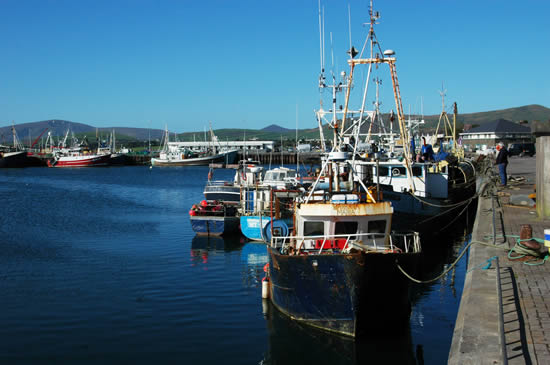
Do new harbour charges threaten growth in marine leisure sector?
David Branigan
The statutory instrument enabling the Fishery Harbour Centres (Rates & Charges) Order 2012 has still to be signed into law by Simon Coveney, the Minister for Agriculture, Fisheries & Marine.
Dingle Harbour is one of the five Fishery Harbour Centres that will be impacted by the increases. Photo Gillian Mills/ Inshore Ireland
A wide range of charges were provided for under the Order, and the inclusion of fees for marine leisure activities attracted a strong response from the Irish Marine Federation which is concerned that development of the sector might be adversely affected.
https://oceanfocus.ie/wp-content/uploads/2020/05/Ocean_Focus_marine_Publication.png
0
0
Guest Writer
https://oceanfocus.ie/wp-content/uploads/2020/05/Ocean_Focus_marine_Publication.png
Guest Writer2012-09-03 14:31:502019-02-14 09:19:55EU fisheries ministers quash proposed privitisation of fish quotasInternational trade has major impact on ‘water frootprint’
A study by the Water Footprint Network (WFN) analysing the quantity and distribution of global water use (1996-2005), calculates the water footprints of individual countries based on their production and consumption, and uses visually-striking graphics to display the pathways of the world’s largest virtual water movements.
First introduced in 2002 at the University of Twente in the Netherlands, the water footprint concept is a measure of ecological impact comparable to the better-known carbon footprint but focusing on freshwater.