
 https://oceanfocus.ie/wp-content/uploads/2020/05/Ocean_Focus_marine_Publication.png
0
0
Guest Writer
https://oceanfocus.ie/wp-content/uploads/2020/05/Ocean_Focus_marine_Publication.png
Guest Writer2011-11-18 14:54:292019-02-14 08:54:10Commission proposes a total ban on cod fishing in the Irish Sea in 2012
https://oceanfocus.ie/wp-content/uploads/2020/05/Ocean_Focus_marine_Publication.png
0
0
Guest Writer
https://oceanfocus.ie/wp-content/uploads/2020/05/Ocean_Focus_marine_Publication.png
Guest Writer2011-11-18 14:54:292019-02-14 08:54:10Commission proposes a total ban on cod fishing in the Irish Sea in 2012
World’s largest maritime centre of excellence to be based in Rebel County
Ireland is on the threshold of moving centre stage in the world of maritime enterprise with the announcement that the largest marine renewable energy research centre – the Beaufort Laboratory – which will be constructed by 2013.
Beaufort – which is already attracting the interest of maritime-related companies world-wide will be the flagship of the Maritime and Energy Research Campus and Commercial Cluster (MERC3) – an already unique and viable partnership that includes the Irish Naval Service, University College Cork, the Cork Institute of Technology and the National Maritime College of Ireland at Ringaskiddy.
Irish Naval Service Personnel graduating from the NMCI
Commodore Mark Mellett, Flag Officer with the Irish Naval Service and Dr Valerie Cummins, Director of MERC3 – joint managers at the centre of this new development – spoke to Inshore Ireland about their separate but complementary roles and of the targets they have for unlocking the vast potential at the heart of maritime Ireland.
https://oceanfocus.ie/wp-content/uploads/2020/05/Ocean_Focus_marine_Publication.png
0
0
Guest Writer
https://oceanfocus.ie/wp-content/uploads/2020/05/Ocean_Focus_marine_Publication.png
Guest Writer2011-11-17 16:26:052019-02-14 08:53:48Jobs bonanza forecast for ocean energy sector – but only with government action
Hobblers Challenge in Dublin Bay
J Ashmore
Ringsend-based St. Patrick’s Rowing Club’s skiff Naomh Padraig under the coxswain of Ken Cunningham took line honours in a time of 2:57:36 for the much coveted Hobblers Challenge cup. Courtown Harbour Rowing Club took second place (3:3:19) and third place honours went to Stella Maris Rowing Club (3:16.00). Host club, St Michaels based in the Coal Harbour Dún Laoghaire, passed under the high walls of the East Pier Lighthouse and battery two minutes later in fourth place.
2011 Hobblers Challenge, Dún Laoghaire, Co Dublin Photo Gillian Mills
Ten boats from four East coast skiff rowing clubs participated in the end-of-season Hobblers Challenge – a gruelling 25km rowing race from Dún Laoghaire Harbour to the Kish Lighthouse and back.
The race is held in memory of the men known as ‘Hobblers’ who once rowed out to met ships at anchor in Dublin Bay and along the east coast. The first hobbler to reach a ship and land a hook on deck was awarded pilotage and unloading of the cargo. The trade survived until the 1930s when the last of Irish Sea trading schooners disappeared.

Recreating history that goes back over a Millennium
Construction of a replica 40ft Viking longboat in Waterford City by 18 FÁS students under the watchful eye of shipwright, Michael Kennedy is almost complete. Final work on rigging the sails, setting reefing pennants and making the oars is underway, along with some minor work on the rudder.
Waterford has a very strong Viking heritage, dating back as early as 812 when Vikings settled in Woodstown near Mount Congreve. In 914 however they moved to a new settlement, Waterford City, which became a well-defended stronghold that survived and prospered.
New system provides real-time snapshot of fishing activity
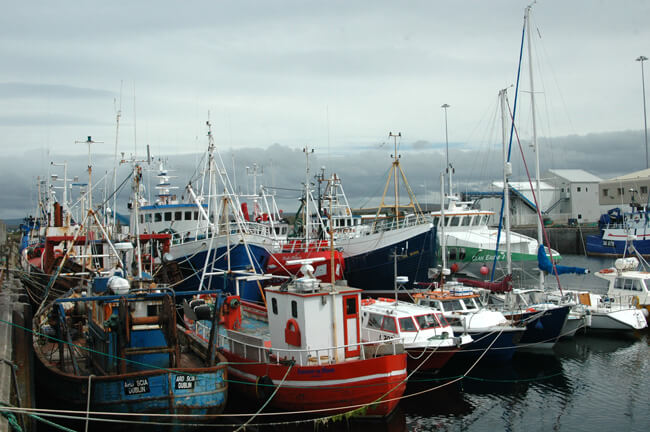
In 2009, the European Council of Fisheries Ministers agreed to the phased introduction of an electronic logbook to replace paper recording of fishing vessel activity. This system is known as an Electronic Recording and Reporting System (ERS).
| Implementation timetable across vessel sizes:
|
The decision of the Council of Fisheries Ministers and the subsequent regulations implementing this decision by the European Commission was strongly supported and welcomed by the Irish authorities. The ERS system for the first time will give the Irish fisheries control authorities real-time access to logged fish catch data of all fishing vessels operating in the Irish 200 nautical mile European Economic Zone (EEZ). It will also allow for real-time management of fish quotas.
Until now, fishing vessels operating within Ireland’s EEZ but not landing into Irish ports did not have their recorded catches verified by Ireland unless boarded at sea by the Irish Naval Service. Given that 300-500 vessels can operate within this area at any one time, it is clear this system will be an essential element in ensuring a level playing field throughout Europe.
https://oceanfocus.ie/wp-content/uploads/2020/05/Ocean_Focus_marine_Publication.png
0
0
Guest Writer
https://oceanfocus.ie/wp-content/uploads/2020/05/Ocean_Focus_marine_Publication.png
Guest Writer2011-11-17 14:36:332019-02-14 08:52:47Shortage of Irish ocean energy graduates could lead to overseas job opportunities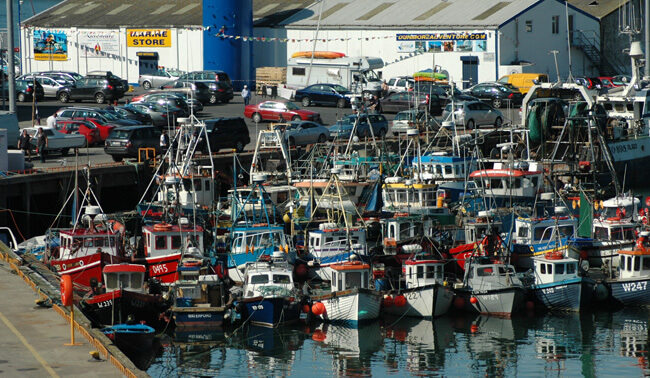
Inshore fisheries management: a tale of lost opportunity?
The inshore fleet at Dunmore East, Co Waterford. Photo Gillian Mills/Inshore Ireland
The inshore fisheries sector, comprising the vast majority of registered vessels in the Irish fleet, is critically important to coastal communities, offering employment in remote, inaccessible areas that see little commercial traffic travelling towards their villages.
As a majority of the species fished are not governed by EU quota, it falls on the Irish State to deliver responsible and effective management. Notwithstanding, no such regulatory system is in place, and without the imperative to curtail annual landings, many shellfish stocks are close to over exploitation.
To address this situation, a Shellfish Management Framework was introduced in 2005, designed to provide an integrated co-management structure. Six years later however, many stocks remain fully exploited and catch rates have declined to a level that is adversely affecting the economic viability of the fleet.
Irish and UK scientists explore uncharted deep-sea vent field
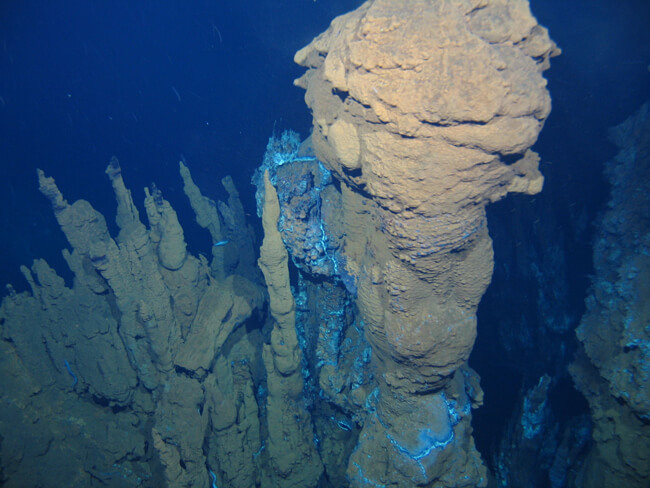
Giant dormant vent on the Moytirra field
John Joyce, Marine Institute
An Irish-led team of scientists from Ireland and the UK has discovered a previously uncharted field of hydrothermal vents along the Mid-Atlantic Ridge – the first to be explored north of the Azores. The VENTuRE mission, led by Dr Andy Wheeler of University College, Cork (UCC), together with scientists from the National Oceanography Centre and the University of Southampton in the UK, NUI Galway and the Geological Survey of Ireland (GSI) spent twenty-five days at sea on board the national research vessel RV Celtic Explorer on an investigation 3,000 metres below the surface of the sea, using the Remotely Operated Vehicle (ROV) Holland 1.
The team comprised many disciplines including marine geologists and geochemists to study the hydrothermal vents, as well as marine geneticists and biologists whose main interest was the new and unusual life forms that live in this harsh and forbidding environment.