A day in the life of RV Keary
David Hardy,GSI
The RV Keary is a 15m aluminium catamaran, built for and operated by the Geological Survey of Ireland (GSI) [www.gsi.ie]. Its primary function is to provide an inshore survey capability for the national INFOMAR programme (INtegrated Mapping FOr the Sustainable Development of Ireland’s MArine Resource) [www.infomar.ie].
As a small inshore survey vessel, she normally operates with a crew of three: two serving as scientists/deckhands, while the third is the vessel’s skipper. For extended operations, a fourth crew member serves as a relief watch officer.
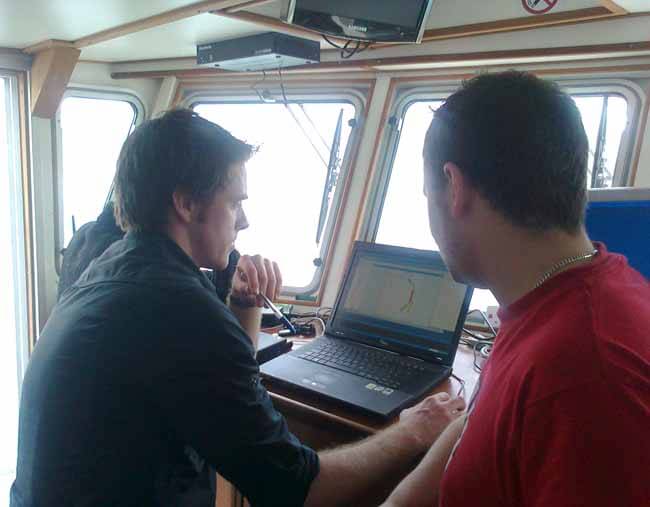
Ronan O'Toole and Niall Finn quality check data in real-time
The boat has two cabins with two bunks in each; a toilet/shower area and a small compact galley. Most of the internal space is dedicated to the precision depth finding equipment, high resolution GPS system, ancillary sensors and related IT infrastructure.
 https://oceanfocus.ie/wp-content/uploads/2020/05/Ocean_Focus_marine_Publication.png
0
0
Guest Writer
https://oceanfocus.ie/wp-content/uploads/2020/05/Ocean_Focus_marine_Publication.png
Guest Writer2011-05-12 12:29:482019-02-13 17:44:16Ireland’s fishing industry today
https://oceanfocus.ie/wp-content/uploads/2020/05/Ocean_Focus_marine_Publication.png
0
0
Guest Writer
https://oceanfocus.ie/wp-content/uploads/2020/05/Ocean_Focus_marine_Publication.png
Guest Writer2011-05-10 12:26:102019-02-13 17:44:18Is climate change already impacting aquaculture?
https://oceanfocus.ie/wp-content/uploads/2020/05/Ocean_Focus_marine_Publication.png
0
0
Guest Writer
https://oceanfocus.ie/wp-content/uploads/2020/05/Ocean_Focus_marine_Publication.png
Guest Writer2011-05-09 12:28:432019-02-13 17:38:37Breakthrough in shrimp farming
https://oceanfocus.ie/wp-content/uploads/2020/05/Ocean_Focus_marine_Publication.png
0
0
Guest Writer
https://oceanfocus.ie/wp-content/uploads/2020/05/Ocean_Focus_marine_Publication.png
Guest Writer2011-05-12 12:29:482019-02-13 17:44:16Ireland’s fishing industry today
https://oceanfocus.ie/wp-content/uploads/2020/05/Ocean_Focus_marine_Publication.png
0
0
Guest Writer
https://oceanfocus.ie/wp-content/uploads/2020/05/Ocean_Focus_marine_Publication.png
Guest Writer2011-05-10 12:26:102019-02-13 17:44:18Is climate change already impacting aquaculture?
https://oceanfocus.ie/wp-content/uploads/2020/05/Ocean_Focus_marine_Publication.png
0
0
Guest Writer
https://oceanfocus.ie/wp-content/uploads/2020/05/Ocean_Focus_marine_Publication.png
Guest Writer2011-05-09 12:28:432019-02-13 17:38:37Breakthrough in shrimp farming
Is the Commission’s stance on fish discarding a kneejerk reaction?
At a specially convened meeting of EU member states, Maria Damanaki, European Commissioner for Maritime Affairs and Fisheries, starkly told delegates she considered the practice of fish discarding ‘unethical, a waste of natural resources and a waste of fishermen’s effort’.
And she added that if 2004 FAO estimates of 7.3 million tonnes or 8% of the total fish catches being discarded was not striking to some members, ‘European fisheries are doing much worse than the global average,’ where discarding in the whitefish fishery is up to 50 per cent and 70 per cent in the flatfish fishery.
The net is never taken from the water - it is simply opened to release the fish, the majority of which are already dead. These fish are not accounted for and the extent of the damage is unknown
‘If we continue with our policy, then we will soon face a situation where the production capacity of marine ecosystems is at risk,’ she warned.
Outlining her basic ideas, Commissioner Damanaki said the approach should be gradual, ‘starting with pelagic fisheries and then to cover a few important demersal mixed fisheries after a short phase in period. The list of species covered could be enlarged year by year,’ she explained.
Bord Bia food initiative in Spain
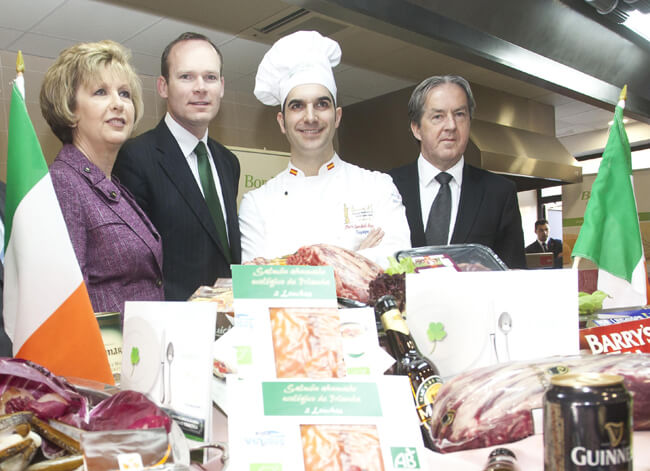
President Mary McAleese has launched a Bord Bia initiative in Spain designed to boost the image and reputation of Irish food in the Spanish market. The project involves reaching out to student chefs at top catering schools across Spain to build stronger relationships with the future generation of chefs and to establish an awareness of, and loyalty to, Irish produce.
Minister for Agriculture, Food and the Marine, Simon Coveney; Michelin star chef, Mario Sandoval and Aidan Cotter, Bord Bia
The President also attended the first of a series of ‘Irish Food Master Classes’ conducted by the internationally renowned Michelin star chef Mario Sandoval. These classes will provide trainee chefs with an insight and understanding of Ireland’s unique food and drink product offerings and highlight Ireland’s commitment to quality and sustainability.

Anglers catch 607 specimen fish in 2010
Brendan Connolly
As an angler, you know your local fishing waters best - be they fresh-water or sea. But, what happens if a sea angler wants to go pike fishing for a change, or if a coarse fisherman would like to try sea angling?
They may not know the best angling locations and therefore have to try and get local information of various areas to decide where to go. Local knowledge may not be easy to get if you don’t know any local anglers.
Angling journalist Mike Thrussell with a bluemouth
There is one source that provides anglers with information about any fish species caught on rod and line, in freshwater and sea alike, relating to the whole island of Ireland.
This is the Annual Report of the Irish Specimen Fish Committee, which is available free of charge from the Inland Fisheries Ireland, Swords Business Campus, Balheary Road, Swords, Co. Dublin. (www.fisheriesireland.ie)
Striving for sustainable resource management in Foyle and Carlingford areas
The Loughs Agency is a cross-border body, exercising a statutory remit for conservation, protection and development across the Foyle and Carlingford catchments. Our objectives for these river systems and sea areas include development of fisheries and aquaculture, conservation and protection of fisheries and sustainable development of marine tourism. The Agency also has a fishery protection function and fisheries and aquatic environment monitoring and reporting responsibility.
Loughs Agency fishery inspectors and officers enforce parallel primary legislation and associated regulations within those parts of the Foyle and Carlingford areas that lie within Northern Ireland and the Republic of Ireland.
https://oceanfocus.ie/wp-content/uploads/2020/05/Ocean_Focus_marine_Publication.png
0
0
Guest Writer
https://oceanfocus.ie/wp-content/uploads/2020/05/Ocean_Focus_marine_Publication.png
Guest Writer2010-08-30 16:10:192019-02-13 17:37:43Overhaul of water governance required to ensure cross agency cooperation