Cork reports robust cruise business despite economic downturn
John Hearne
Brendan Keating took an atypical route to his stewardship of the Port of Cork Company. A native of Galway, he completed his secondary education in Rockwell College in Tipperary before taking a B Comm in University College Galway.
He then embarked on a career in local government which saw him move from Meath to Cork, where he was assistant city manager, before moving north to Limerick, where he became city manager in 1999.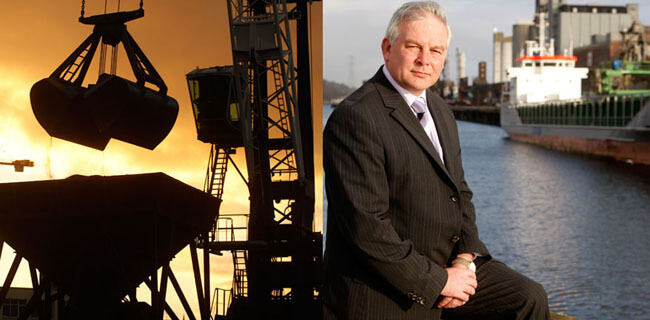
Returning to Cork in 2002 to become chief executive of the port company, he says that all those years in local government have proved invaluable.
“The environment is different in that you’re operating in a commercial world in the port business. But from a managerial perspective, very many of the issues remain the same. The experience I had has stood me in good stead in this business.”
How is the Port doing? Is there any indication that the downturn may be running out of steam?
In the circumstances, we’re doing ok. Trade is down 18% on average, but despite that, we’re of the view that the climate may have bottomed out for the most part. The figures are finally beginning to hold, but we’re only looking at the last two months of data, so it’s difficult to give a definitive position right now. We’re still confident that the worst of it is over.
Are there any particular areas doing better than others?
Let’s put it this way: The load on/load off business appears to have bottomed out. We would always have had a very strong export business, so that side of the house is holding up ok. We have a strong industrial base in this region, that being Cork/Kerry and the mid-west, and the Port of Cork has established itself as the export port for the majority of the goods. We’re also very dependent on the agricultural sector and the volume of trade it generates for the region.
Have you had to lay off workers?
Yes, we’ve had to lay some people off, plus we’ve not filled vacancies as they arose. We’ve always been very conscious of managing our costs, but more particularly in 2009 we have had a very strong drive towards managing our cost base and ensuring at all times that our costs are reasonable.
In March of this year, we had a major rationalisation programme which saw the elimination of the casual dock labour system. That was done in association with the stevedores and of course the various different port customers. That has allowed us to be much more cost effective and to be responsive to the needs of our customers.
The big news last year was An Bord Pleanála’s rejection of your application to develop new port facilities in Ringaskiddy. Was this a big disappointment for the company?
We were very surprised and extremely disappointed because Ringaskiddy had been identified in the Cork County Development Plan as the location for future port development. Equally, it had been identified in the Cork Area Strategic Plan in 2002 and before that in the Cork Land Use and Transportation Study, which was initially advanced in 1973-76 and was further revised in the early eighties, so from our perspective, we found we had little choice but to advance proposals for Ringaskiddy.
But the decision is the decision and we have to live with it. Following the rejection, we undertook a very comprehensive evaluation of the material we submitted. We brought in independent consultants who spoke directly to the board with regard to the process, and arising from that we’re very confident that we can overcome the issues.
To that end, we’ve started a major review of our strategic plan, and we’re now evaluating a number of sites in Cork harbour to ensure that the site, when selected for this new facility, will have been subjected to a robust selection process. Next time round, it will stand up to scrutiny from bodies such as Bord Pleanála.
In rejecting the application, Bord Pleanála cited road and rail infrastructure issues. In choosing the site for the next application, what criteria have you been looking at?
We have to assess suitability from a number of perspectives, the priority being depth of water, but also land connections and the road/rail issues. We have to ensure that they’re all evaluated and that appropriate weighting is attached to all the relevant issues, including environmental issues. Engagement with local communities is also key to ensuring that any issues or fears among communities are listened to and dealt with.
In that context, each heading is looked at and the board ultimately chooses the most appropriate site. After all of that, the next stage would be to advance a planning application, which we hope would be successful.”
So the commitment to redevelopment is as strong as ever. What’s the main driver here?
We have to develop. Ships are getting bigger all the time, requiring deeper water all the time. We have to be able to turn them efficiently and while we’re able to handle them very well in our existing container terminal in Tivoli, we are anticipating challenges down the road and we want to be prepared for what the next generation of shipping will bring our way.
You invested heavily in cruise terminal facilities at Cobh two years ago. Is that investment paying off?
Yes. We’ve been very encouraged with the growth in the cruise business that we’ve enjoyed in 2008 and 2009. We had 51 calls in 2008 and 54 in 2009. Obviously, we always had confidence that there was significant growth potential in the cruise sector, and we’re delighted that our confidence has been vindicated by the increase in business. This year a total of 103,273 passengers and crew visited Cork, a record number for the Port of Cork.
How many arrivals are you expecting for 2010?
We expect to handle 50 vessels, just a marginal reduction on last year, but it changes on a monthly basis; you lose some, you pick up others. The great advantage the Port of Cork has is that we can handle the larger vessels thanks to our dedicated cruise facilities in Cobh, plus the draft availability – we can take vessels drawing in excess of 8m of water. The cruise business is hugely beneficial to the south west region. Between direct and indirect spend, we reckon it’s worth in excess of €45m to the region, and it’s an area in which we see considerable additional potential for growth and one we’re going to continue to give priority to into the future.
The reinstatement of the Cork/Swansea ferry is another major boost to the region
Yes. Fastnet Lines are in the throes of a major fundraising venture. They need to raise about €2.5m to put the necessary working capital in place so that the vessel can operate efficiently. While they are challenged by the process, there’s a confidence that it will sail and be operational in March 2010.
There’s been a lot of talk too about a new ferry service serving northern Spain – what’s the latest on that?
We’ve been trying to promote this service for quite some time. We identified a gap in the market, and we have been promoting that with the shipping companies and also with the Port of Gijon in northern Spain, with whom we have established a partnership. There are a number of people examining the proposition at the moment, and we expect we will have a decision on it by the end of the year. If that goes the right way, we’re hopeful that there will be a new service operating in late January or early February next year.
We’re also hoping that we can establish a relationship with ports on the western coast of France, but the Spanish service should open up the potential for servicing the food markets of Spain, and there would also be opportunities for taking fresh fruit and vegetables up to Cork from Spain. There’s quite a level of interest from hauliers in this particular region, who feel that they’re challenged on a continual basis by the road bridge through the UK. If it goes ahead, this service would have the effect of reducing the volume of trucks trundling through the UK.
There have been issues with Cork City Council over the pace and scale of developments in the docklands – how are those being worked out?
There have been issues with Cork City Council over the docklands, but first and foremost, let me state that the Port of Cork Company is very supportive of the redevelopment of the Cork docklands region. We feel that it offers a very strong and environmentally sustainable redevelopment proposition and will also serve to strengthen the economic capability of the region.
We feel however that no development can take place in the docklands until there’s agreement on the relocation of the Port of Cork. And from where we sit, that involves the acquisition of the City Quays. Once there’s agreement on that, the Port of Cork can proceed to invest in the provision of replacement facilities.
While we are wholly owned by the state, we are a limited liability company, and we exist for the purpose of facilitating trade, so therefore any assets assigned to other uses will have to be replaced so that the trading capability of the company is not compromised.
Do you think the City Council understand and accepts this?
Well, in their development plan, Cork City Council has set down in black and white that the expansion and development of the Port of Cork will be facilitated and encouraged. There are however other aspects such as the timing of the construction of bridges that we haven’t always been able to agree on.
Having said that, there was a review recently of the south docks area plan and in that, Cork City Council agreed that, on the issue of bridges, that there would be a process which would involve first, the provision of one bridge, then the relocation of the Port of Cork, then the provision of the second bridge. From our perspective, that’s a satisfactory outcome.
Given the growth of the marine leisure sector in recent years, you also have development plans in that area?
Yes, we are looking at a number of proposals right now. We’re committed to participating in the development of the leisure business in Cork Harbour. We see it as an element of the business. It has some commercial potential, but more particularly it helps us to support the cruise business and also to support communities within the harbour who would want to develop their leisure activities and relationships with the water. Cork harbour is the second largest natural harbour in the world, with very significant potential for increased leisure activity.
You were awarded the ISO14001 environmental accreditation last year – how has this impacted the Port’s activities?
“It re-enforces our commitment to ensuring that activities in the port are undertaken in a sustainable way and that, where we can, we minimise the impact of our activities on the communities which we operate adjacent to. For example, we’ve improved significantly our methodologies for handling dusty cargo. That’s not to say we haven’t room for improvement, but we have a framework for doing that now, and we have an accreditation process to ensure it is sustained.
Is there much sympathy locally for the Port and its activities? Is there an understanding of how important you are to the economic success of the region?
I think there’s a greater understanding of it in 2009 than there would have been in earlier years. We’ve found that as a consequence of engaging with the general public, particularly through the different business associations in Cork and the south west region. Business people are in absolutely no doubt as to the critical nature of an efficient deep water port serving the region.
We also reach out to primary school children through our Schools Initiative, whereby we try to educate them on commercial port activity while also raising awareness of our natural harbour and its many benefits. There are community groups who would be concerned with the scale of developments that a major port brings with it, but we will engage and consult with them as best we can, to identify their fears and seek to allay them.