
Forum to help restore native oyster stocks in Irish waters

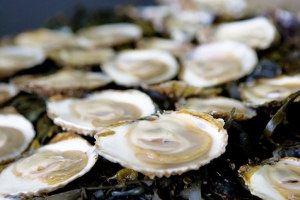
An Irish Native Oyster Forum has been established to help restore native oyster (Ostrea edulis) populations in Irish waters.
The objective is that the Forum will “better influence” policies that may affect native stocks which “remain of high environmental and socio-economic importance to fishing communities,” remarked Patricia Daly, BIM, secretariat.
Earlier this year, the Tralee Oyster Fisheries Society invested in a purpose-built barge to deploy coupelles (spat collectors) in large frames during the summer months.
Juveniles are then stripped from the collectors and held in a designated nursery area until they are large enough to resist predation when restocked in the fishery.
Denis O’Shea and members of the Society visited France last year to learn the techniques of this method of spat collection and to bring back knowledge to Forum members who hope to adopt similar technologies within their own fisheries.
Status and management
During a reference period 2010-2012, the results of fourteen oyster surveys in six bays on Ireland’s west coast prior to and following annual late autumn fisheries were published by the Marine Institute in ‘The Status and Management of Oyster (Ostrea edulis) in Ireland’, compiled by Oliver Tully & Sarah Clarke.
Based on local knowledge of bed distribution, surveys took place in Tralee Bay, Galway Bay, Kilkeran Bay, Clew Bay, Blacksod Bay and Lough Swill, focusing on density, biomass, size composition, growth and mortality.
The majority of national oyster biomass occurred in inner Tralee Bay where it varied from 980-1,1330 tonnes. The biomass in outer Tralee Bay and Lough Swilly was approximately 100 and 1124 tonnes respectively. Estimates in inner Galway Bay, Kilkieran Bay, Clew Bay and Blacksod Bay were all less than 50 tonnes.
Documented history of oyster fishing in Irish waters dates back to the 1500s although records of national production are incomplete. Peak output was in the mid and late 19th century, due significantly to the short-lived offshore fishery in the Irish Sea and the Galway fishery which was important up to the early 20th century.
Overall, long-term trends in national production is of fluctuation with local extinctions or severe declines and various restoration attempts. By 1870, half of Irish production took place from Arklow to Wexford where UK boats also fished large quantities. Production from these beds peaked at 34-38 million tonnes in 1863 and 1864 but had declined dramatically by 1888.
Licencing regimes – from open public access to private licences – were introduced in an attempt to manage the falling stocks. In Arklow, heavy fishing pressure decimated the offshore beds which despite being extensive in area were not highly productive, with sporadic larval retention and settlement.
In coastal bays and estuaries, overfishing or unregulated fishing also played a strong role in stock decline, along with poor compliance with bye-laws as the fishery authorities were debarred from direct enforcement.
Impacts
The authors suggest however it is difficult to separate the effects of fishing from environmental effects on recruitment and productivity over longer periods of time.
‘Cold winters of the 1940s and early 1960s, probably contributed to mortality of spawning stock in shallow water areas and more recently, Bonamiosis infection, first detected in Ireland in 1987, has had a significant deleterious effect on stocks.’
Managing threats to native oyster beds is important to optimising recovery potential, say Tully & Clarke. This would include drainage to potentially increase freshwater volume flow through estuaries, urban development, associated changes in microbiological and viral status of water, and managing non-native species such as the Slipper limpet and Pacific oyster, the latter of which is a major threat to the native oyster stock in Lough Swilly.
The authors concluded in 2012 that from a national perspective, commercial viability of the fishery and prospects for maintaining the populations was ‘at significant risk,’ due to a concentration of biomass in inner Tralee Bay along with low and widely dispersed biomass in other sites, low catch rates irregular recruitment.
‘Managing the recovery of native oyster populations is a more feasible project than restoration of stocks that have gone extinct as has occurred in many areas of the UK. Fishery management plans have a vital role to play in this recovery.’
Forum members
Two representatives from Tralee Oyster Fisheries Society; Clarinbridge Oyser Co-Op; Comharchumann Sliogeisc Chonamara; Clew Bay Oyster Co-Op; Achill Native Oyster Fishermen’s Group; North Mayo Oyster Development Co-Op and Lough Swilly Wild Oyster Society Ltd.
The Forum will meet four times per year with advisors from BIM and the Marine Institute, and is funded under the European Maritime and Fisheries Fund.

