Ireland’s Commissioner says research and innovation policy heads up the political agenda
In November 2009 when European Commission President Mario Barosso offered Ireland’s Máire Geoghegan-Quinn the powerful Research, Innovation and Science portfolio it’s probably true to say that a few eyebrows were raised at home.
And while few doubted Geoghegan-Quinn’s ability to survive in the Brussels hot house, the question was how would someone like her, with no obvious interest or experience in science research, come to grips with one of the Commission’s most wide-ranging, energy-sapping and intellectually-demanding jobs.
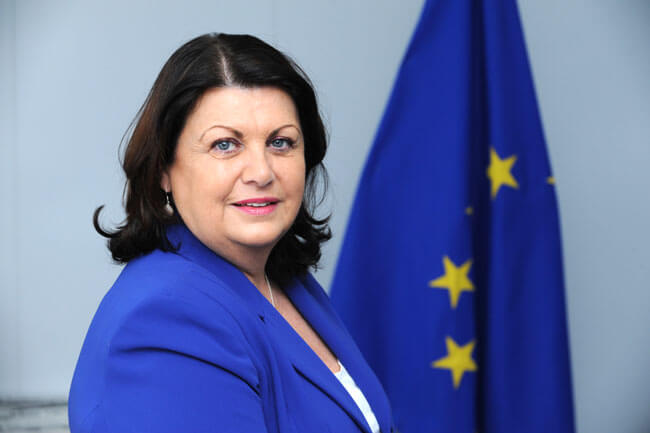
Maire Geoghegan-Quinn, EU Commissioner for Research, Innovation & Science
Two years on however, such doubts have long disappeared and Commissioner Geoghegan-Quinn shows no signs of being a fish out of water. On the contrary, she continues to demonstrate a phenomenal energy and an enviable ability to master even the most complex brief, and is seen to be one of the Commission’s best performers.
Just as importantly, she is still clearly enthusiastic and fully dedicated to her responsibility for EU-wide research, and seems determined to improve conditions amongst the EU research community.
Inshore Ireland spoke to Commissioner Geoghegan-Quinn about how her portfolio impacts on the wider aquatic environment.
What do you hope to achieve during your term as Commissioner for Research Innovation and Science?
I have set ambitious targets in the Innovation Union Flagship – my contribution to delivering the EU 2020 Strategy. I’m pleased to say that research and innovation policy are now firmly at the top of the political agenda as critical factors for European economic recovery, growth and job creation.
It’s important in times of economic crisis to look to growth-enhancing measures.. Innovation Union, which I launched last year, is having an impact and has set the scene for Horizon 2020 – the EU’s new programme for supporting research and innovation (2014-2020). Above all, I would like the public to see the impact of EU- funded research and innovation on their daily lives and on Europe’s future.
What are the highlights of Horizon 2020 – the EU’s growth strategy for this decade?
Stimulating the ‘bioeconomy’, including freshwater and inshore water economic activities, is part of the Europe 2020 growth strategy, and shortly I will be launching a major initiative in this area. It is vital we maintain the health and productivity of our freshwater and inshore ecosystems, which are subject to many natural and man-made pressures. We need research and innovation to tackle challenges and opportunities presented by climate change, scarce resources, and in some cases, poor water management.
You often refer to the ‘i-economy’. What do you mean, particularly regarding the marine and fresh water environments?
I want researchers to work with business and commercial partners to bring innovative ideas to market quickly and efficiently. It will take time to break down existing barriers and tackle the problems affecting small businesses such as access to finance and research. This is an objective of the Innovation Union initiative. In fact, under our current programme, we earmark a significant proportion of our budget to help small businesses. A good example in the freshwater and marine environment area is the European Aquaculture and Innovation Technology Platform where research and industry work together on industry-driven research needs.
Can you sketch some key elements of strategy?
In essence, Horizon 2020 will concentrate European research and innovation efforts in three closely related areas: supporting excellence in the science base; creating industrial leadership and boosting competitiveness and tackling societal challenges. Access to financial support will be simpler and quicker and there will be one-stop-shop assistance especially for newcomers.
The current economic climate is impacting negatively on the R&D community. How best can crucial research be prioritised and funded through a recession?
Innovation Union will improve conditions and access to finance for research and innovation in Europe – particularly important in these difficult economic times. It operates at local, regional, national and EU level. During times of austerity we have to concentrate on issues that have a real impact on the current and future prosperity of Europe. This is the rationale behind Horizon 2020. We also need to ensure we’re not duplicating efforts needlessly across Europe. We still have some way to go before we really have a fully operational European Research Area.
Climate change is now an accepted reality. Where should research be directed in order to minimise infrastructural damage?
Europe has 89,000 km of coastline and is very vulnerable to rising sea levels, so we need to improve our understanding of natural processes and how they are affected by human activities. This means being able to predict and quantify the impact of climate change especially on sea levels, where we are at constant risk of coastal erosion and flooding. Research in this area is essential to provide the evidence necessary for better policy-making and to find innovative ways to minimise the impact. Climate change is one of the major societal challenges that Horizon 2020 will address.
Overfishing is a persistent ecological problem. As Research, Innovation and Science Commissioner how are you contributing to this critical debate?
I am actively involved in this debate, since the Common Fisheries Policy is probably among the most science-based policies in Europe. We must move towards an ecosystem approach to fisheries management where research and innovation is key to reducing the ecological footprint of fisheries on the marine ecosystems.
The reforms proposed by Commissioner Damanaki include transition to the maximum sustainable yield and reduction of unwanted bycatch. Studies are on-going to change fishing practices and develop innovative techniques such as new selective gears and devices. My services in the Joint Research Centre (JRC) have particular expertise in this area, and are working closely with colleagues in the Directorate General responsible for Fisheries and Maritime Affairs.
You say that ‘getting smart’ about our maritime economy will play a vital role in Europe’s economic recovery and that the Smart Seas initiative is critical to underpinning the European economy. What do you mean?
Sea and ocean-related business account for as much as 5% of Europe’s total economic activity. It covers maritime transport, tourism, fisheries, aquaculture and associated food processing. But the potential is even greater, with more than 90% of marine biodiversity remaining unexplored.
In fact, the seas and oceans represent one of the few areas where we can add substantial and sustainable growth to our economy. For example, marine-based biotechnology industry is expected to grow by 10% annually in the next decade.
The seas and oceans also offer enormous potential for offshore renewable energy generation, and of course they contain untapped mineral resources. I believe that Ireland has a unique opportunity – not only because of its strategic location – but because of its particular expertise and research capacity in the Marine Institute and many of our universities and institutes of technology.
Our seas and oceans also play a crucial role in climate regulation and they are heavily affected by human activities and climate change. This is why we must use these resources intelligently. This is what I mean by getting smart. For example, we need to make sure that offshore wind farms have minimal impact on the marine environment, and this means research and design innovation. The same holds for mineral extraction.
The European Research Area (ERA) has been declared. What steps have been taken to ensure that researchers work more closely together?
The European Energy Research Alliance (EERA), between fifteen leading European Research Institutes, supported by the European University Association and the European Heads of Research Councils, has been set up to do exactly that. The EERA conceives and implements Joint Research Programmes in support of the Strategic Energy Technology Plan to pool and integrate activities and resources at national and EU level. In fact, the EERA Joint Programme on Marine Energy has just been officially launched at the SET-Plan Conference on 28-29 November 2011.
What do you mean by ‘bio-economy’?
This encompasses economic activities using biological resources from land and seas for production and processing of products – both in the food and non-food sectors. In the maritime area we have projects on managing deep-sea fisheries; traceability of fish products; escapees in sea-cage aquaculture and even projects investigating how marine bioactive compounds might be used in new drugs against cancer, for example.
The European shellfish sector in particular has suffered from incidences o fmarine biotoxin outbreaks and public health issues. How do we allay consumer fear of consuming shellfish?
The EU has a strong regulatory framework for food safety to provide the highest standards of protection. The European Food Safety Authority carries out regular risk assessments on marine biotoxins in shellfish and of course this is underpinned by sound scientific advice based on research.
Over the years, many EU-funded research projects have addressed this type of hazard and have improved detection technologies. I am convinced we must also work with the aquaculture industry itself. We will soon be funding projects to help the European mollusc industry access research results and use them to improve product quality.
Inshore Ireland regularly covers the marine renewable energy industry, and the opportunities are said to be enormous. How do we avoid duplication of effort and in R&D in this sector?
I mentioned earlier the Strategic Energy Technology Plan. One of its main objectives is to create synergies and to avoid duplication of efforts between the EU and the Member States. A steering group comes up with joint actions through coordinating policies and programmes, makes resources available and monitors and reviews progress in a systematic manner, all fully geared towards reaching our common objectives.
Strategic planning and implementation is assisted by the SETIS – the European Commission’s Information System for the SET-Plan led by the Joint Research Centre, which follows all energy technologies, including marine energy.