Ireland’s maritime safety regulations must be reviewed
All Irish legislative procedures are currently frozen due to the absence of a permanent government following the indecisive February election.
The legislative paralysis will now be prolonged, even if a government is formed in the foreseeable future, due to the biggest crisis in recent history as we cope with the unprecedented COVID-19 pandemic emergency.
What was achieved in Opatija, Croatia, at a High-Level EU Maritime Ministerial conference just a few weeks ago was very important for momentum in implementing international regulation.
I attended the conference as an International Maritime Organisation (IMO) consultant with IMO Secretary General Kitack Lim, where it was my job with Secretary General Lim, and Dr Heike Deggim, Director of IMO’s Maritime Safety Division, to highlight the importance of ratifying the Cape Town Agreement for Fishing vessel Safety 2012 (CTA) so it can come into force.
Inclusion of the CTA at the top of the agenda involved months of negotiation by me on behalf of the IMO in conjunction with the Government of Croatia.
No agreement
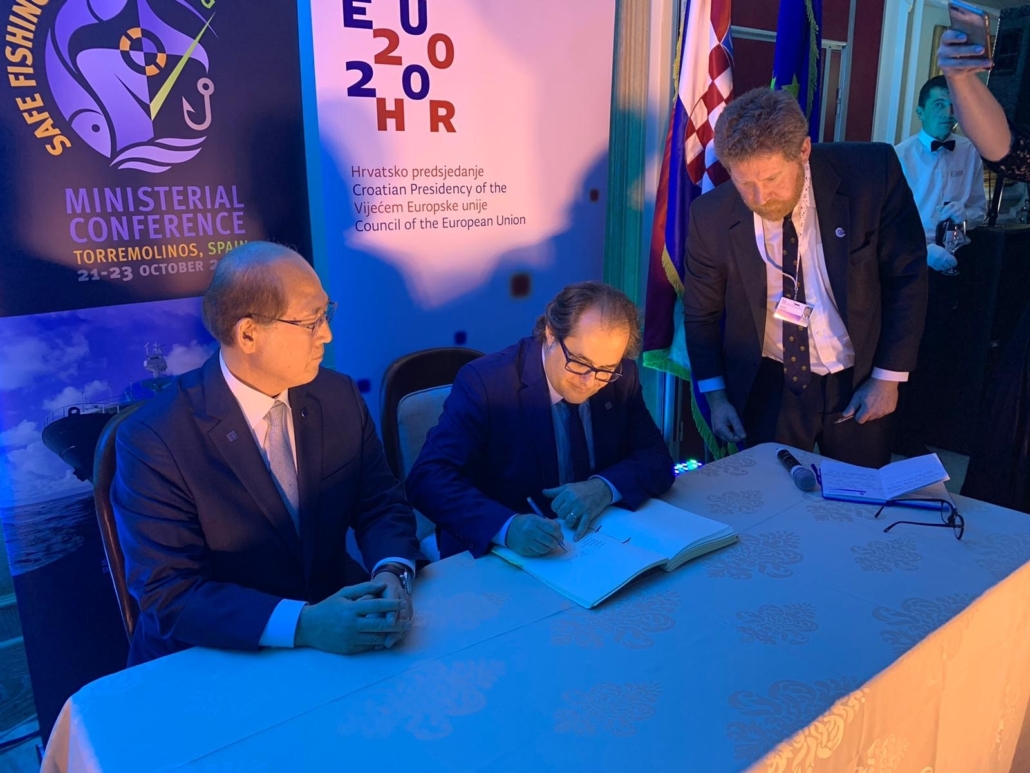
During the conference, further momentum towards implementing the CTA was evident with three more States (Bulgaria, Poland and Portugal) signing the “Torremolinos Declaration” – a formal document under which States publicly indicate their determination to ratify the CTA by the tenth anniversary of its adoption (October 11, 2022) and to combat illegal, unreported and unregulated fishing.
Almost eight years after its adoption, the Agreement has still not entered into force, despite repeated pleas by the IMO’s Maritime Safety Committee, Council and Assembly, and the sustained efforts of the IMO Secretariat to increase awareness of its positive impact and explain its provisions.

Michael Kingston (left); Dr Heike Deggim IMO Director of Maritime Safety Division; IMO Secretary General Lim; Mr Branimir Farkas, Croatian Ministry of Maritime Affairs, Transport and Infrastructure; and Mr Tian-Bing Huang, IMO Maritime Environment Division, during the Opatija, Ministerial conference
Currently, only 14 States comprising 1,425 fishing vessels have consented to be bound by the Agreement. For it to enter into force, 22 States comprising no less than 3,600 vessels (24m in length and above) operating on the high seas, must ratify.
Ireland signed the ‘Torremolinos Declaration’ last October, but to date have still not initiated the ratification process, despite repeated requests to do so.
Ireland originally signed the CTA in 2012 in Cape Town. Why then has nothing happened in the meantime?
Ocean Focus sought clarification from the Department of Tourism and Sport in 2017 in my article ‘Safety will not stand still for Ireland’. DTTAS indicated then that the matter was ‘being reviewed’.
It would appear there is a complete failure to understand the importance of maritime safety regulation in Ireland.
In addition to failing to ratify the CTA, Ireland has not ratified several other conventions: e.g. ‘The Nairobi International Convention on the Removal of Wrecks 2007’; the ‘Ballast Water Convention 2017’; and ‘The Polar Code 2014’.
Ireland is yet to implement amendment provisions under the 1974 Safety of Life at Sea (SOLAS) for specialist ships carrying dangerous cargo, or fire-fighting provisions on international passenger ships.
RMS Titanic
Never could our maritime community be more important than now as we rely on critical shipping links outside the jurisdiction during the COVID-19 emergency.
For the foreseeable future, we have lost the opportunity to protect our seafarers and fishers who visit our shore, not to mention all the associated benefits for Ireland of ratifying the CTA.
It was fitting that while in Croatia I accompanied IMO Secretary General Lim on a visit to the Titanic Exhibition at the Maritime and History Museum of Rijeka.
The Titanic is a stark reminder of why regulation is so important. The catastrophic loss resulted in the first SOLAS Convention of 1914, and indeed out of that tragedy the IMO was ultimately established.
Ocean Focus invited DTTAS to respond to the following questions:
1. Can the Department explain why, almost eight years after signing the Cape Town Agreement, it has still not been ratified?
2. Can the Department explain why no enabling legislation to implement the provisions of the Cape Town Agreement into Irish law has been published?
3. Can the Department explain why there is such a delay in ratifying other International Maritime Organisation Conventions such as the Nairobi Convention; the Polar Code; and the Ballast Water Convention?
4. Can the Department explain why, despite the Safety of Life at Sea Convention 1974 (SOLAS) being amended on a twice-yearly basis, important amendments dating back several years have not been provided for in Irish law?
5. Can the Department explain if its Port State Control inspectors are auditing ships in Irish waters for compliance with updated SOLAS provisions which are not, in fact, part of the Irish law?
6. Can the Department explain if ships registered under the Irish flag are obliged to comply with updated SOLAS provisions in order to obtain insurance and to trade in foreign ports, despite same not being Irish law and whether this amounts to a de facto derogation of sovereignty by the Irish State, facilitated by the Department?
DTTAS responds:
‘Ireland is committed to striving to achieve the highest level of maritime safety. In that regard, officials of the Department of Transport, Tourism and Sport, are preparing draft legislation to enable Ireland to ratify the Cape Town Agreement. This is part of an on-going legislative programme keeping Ireland’s maritime safety code updated.
Ireland continues its active engagement at the International Maritime Organisation and at the European Maritime Safety Agency to enhance the safety regime for shipping. Furthermore, Ireland is a member of the Paris Memorandum of Understanding on port state control and carries out inspections on ships visiting Irish ports to ensure they comply with the latest international maritime safety laws.’
Further information: Dáil report October 2019
Michael Kingston, IMO consultant

