Ketchikan: canned salmon centre of the world
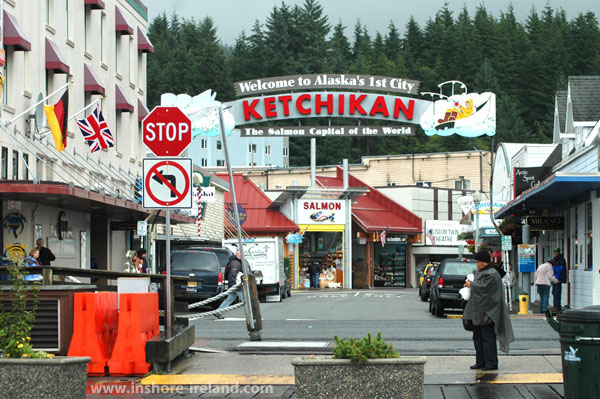
As the sign says: ‘Welcome to the capital of salmon’. Everything about Ketchikan resonates of this king of fish – from the signage to the clothing to the very street talk. So I discovered on a trip to this Alaskan town as a guest of John West Seafoods.
This largest state of the USA is 1,700 square kilometres or just over 20 times the size of the island of Ireland. To the north is the Arctic Ocean; to the south the Gulf of Alaska and the Pacific Ocean and to the west is the Bering Sea. To the east it borders Canada.
Due to its remote location of 64˚N and 152˚W and population of roughly 670,000 or one person per square mile, the surrounding waters are some of the cleanest and most natural marine environments on the planet, and produce 85% of the world’s supply of wild salmon.
Alaskans are passionate and very protective of their resource. So much so that in 1959 when the territory became a State and took on the management of its fisheries, they enshrined into their constitution that ‘fish…be utilized, developed and maintained on the sustained yield principle’.
In other words, fisheries conservation and sustainability became State law.
Ecosystem protection
Alaska is the only State to have written such conservation language into its constitution – and I don’t know of any other country that has it either,” says Randy Rice, Seafood Technical Program Director of the Alaska Marketing Institute.
Sustainability is a well used catchphrase but when it comes to seafood, “it means that fisheries can exist long-term without compromising the survival of the species or the health of the surrounding ecosystem,” he says.
About 2.1m square kilometres of Alaskan waters are designated Marine Protected Areas. The objectives are to conserve habit and biodiversity, increase scientific knowledge and educational opportunities and protect cultural heritage and fisheries management.
“This is not just a recent rush to get green, there’s a history behind it,” he says.
For marine biologist Scott Walker who works for the Department of Fish and Game, it’s all about sustainability:
“We have escapement levels for each salmon species (pinks, coho, sockeyes, and chum) and for each system. We have a set of index escapements that we fly each year – usually several times – each time attempting to get a ‘peak’ count. My job is to fly, walk or skiff these areas to ensure we have good escapements.
Sustainability is never more than a sentence away:
“With our own control we fish at levels we feel the area can handle; each area has its own level of harvest due to the escapements that we see in our surveys,” he explains.
Daily observations
Some of their management decisions are based on science, some on “feel and experience”, and “some on what we physically see and count,” he adds.
“We have a small piper cub aeroplane that we use every day in good weather throughout the summer season. In the south-east region there are about 2,000 index streams for pinks, about 50 for chum and 20 for cohos.
Walker explains that the pinks are a two-year fish (having spent roughly 1.5 years at sea).
“When they start scattering to their streams and we see the streams fill up, we then allow commercial fishing.”
Salmon management in south-east Alaska is mostly State controlled, and harvesting is broken into various types such as commercial, subsistence, personal use and sport fishing.
Federal government however has a ‘toehold’ in some subsistence fishing that occur in freshwater, as Walker explains:
“They have this small amount of control because the fresh waters are in the Tongass National Forest. They would like more control and are constantly trying to butt into our fisheries.”
Federal law states that subsistence needs come before commercial harvest needs.
“There are a few places where federal subsistence fisheries occur in fresh waters. Federal government wants us to shut down commercial fisheries to provide for more subsistence harvest.”
So, what are subsistence fisheries?
“It’s all about a definition that has been put into regulations,” he says.
“If you live in a particular place (non-rural), you’re doing a personal use fishing; if you live in another place defined as ‘rural’ then you are subsistence fishing.”
To add to the confusion, some entire areas however are defined as ‘subsistence areas’ and others as ‘personal use areas’.
“In Ketchikan for instance, one section has a high ‘native population’ and is actually considered ‘rural’ and yet on both sides and around Ketchikan, it is considered ‘non rural’ and we can’t subsistence fish there as a rule.”
With subsistence fishing a few circumstances allow the sale of fish that is caught, usually when the fisherman is a native or lives in an area defined as ‘rural’.
“I’m not allowed to sell anything I catch; however the person living next door to me who may have the same colour skin is allowed because their ancestry has historically bartered or traded animals.”
Rapid response
When it comes to management and enforcement, Walker can open/close a fishery almost instantly:
“If there’s a concern that fishermen are going to harm the resource I can stop everything – but I better have a good reason and the facts to back up my decision,” he explains.
“I can change regulations and make emergency, temporary changes that are usually set for 30, 60 or 90 days.
“Almost the entire fleet would be on standby. I can email or fax the information to the processors who get it out to their members. We also contact the local newspapers and can call in the coast guard if it’s an emergency and they will announce the change every hour on the weather channel.
Limited entry
Most of the fisheries in the State of Alaska have been under ‘limited entry’ since about 1976 when a cap was introduced. For example, seiners (about 400) have access all throughout south-east Alaska and can fish in any area that is open.
“Each fishery has an area that it has been allocated to. In south-east Alaska and mostly State wide, we can’t just increase one gear group’s allowance as it would have to come from another group.”
The three largest gear groups are gillnetters, seiners and trollers. The trollers (using a weight carrying ten leaders with hooks) fish mostly for cohos and Chinook whereas the seiners target pink salmon for volume.
Gillnetters work on a 1-2 person crew; the boats are also smaller and they operate in a smaller designated area.
Once again conversation is brought back to stock sustainability – and not just in relation to Alaska:
“Because we have the ability to catch a lot of Canadian sockeyes and the potential to damage their runs, we have the Pacific Salmon Treaty which limits the take of salmon in south Alaskan waters. It also keeps the Canadians from catching too many ‘American’ fish in the south regions of Canada.
Processing frenzy
The harvesting process begins with the salmon being pumped using refrigerated salt water into tender vessels that return to the canneries; this process continues unabated for approximately 6-8 weeks, depending on the particular salmon run.
Unloaded by wet pump to maximise protection, the fish cross a grading table where they are sorted into species and re-weighed and held in refrigerated holding bins at 0˚C. This process takes about two minutes.

Steve Cosgrove and Nancy Wendt quality test up to 30,000 cans per year
Each year quality assurance staff for John West Foods Limited sample and examine between 20,000 to 30,000 cans in Seattle, Washington, to ensure that only the best quality salmon receives their label.
Nancy Wendt, technical manager for John West Foods Limited, North America, takes up the story:
“The canneries are striving to minimise the time between the fish being caught and canned. This will ensure that the fish are at their peak condition and thus ensuring the best possible quality.
“We take quality control very seriously in John West and work extremely closely with our suppliers to help achieve this objective. A quality standard manual is circulated and this is the benchmark for the canneries to use in selecting the fish for John West cans. We then in turn examine samples that are representative of the production batches to ensure that all adhere to John West standards. These quality tests look at everything from colour, taste, texture, the condition of the cans and also the ph level of every can.
“The number one concern for John West is the quality and food safety. This will never be compromised in order to achieve market demand quantities. If the product does not adhere to the outlined standards, it is rejected and if we are short on our quantities, then we are short,” she says.
2008 preliminary results
Commercial fishermen harvested 146 million salmon in 2008, representing the 16th largest harvest since Alaska became a State 49 years ago. The harvest was 67 million fish less than the 2007 harvest of 213 million fish; 13.5 million fish above the preseason forecast of 132.5 million fish, and 27.3 million fish below the most recent 10 year average (2007-1998) commercial harvest of 173 million salmon.
At $409.3 million, the value of the 2008 catch is higher than the most recent 10 year average of $289 million and only $7.4 million less than fishermen earned in 2007, marking the second consecutive year since 1995 that the total value has exceeded $400 million.
Preliminary 2008 prices are showing increased value for Chinook, coho, pink, and chum salmon compared to the final 2007 prices. Only the preliminary sockeye salmon price in 2008 is slightly below that for 2007.

