Norway-Ireland aquaculture dialogue

Representatives from Ireland’s aquaculture sector, Dáil deputies and media, gathered at the invitation of the Norwegian Ambassador in association with the Irish Farmers’ Association for the launch (26/11) of the Aquaculture Dialogue Norway-Ireland.
Ambassador Else Berit Eikeland noted the opportunities in Irish coastal communities, and underlined the ‘blue’ economy in Norway which produced 1.7% of the world’s aquaculture production in 2017.
“Ireland’s challenge is to better communicate the key role that food produced in the ocean can play in meeting future global protein demands,” she said.
Aquaculture growth has suffered near stagnation for almost 12 years in the wake of an ECJ judgment that Ireland was in breach of the EU Birds and Habitats Directive and had failed to create a system for data collection, definition of scientific interests and adequate assessment of aquaculture licence applications in Natura 2000 areas.
Presentation
In a presentation, Catarina Martins, chief sustainability officer of MOWI (world’s largest producer of Atlantic salmon) said that with wild-capture fisheries under increasing pressure, aquaculture could bridge that gap and play a greater role in providing food security for the planet.
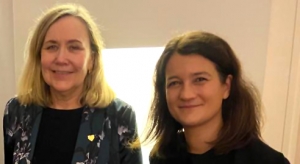
Ambassador Eikeland with Catarina Marins MOWI at the launch of the Norwegian-Ireland Aquaculture Dialogue
According to MOWI, stewardship of the environment and transparency ‘is essential to reaching a long-term goal of producing healthy, nutritious and affordable food’, underpinned by alignment with the United Nation’s Sustainable Development Goals and engagement with the WWF, the Global Salmon Initiative and the Aquaculture Stewardship Council.
A scientific paper written for the ‘High Level Panel for a Sustainable Ocean Economy’ finds that with better management and technological innovation, ‘the ocean could provide over six times more food than it does today’. This equals two-thirds of the animal protein required to feed future global population.
This potential could be realised “with a lower environmental footprint than many other food sources”, remarked Christopher Costello, lead author of the paper.
The Future of Food from the Sea examines the current status and future potential of food production from the ocean.
It suggests the ocean is ‘uniquely positioned’ to contribute to food security due to the highly nutritious nature of seafood ‘which contains essential vitamins, minerals, long-chain omega-3 fatty acids and other nutrients not found in plant-based or terrestrial animal proteins’.

