
Shipwrecks and wind farms – an unlikely alliance

A voyage in the north Irish Sea where researchers mapped 65o km2 will help characterise the suitability of the area for wind turbine foundations and identify engineering challenges and the presence of shallow gas.
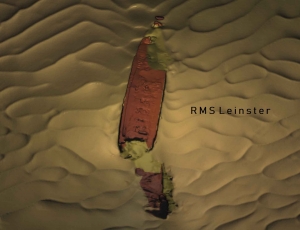
The shipwreck sites have been the focus of ongoing research by iCRAG – the SFI Research Centre for Applied Geosciences – and project partners at Ulster University. They act as natural laboratories and enable researchers to learn more about the structural stability of objects placed on the seabed.
The voyage was part of the GSIT survey and was led by postdoctoral student, Dr Mark Coughlan (UCD) and member of the iCRAG team.
“Offshore wind will be critical to Ireland’s future in terms of reducing dependency on fossil fuels for electricity generation. Countries like Germany, the UK and Denmark have strongly pushed for offshore wind and [have] seen significant cost reductions and now the Irish government is beginning to follow suit.”
Challenges
He cautioned however of the many technical challenges to deploying turbines on the seabed as witnessed in the UK “with real fiscal implications”.
“The more we know about the seabed and its properties, the earlier challenges can be addressed, leading to a sustainable and cost-effective marine renewable energy development plan.”
Jan Majcher, a PhD student at Ulster University studying the shipwrecks said the thousands of shipwrecks resting on the Irish seabed were interesting from many perspectives:
“They are mostly regarded as time capsules, providing fascinating insights into the past for archaeologists and thrilling underwater experiences for divers. Others contain hazardous substances, which may eventually lead to pollution of the marine environment.”
Although often considered as impediments to offshore engineering, “shipwrecks are actually excellent analogies for what happens when man-made structures are intentionally placed on the seabed”, he added.
Wrecks perturb near-seabed currents, causing certain types of sediments to be washed away, or scoured.
“Scour holes developed in this way, near shipwrecks, can ultimately lead to their collapse. The same principles apply to engineering structures on the seabed, for example wind or tidal turbines,” Majcher explained.
The GIST Survey research was funded by Science Foundation Ireland and Geological Survey Ireland, supported by the Marine Institute, funded under the Marine Research Programme 2014-2020.

