
 https://oceanfocus.ie/wp-content/uploads/2020/05/Ocean_Focus_marine_Publication.png
0
0
Guest Writer
https://oceanfocus.ie/wp-content/uploads/2020/05/Ocean_Focus_marine_Publication.png
Guest Writer2011-07-07 15:01:242019-02-13 17:43:06An untapped potential laps our shores
https://oceanfocus.ie/wp-content/uploads/2020/05/Ocean_Focus_marine_Publication.png
0
0
Guest Writer
https://oceanfocus.ie/wp-content/uploads/2020/05/Ocean_Focus_marine_Publication.png
Guest Writer2011-07-07 15:01:242019-02-13 17:43:06An untapped potential laps our shores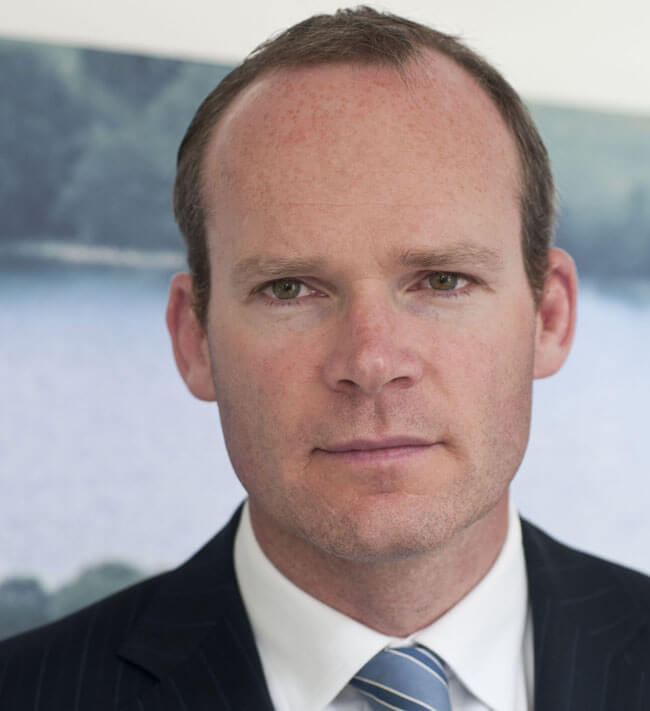
A new hand at the helm of the marine sector
& Gillian Mills
One of the youngest members of the new government, Simon Coveney displays a genuine interest in his portfolio, and above all for the marine sector, based on personal interest and experience of things maritime.
Whilst only a few short months as Minister for Agriculture, Food and the Marine, he brings a sense of urgency that just might see an end to bureaucracy and logjams that have stymied development across many elements of the marine sector.
Inshore Ireland spoke to Minister Coveney to tease out his ambitions for a sector that has long since sought Cabinet recognition to achieve its full potential.
Guidance to compliance for the Irish inshore fleet
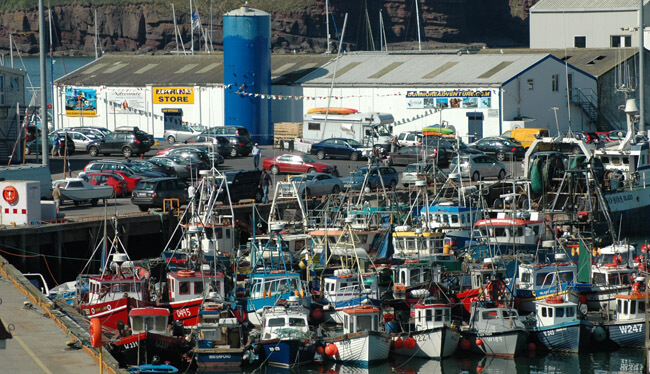
The Sea-Fisheries Protection Authority’s Guide to Compliance for the Irish Inshore Fleet is a concise guide that summarises the principal requirements applying to Irish fishing vessels under 15 metres operating in Irish inshore waters. The guide is available in both Irish and English language versions from SFPA port offices, which are located in the Main Fishery Harbour Centres. Typically the inshore fleet comprises fishing vessels under 15m, representing approximately 87 per cent of the entire Irish fleet in terms of vessel numbers.
The inshore fleet at Dunmore East. Photo Gillian Mills/Inshore Ireland
The guide was developed through ongoing cooperation between the SFPA and the Irish South and East Fish Producers Organisation, the Kilmore Quay Harbour Users Group in conjunction with the Ministerial appointed SFPA Consultative Committee and other industry stakeholders.

Review to bring parity of crawfish minimum landing size underway
The Minister for Agriculture, Food and the Marine, Simon Coveney, has asked BIM to review current conservation measures for crawfish by July 29 because the current prohibition on landings below 110mm “present difficulties for Irish inshore fishermen as smaller crawfish are preferred by European markets”.
He added that a range of technical conservation measures were in use internationally.
“I want to see if we can find a management strategy for this species which will allow Irish inshore fishermen to compete in international markets, while stabilising the stock and ensuring its long-term sustainability and bringing to an end undesirably by-catch.”
https://oceanfocus.ie/wp-content/uploads/2020/05/Ocean_Focus_marine_Publication.png
0
0
Guest Writer
https://oceanfocus.ie/wp-content/uploads/2020/05/Ocean_Focus_marine_Publication.png
Guest Writer2011-05-12 12:29:482019-02-13 17:44:16Ireland’s fishing industry today
Is the Commission’s stance on fish discarding a kneejerk reaction?
At a specially convened meeting of EU member states, Maria Damanaki, European Commissioner for Maritime Affairs and Fisheries, starkly told delegates she considered the practice of fish discarding ‘unethical, a waste of natural resources and a waste of fishermen’s effort’.
And she added that if 2004 FAO estimates of 7.3 million tonnes or 8% of the total fish catches being discarded was not striking to some members, ‘European fisheries are doing much worse than the global average,’ where discarding in the whitefish fishery is up to 50 per cent and 70 per cent in the flatfish fishery.
The net is never taken from the water - it is simply opened to release the fish, the majority of which are already dead. These fish are not accounted for and the extent of the damage is unknown
‘If we continue with our policy, then we will soon face a situation where the production capacity of marine ecosystems is at risk,’ she warned.
Outlining her basic ideas, Commissioner Damanaki said the approach should be gradual, ‘starting with pelagic fisheries and then to cover a few important demersal mixed fisheries after a short phase in period. The list of species covered could be enlarged year by year,’ she explained.
A case of protecting votes at all costs?
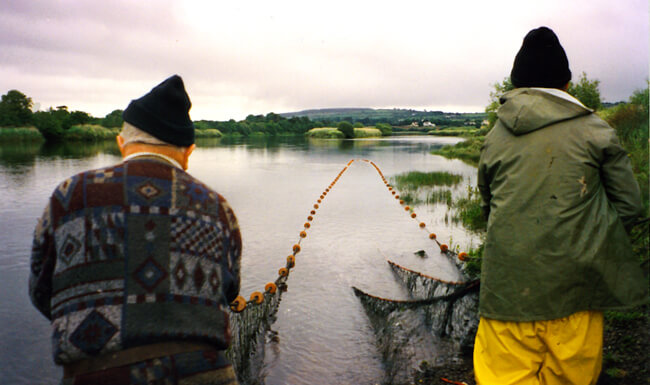
Draft-netting on the Laune Estuary, Kilorglin, Co Kerry. All commercial fishering should be confined to estuaries - not common estuaries. Photo Martin O'Farrell
Martin O’Farrell
It is now proposed to commence a ‘pilot’ salmon fishery to exploit salmon returning to the Laune and Maine rivers which discharge to Dingle Bay via Castlemaine Harbour. It is also likely that adult salmon returning to the nearby Caragh and Behy rivers will be exploited in this fishery. All salmon harvested will be scientifically examined by State personnel who will police the pilot fishery.
At a time when economic gloom is all around us and Atlantic salmon populations are at an all time low, this initiative proposes to target an initial quota of 800 fish. Each fish will be typed genetically and its river of origin will be determined. It is hoped that most of the 800 will be Laune fish as this catchment has been assessed by the Standing Scientific Committee (SSC) of the former National Salmon Commission as being well above conservation limits.
https://oceanfocus.ie/wp-content/uploads/2010/05/fig1.jpg
282
440
Guest Writer
https://oceanfocus.ie/wp-content/uploads/2020/05/Ocean_Focus_marine_Publication.png
Guest Writer2010-05-21 14:04:272019-02-13 17:32:23Rhetoric or real? The price of Ireland’s entry to the EU
https://oceanfocus.ie/wp-content/uploads/2020/05/Ocean_Focus_marine_Publication.png
0
0
Guest Writer
https://oceanfocus.ie/wp-content/uploads/2020/05/Ocean_Focus_marine_Publication.png
Guest Writer2010-05-03 12:34:272019-02-13 17:30:53Scallops: safe and sustainable from tide to table