
 https://oceanfocus.ie/wp-content/uploads/2020/05/Ocean_Focus_marine_Publication.png
0
0
Guest Writer
https://oceanfocus.ie/wp-content/uploads/2020/05/Ocean_Focus_marine_Publication.png
Guest Writer2011-11-17 14:36:332019-02-14 08:52:47Shortage of Irish ocean energy graduates could lead to overseas job opportunities
https://oceanfocus.ie/wp-content/uploads/2020/05/Ocean_Focus_marine_Publication.png
0
0
Guest Writer
https://oceanfocus.ie/wp-content/uploads/2020/05/Ocean_Focus_marine_Publication.png
Guest Writer2011-11-17 14:36:332019-02-14 08:52:47Shortage of Irish ocean energy graduates could lead to overseas job opportunities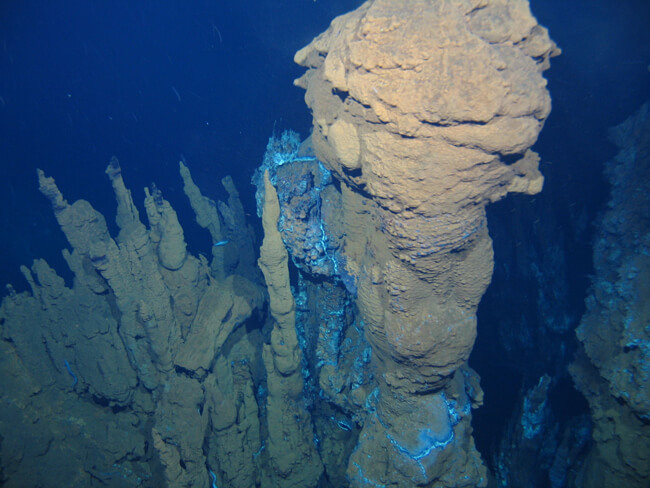
Irish and UK scientists explore uncharted deep-sea vent field
Giant dormant vent on the Moytirra field
John Joyce, Marine Institute
An Irish-led team of scientists from Ireland and the UK has discovered a previously uncharted field of hydrothermal vents along the Mid-Atlantic Ridge – the first to be explored north of the Azores. The VENTuRE mission, led by Dr Andy Wheeler of University College, Cork (UCC), together with scientists from the National Oceanography Centre and the University of Southampton in the UK, NUI Galway and the Geological Survey of Ireland (GSI) spent twenty-five days at sea on board the national research vessel RV Celtic Explorer on an investigation 3,000 metres below the surface of the sea, using the Remotely Operated Vehicle (ROV) Holland 1.
The team comprised many disciplines including marine geologists and geochemists to study the hydrothermal vents, as well as marine geneticists and biologists whose main interest was the new and unusual life forms that live in this harsh and forbidding environment.
https://oceanfocus.ie/wp-content/uploads/2020/05/Ocean_Focus_marine_Publication.png
0
0
Guest Writer
https://oceanfocus.ie/wp-content/uploads/2020/05/Ocean_Focus_marine_Publication.png
Guest Writer2011-09-13 16:05:502019-02-13 17:49:30Reasons to be cheerful….. part one!
https://oceanfocus.ie/wp-content/uploads/2020/05/Ocean_Focus_marine_Publication.png
0
0
Guest Writer
https://oceanfocus.ie/wp-content/uploads/2020/05/Ocean_Focus_marine_Publication.png
Guest Writer2011-07-07 14:48:282019-02-13 17:43:08Ireland is ‘closed for business’ declares ocean energy body
https://oceanfocus.ie/wp-content/uploads/2020/05/Ocean_Focus_marine_Publication.png
0
0
Guest Writer
https://oceanfocus.ie/wp-content/uploads/2020/05/Ocean_Focus_marine_Publication.png
Guest Writer2011-07-07 11:20:582019-02-13 17:43:55Will Ireland again lose out to foreign investment – this time on marine energy?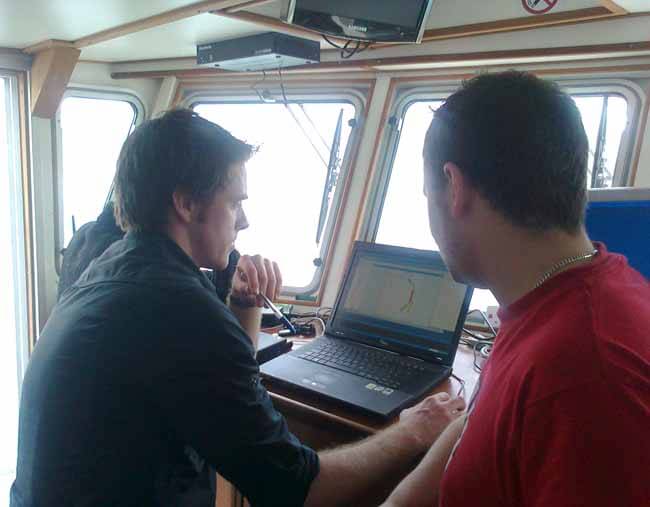
A day in the life of RV Keary
David Hardy,GSI
The RV Keary is a 15m aluminium catamaran, built for and operated by the Geological Survey of Ireland (GSI) [www.gsi.ie]. Its primary function is to provide an inshore survey capability for the national INFOMAR programme (INtegrated Mapping FOr the Sustainable Development of Ireland’s MArine Resource) [www.infomar.ie].
As a small inshore survey vessel, she normally operates with a crew of three: two serving as scientists/deckhands, while the third is the vessel’s skipper. For extended operations, a fourth crew member serves as a relief watch officer.
Ronan O'Toole and Niall Finn quality check data in real-time
The boat has two cabins with two bunks in each; a toilet/shower area and a small compact galley. Most of the internal space is dedicated to the precision depth finding equipment, high resolution GPS system, ancillary sensors and related IT infrastructure.
Independent study says Ireland’s mapping project is value for money
According to Gareth Hetherington of Pricewaterhouse Coopers who carried out an options appraisal report into the INFOMAR mapping programme, their analysis over a 20-year period of the current value of benefits is estimated at €440m.
“This in ratio to cost is approx 4/5:1 so the return on the capital employed is quite good. We’re looking at industry as an exercise or project that can help generate economic activity in light of the recession. [These] are basically the types of projects which all governments say they want to fund,” he emphasised.
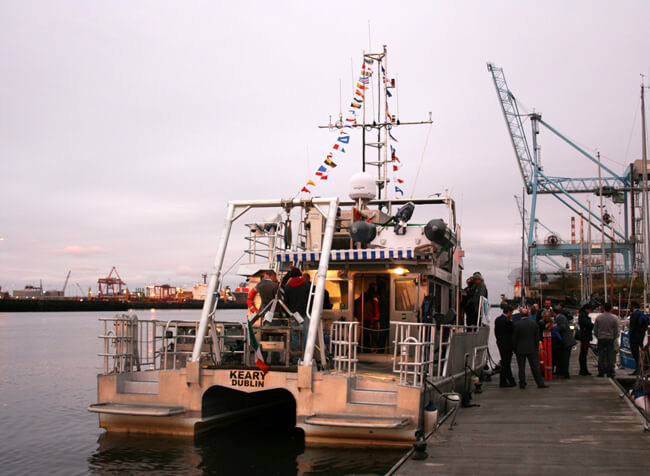
RV Keary was officially named by Barbara Keary, wife of the late Ray Keary, at the Poolbeg Marina in the heart of Dublin. Photo Gillian Mills/Inshore Ireland
“If the private sector was left to undertake the seabed mapping study, the cost associated [to deliver] a project of this nature would be so disproportionate to the financial benefits it wouldn’t be worth their while.”
Gareth Hetherington was speaking at the ten-year celebration seminar of the Irish National Seabed Survey (INSS) and INFOMAR.
Unique design to aid Ireland’s seabed mapping capabilities?
Running before dark skies that were building in the Irish Sea, a silver shimmer appeared on the horizon off Bray Head. It was the RV Keary – a purpose built, aluminium catamaran whose journey had begun 7,000 miles away in a boatyard in Cape Town almost two years ago.
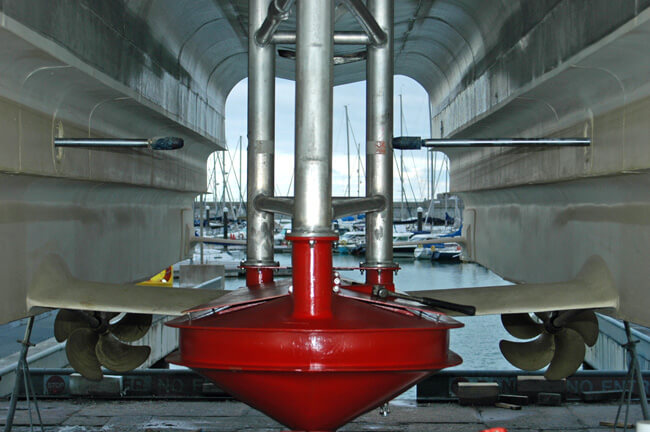
High speed props, hydrofoil stabilising rams and the asymmetric hull combine to create a highly technical craft. Photo Gillian Mills/Inshore Ireland
The vessel is named after the late Ray Keary of the Geological Survey of Ireland who for years had quietly championed the value of Ireland’s marine resource. Finally his message was heard when the GSI received approval from government in 1999 to commence mapping Ireland’s seabed territory, an area that is nine times the size of its landmass.
A snapshot of Ireland’s earth science agency
As director of the Geological Survey of Ireland for the last seventeen years, Dr Peadar McArdle has managed to steer the agency on a course that has given the public a wider awareness of the potential economic benefits of the marine environment.
After a primary degree in geology from UCD in the early 70s, McArdle continued with postgraduate research before heading to Africa where he gained invaluable experience as a young geologist with the national survey of Malawi.
On his return to Ireland he spent a short time in the private sector with Silvermines before joining the Geological Survey in 1975 where he was involved in the minerals area.